The Handmaid's Tale
Book Summary & Analysis
Book summary and writing analysis of The Handmaid's Tale by Margaret Atwood.
The Handmaid’s Tale works because it asks one brutal question and refuses to let you answer it cheaply: how does a person stay a person when the state turns your body into policy? Offred, the narrator, does not “fight the system” in a clean heroic arc. She tries to survive a daily program of ritualized coercion, and that choice creates the book’s pressure. The primary opposing force does not wear one face. Gilead does. It shows up as law, religion, uniforms, language, and neighbors who smile while they inform on you.
Atwood builds the setting with concrete, ordinary details so you can’t file it under “fantasy.” She places you in Cambridge, Massachusetts, in the near future, after a theocratic coup. You see the Commander’s house, the walled streets, the checkpoints, the market where women trade eggs and gossip, and the Red Center where Aunts train Handmaids like livestock with scripture as a cattle prod. The realism matters: the book wins trust by treating dystopia as a management style, not an apocalypse.
The inciting incident does not arrive with sirens. It arrives with paperwork and silence. In Offred’s remembered opening moves, the government freezes women’s bank accounts, and Luke tries to reassure her while she watches her job and money vanish in a day. That scene does the real work: it turns “rights” into something you can lose before lunch, and it shows you how decent people collaborate with disaster by calling it temporary. If you imitate this book and start with torture, you miss the point. Atwood starts with a shrug that becomes a cage.
The structure escalates stakes by tightening Offred’s options while widening her awareness. First, she must perform the Ceremony and avoid punishment; then she must interpret micro-signals to stay alive inside the household politics of Serena Joy, Nick, and the Commander. As the Commander pulls her into secret meetings and forbidden Scrabble, Atwood raises a dangerous new possibility: intimacy with power. That temptation complicates every moral judgment you want to make about Offred, and it forces you to feel how tyranny recruits people with small comforts.
Atwood keeps the central dramatic question personal, not ideological: will Offred protect the last intact part of herself—memory, desire, choice—long enough to matter? Each reveal raises the cost of a wrong read. A shopping trip can become a hanging. A glance can become an accusation. A friendship can become a trap. The opposition force uses surveillance and scarcity, but it also uses something more effective: uncertainty. When Offred cannot know who listens, she polices herself.
Naive imitators treat this novel as “a message” with characters attached. Atwood does the reverse. She builds a message out of character-level compromises. Offred’s resistance shows up as narrative control: what she tells you, what she refuses to say, how she revises her own memories mid-sentence. The stakes escalate because her interior life becomes contested territory. If you only copy the red robes and slogans, you will write a poster. Atwood writes a trap that closes one ordinary decision at a time.
The late movement of the book shifts the question from endurance to consequence. Offred discovers how networks form under pressure—Moira’s legend, Ofglen’s risks, whispered passwords, small acts that carry large penalties. Atwood plays fair with the danger: help can save you, and help can also expose you. Offred’s choices do not build toward a triumphant overthrow; they build toward a moment where any exit—capture, rescue, execution—looks identical from the back seat of a van.
And then Atwood commits the craft move most writers fear: she reframes the entire narrative as an artifact. The “Historical Notes” do not comfort you. They show you how institutions later sanitize lived terror into academic argument, and they remind you that stories survive, but people pay the price. That ending lands because Atwood never asked you to admire Offred. She asked you to sit with her limits—and to notice how easily yours could shrink too.
Story Structure & Narrative Arc
Story structure and emotional arc in The Handmaid's Tale.
This story runs as a subversive Man-in-a-Hole that never gives you the clean climb out. Offred starts emotionally numb but observant, clinging to memory as a private refuge. She ends more awake to her own desire and to the costs of complicity, but she does not end “safe” or “free” in any settled way. The arc tracks agency, not victories.
Atwood lands the big moments by making the small moments dangerous first. The early rhythm alternates between present-tense constraint and past-tense recollection, so each memory reads like contraband. Midway, illicit closeness with the Commander spikes Offred’s apparent fortune, and then the book yanks it away with betrayal and public violence. The lowest points hit because Offred cannot tell whether she faces rescue or arrest, and neither can you until the last page turns the narrative into evidence.

Studying this book—and stuck on your pages?
Put your draft in Draftly. Fix scenes and dialogue in the text—not in another tab. When you want sharper feedback, AI editors are ready.
Free welcome credits included. No credit card needed.Writing Lessons from The Handmaid's Tale
What writers can learn from Margaret Atwood in The Handmaid's Tale.
Atwood wins your trust with a voice that refuses to pose. Offred speaks in plain sentences, then corrects herself, qualifies a memory, or admits she invents a detail because she needs it to make sense. That self-editing on the page does two jobs at once: it characterizes a mind under pressure, and it turns the narration into a live ethical problem. You don’t just watch a regime control bodies; you watch it press on the act of telling.
She also controls distance with ruthless precision. Offred narrates the Commander’s house like a prison you must dust: bedroom, kitchen, garden, the route to the market, the Wall. She keeps returning you to those spaces until they feel inescapable, then she punctures them with illicit pockets of play—Scrabble in the study, the Commander’s magazine stash, the club-like outing to Jezebel’s. Modern dystopia often takes the shortcut of “bigger world, bigger stakes.” Atwood tightens the world first so each expansion feels radioactive.
Dialogue becomes a weapon because nobody can say what they mean. Watch the Scrabble scenes with the Commander: he plays genial host, she plays compliant guest, and both negotiate power through jokes, word choice, and pauses. Or listen to Serena Joy’s clipped exchanges with Offred in the sitting room, where every polite phrase carries an implied threat. Many writers try to “show oppression” with speeches and slogans. Atwood shows it with conversational physics: who initiates, who interrupts, who can ask a question without dying.
Finally, she uses structure to argue without preaching. The book crosscuts present-tense constraint with past-tense life-before, and that juxtaposition delivers the real horror: not pain, but reduction. Then she adds the “Historical Notes,” which look like a scholarly appendix and read like a second violation. Academics turn Offred into a case study, and you feel how institutions launder cruelty into rhetoric. That move teaches a hard craft lesson: if you want a theme to stick, don’t announce it. Design an ending that makes the reader participate in the problem.
How to Write Like Margaret Atwood
Writing tips inspired by Margaret Atwood's The Handmaid's Tale.
Write the voice like a survivor, not like a spokesperson. Offred never performs purity for you; she performs accuracy under stress. Let your narrator contradict herself, backtrack, and confess to speculation, but make those moves reveal fear, desire, and self-protection rather than author indecision. Keep the sentences clean. When you reach for a lyrical flourish, ask if the character would risk that kind of attention. In this kind of story, style counts as behavior, and behavior creates consequences.
Build characters as competing strategies for living under the same boot. Offred survives by noticing and adapting, Moira survives by refusing and paying for it, Serena survives by enforcing rules she can’t fully benefit from, and the Commander survives by treating cruelty as a hobby with rules. Don’t write villains who enjoy evil. Write people who justify, bargain, spiritualize, or outsource harm. Give every major character a private need that conflicts with the public role, then force them to trade one for the other.
Avoid the big genre trap: substituting atrocity for escalation. You can always add more violence, but you can’t always add more meaning. Atwood escalates by shrinking safe choices, not by inventing new tortures every chapter. She turns ordinary acts into high-stakes acts: shopping, talking, reading, remembering. If you write dystopia as a parade of shocks, your reader goes numb and starts scanning. If you write it as a system that makes the smallest comfort morally expensive, your reader stays awake.
Run this exercise and don’t cheat. Write three scenes in the same constrained location, like a kitchen or an office, where the rules never change but the meaning does. Scene one shows the routine. Scene two introduces a “gift” from power that feels like relief but carries a hook. Scene three forces your protagonist to use that gift, and the use exposes them to a new threat. Between scenes, add short memory fragments that contradict the present. Make the fragments sharpen the present danger, not soften it.
Who Would Edit This Book?

Callum Rhys Mahoney
Developmental Fiction Editor and Manuscript CoachI grew up between Wagga and my aunt’s place out near Narrandera, in a family that could argue for sport and then feed you like nothing happened. Books were around, but not in a precious way. My old man liked stories where people did what they said they’d do, even if it cost them. I still hear that voice when a character “can’t” make a decision because the plot needs another chapter. I didn’t set out to be an editor. I studied teaching, worked a few rough years in classrooms, and then left after a run of short contracts and one admin reshuffle that made it clear I was replaceable. A mate pulled me into doing learning materials and assessments because I could spot where people were gaming the question. That work taught me to watch for what the text rewards versus what it claims to reward - which is the same problem in a lot of manuscripts. I also spent a couple of seasons doing night shifts at a servo when money got tight. I kept a notebook behind the counter and wrote scenes between customers, mostly to stay awake. I remember one bloke coming in every Thursday, buying the same pie, and telling me the same story about a dog he swore was smarter than his ex. I don’t know why I remember that, but I do. Editing started as favour-work. People in town found out I’d read their drafts and I’d send back long emails with scene-by-scene notes. Somewhere along the line it became my paid work, mostly because I was consistent and because I’m not afraid to say, “This turn doesn’t belong to your protagonist.” I’m biased toward decisive characters and I don’t plan to cure myself of it; I’d rather a story risk an ugly choice than drift into polite inevitability.
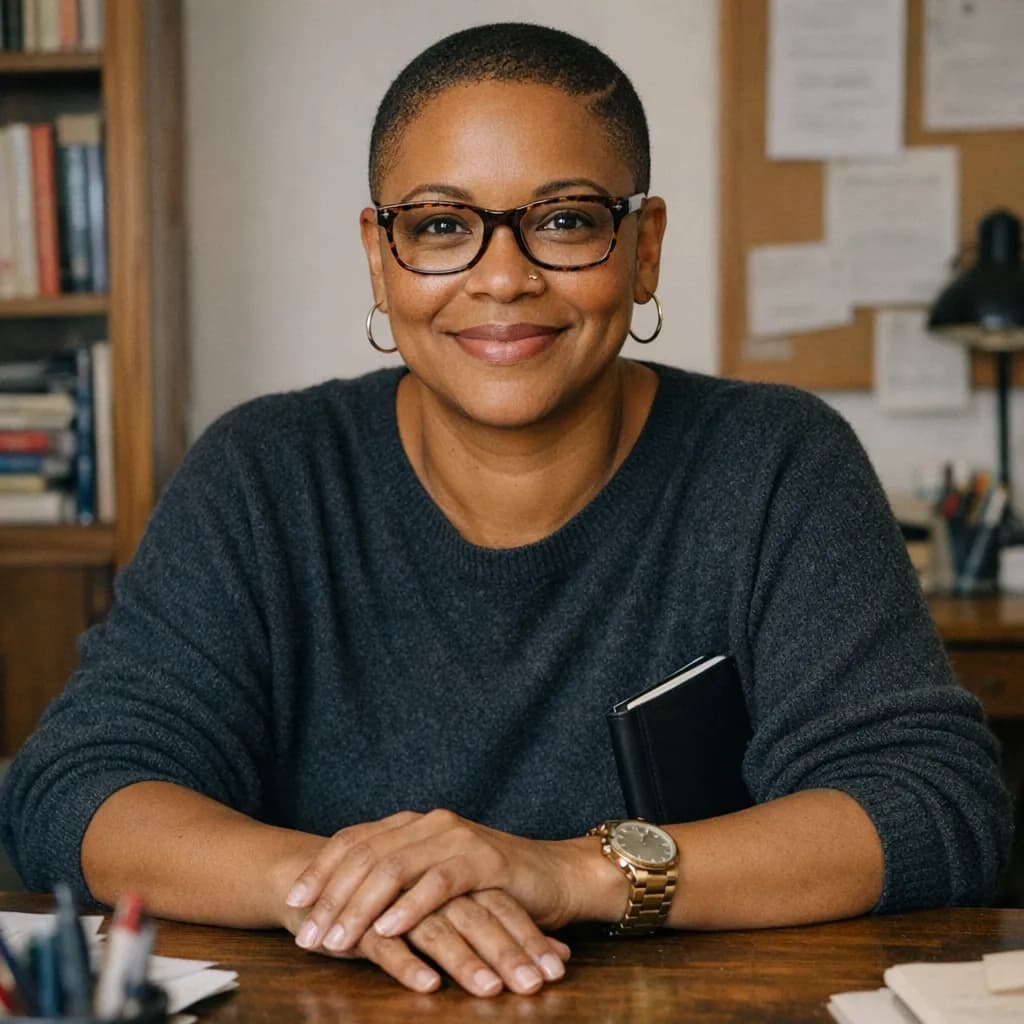
Danae Marcelline Brooks
Developmental Fiction Editor & Manuscript CoachI grew up between church basements, tidewater heat, and people who could tell a whole family story while stirring a pot and never looking up. My mom kept paperback romances in a shoebox like they were contraband, and my aunt kept a shelf of mystery novels with cracked spines. I read both. I learned early that readers forgive a lot, but they don’t forgive being bored or being lied to. I didn’t come up dreaming about editing. I wanted steadier work than “writer,” and I was the kid who could take notes fast, so I ended up in admin jobs where I got volunteered into fixing other people’s documents. Outside of that, I spent a couple years doing hair out of a friend’s kitchen. That part of my life doesn’t explain my editing, but it’s true: I still remember the sound of a cape snapping and how people tell you the most pointed truths when they think you’re not allowed to answer back. Sometimes I miss that kind of honesty. A storm took out power for a week when I was in my late twenties, and I agreed to help a neighbor organize a stack of workshop pages because there wasn’t much else to do at night. The pages were a mess, but the voice was alive. I wrote margin notes the way I talk, not the way school taught me, and the neighbor asked for more. That turned into being the person people handed drafts to. I still carry this old belief that if you “work hard enough,” the story will behave. I don’t defend it, but I catch myself acting like it’s true when I see a writer piling scenes on top of scenes. Now I’m a developmental editor because I’m impatient with pretty sentences that protect a story from making decisions. My bias is I’ll side-eye passive main characters harder than most editors will, even when the genre gives them excuses. I don’t correct that. It’s the lens I read through, and writers who want a gentler read should pick someone else. If you want a first reader who will point at the exact scene where your book starts dodging consequences, I’m your person.
Frequently Asked Questions
- What makes The Handmaid's Tale so compelling?
- Many readers assume the hook comes from the premise alone: a theocratic dystopia with rigid roles. The book grips you because Atwood attaches that premise to a single, intimate consciousness that constantly recalibrates what “safe” means. Offred’s smallest choices—when to speak, what to remember, who to look at—carry disproportionate risk, so each scene becomes a live negotiation. If you want similar pull, build a system that changes the cost of ordinary behavior, then let voice reveal the compromises your plot demands.
- How do I write a book like The Handmaid's Tale?
- A common rule says you need airtight world-building and a clear rebellion plot. Atwood proves you need something harder: a narrator whose inner life keeps colliding with the regime’s language, rituals, and incentives. Start by designing constraints that operate daily, not just during “action” scenes, and make your protagonist complicit in small ways so you can pressure their self-image. Then escalate by narrowing options, not by piling on spectacle. If you can’t summarize your character’s strategy for survival, you don’t have the engine yet.
- What themes are explored in The Handmaid's Tale?
- People often list themes as labels—power, gender, religion, control—and stop there. Atwood dramatizes themes as trades: safety versus freedom, belonging versus integrity, comfort versus truth, memory versus numbness. She also examines how language itself becomes a tool of governance, from prescribed greetings to forbidden reading. When you write theme-forward fiction, don’t “include” themes like decorations. Put your character in situations where any choice costs them something they value, then let the story record the bill.
- How long is The Handmaid's Tale?
- Many assume length determines depth, especially with “serious” dystopian novels. Most editions run roughly 300–320 pages, but Atwood earns weight through compression: recurring locations, repeated rituals, and carefully rationed revelations. She spends pages on how a room feels because that sensory specificity doubles as political information. Use this as a craft reminder: you can write a relatively lean book and still create a heavy aftertaste if you design scenes that do double duty—character pressure plus system exposure.
- Is The Handmaid's Tale appropriate for young readers?
- A common assumption says “dystopia” automatically fits teens because schools teach it. This novel includes sexual coercion, violence, and psychological control presented with unsettling calm, so appropriateness depends on maturity and context, not age labels. Craft-wise, Atwood’s restraint can make the material hit harder because she lets implication do work that explicit description often dulls. If you write for younger audiences, notice how you can signal danger without gratuitous detail while still respecting the truth of the situation.
- What can writers learn from The Handmaid's Tale about world-building?
- Writers often think world-building means inventing more institutions, slang, and history than the reader needs. Atwood selects a few pressure points—money, reproduction, literacy, surveillance—and shows how they reshape kitchens, streets, and friendships. She anchors the regime in familiar American spaces, which keeps the fear plausible rather than theatrical. Take the lesson: pick the handful of systems that would actually change daily behavior, then reveal them through routine scenes where characters must navigate rules to get through the day.
About Margaret Atwood
Use a calm, observant narrator to describe the unbearable plainly, and you’ll make dread feel inevitable instead of dramatic.
Margaret Atwood writes like she’s holding two lights over the page at once: one for the literal scene, one for the meaning you’d rather not admit you saw. Her engine runs on precise observation plus moral pressure. She doesn’t lecture. She arranges details so your own mind supplies the indictment, then she moves on before you can object. That’s the trick: she makes you complicit, not convinced.
Technically, she works with contrasts that should cancel each other out but don’t: plain speech carrying sharp intelligence, humor carrying dread, intimacy carrying threat. She often lets a narrator sound calm while the world turns monstrous in the margins. If you copy only the “clever” lines, you’ll miss the real mechanism: controlled withholding. She parcels context like rations, then makes each new fact revise the last one.
Her sentences tend to look simple until you try to build them. She stacks concrete nouns, then pivots into a conceptual sting. She uses metaphor the way a prosecutor uses exhibits: not decoration, evidence. The hardest part is her discipline with implications. She trusts the reader to connect dots, but she chooses the dots with surgical care.
Modern writers need her because she solved a contemporary problem: how to write political and psychological pressure without turning fiction into a speech. Her work widened the lane for speculative realism, where the invented world feels like a slight adjustment of your own. She drafts with an editor’s ear for revision: sharpen the image, clarify the turn, cut the moralizing, keep the unease.














Ready to improve your draft with direction?
Open Draftly, bring your draft, and move from stuck to a stronger draft without losing your voice. Editors are on standby when you want a deeper pass.
Free welcome credits included. No credit card needed.