The Death of Artemio Cruz
Book Summary & Analysis
Book summary and writing analysis of The Death of Artemio Cruz by Carlos Fuentes.
The Death of Artemio Cruz works because Fuentes builds a story engine that can’t stall: a man lies dying in Mexico City, and his failing body forces his mind to cycle through the moments that made him rich, feared, and empty. The central dramatic question never asks “what happens next?” It asks “what did this man do to become this, and will he admit it before he can’t speak?” You keep reading because every memory functions like a cross-examination. Fuentes doesn’t let you sit in neutral. He drags you forward by tightening the moral noose.
You want to imitate the shifting voices, but you’ll fail if you treat them as decoration. Fuentes uses a strict alternation of perspectives and tenses—first person (the “I” trapped in flesh), second person (the “you” that accuses and commands), and third person (the “he” observed like a case file). That system does two jobs at once: it dramatizes fragmentation, and it lets Fuentes control distance. He can slam you into sensation, then step back to judge the scene, then turn the knife with an intimate “you” that won’t let Artemio hide behind narration.
The inciting incident happens in the opening deathbed sequence: Artemio Cruz wakes, fights for breath, hears the machinery of care around him, and realizes he may not outlast the night. That simple physical crisis triggers the book’s true action: the mind’s frantic accounting. Notice the mechanics: a bodily sensation cues a memory; a memory exposes a bargain; the bargain produces a present-day consequence in the sickroom—his family, his fortune, his isolation. If you miss that causal chain, you’ll copy the surface (flashbacks) and lose the pressure (each flashback must change what “dying” means).
Fuentes escalates stakes by making each return to the room more humiliating and more revealing. Artemio’s power looks absolute on paper—land, contacts, a history with the Revolution—but the opposing force doesn’t wear a villain’s face. It wears time, decay, and the people who now wait to divide what he built. In the private arena, the opposition comes from his own choices: the way he traded loyalty for leverage, love for ownership, ideals for access. Every time the narrative cuts away from the bed, it doesn’t relax. It loads another charge and brings it back to detonate in the present.
The setting matters because it supplies the book’s moral weather. Fuentes anchors Artemio’s rise in the violence and opportunism around the Mexican Revolution and its aftermath, then carries him into the glossy, transactional Mexico City of political deals and media power. You watch a nation harden into institutions, and you watch a man harden with it. That parallel gives the book scale without losing intimacy. The country doesn’t “symbolize” him. It trains him, rewards him, and then mirrors his rot.
Structure-wise, the book doesn’t build to a single plot twist; it builds to a narrowing of excuses. Early memories let Artemio interpret himself as a survivor. Later ones expose him as a chooser. That shift marks the real midpoint turn: the story stops asking whether he suffered and starts asking what he did with the suffering. The late-stage escalation comes from proximity to irreparable acts—betrayals, acquisitions, manipulations—presented not as headline events but as decisions made in rooms, under pressure, with someone watching.
If you imitate this book naively, you’ll confuse fragmentation with depth. Fuentes earns complexity through repetition with variation: the same hungers reappear in new disguises, and each reappearance costs Artemio more humanity. He also keeps a clean dramatic spine: one dying man, one reckoning, one shrinking window to tell the truth. When you attempt a similar design, you must treat every temporal jump as a beat that changes the moral scoreboard. Otherwise you’ll write pretty discontinuity—and your reader will leave.
Story Structure & Narrative Arc
Story structure and emotional arc in The Death of Artemio Cruz.
Fuentes writes a tragedy that behaves like a “man in a hole” turned inside out. Artemio starts with external fortune and internal panic: he owns everything that counts in public and nothing that counts in private. He ends with the same body in the same bed, but he sheds the last illusion that power can buy meaning. The arc doesn’t lift him. It strips him.
Key shifts land because Fuentes ties emotion to viewpoint control. The first-person scenes deliver raw sensation and fear. The second-person sections switch to accusation and self-command, so every attempted self-justification becomes a courtroom outburst. Third person turns him into evidence. Low points hit hardest when the narrative returns to the bed after a “successful” memory, and the present proves the victory didn’t survive into love, loyalty, or peace.

Studying this book—and stuck on your pages?
Put your draft in Draftly. Fix scenes and dialogue in the text—not in another tab. When you want sharper feedback, AI editors are ready.
Free welcome credits included. No credit card needed.Writing Lessons from The Death of Artemio Cruz
What writers can learn from Carlos Fuentes in The Death of Artemio Cruz.
Fuentes teaches you how to make structure do emotional labor. The rotating “I / you / he” system doesn’t show off; it forces a constant recalibration of intimacy and judgment. First person gives you bodily panic and sensory grit. Third person lets you watch Artemio like a dossier, which turns his life into a pattern instead of a confession. Second person does the real dirty work: it denies him the comfort of narrating himself as the hero. Most modern novels chase “immersion” and forget “interrogation.” Fuentes gives you both, in alternating pulses.
He also shows you how to braid theme into scene-level causality. You don’t read about corruption as an idea; you watch decisions happen in rooms where someone wants something, someone fears something, and someone holds the leverage. When Artemio deals with the people closest to him in the sickroom—his wife Catalina, his daughter Teresa, the doctor, the aides—the dialogue doesn’t exist to “reveal backstory.” It exists to enforce hierarchy. Catalina’s presence reads like a lawsuit delivered in manners. Artemio’s attempts to control the room expose how little authority remains when the body fails.
For atmosphere, Fuentes anchors abstraction in concrete spaces: the stifling Mexico City bedroom with its medical paraphernalia and watchers, and the remembered landscapes of upheaval where land and loyalty shift hands. He uses sensory cues as trapdoors into time, so the setting operates like a trigger mechanism, not a wallpaper. Many writers try to signal “literary” by piling on lyrical description. Fuentes picks sharp details that change the scene’s power dynamic. The room feels crowded even when no one speaks, because everyone waits for the estate to become available.
Finally, he models how to handle an unlikeable protagonist without begging the reader for sympathy. He doesn’t soften Artemio. He contextualizes him, then refuses to absolve him. That refusal creates a stronger hook than likability: moral suspense. You keep turning pages because you want to see whether Artemio will tell the truth to himself in time, and whether the book will let him. Writers often shortcut this with melodramatic trauma or a late redemption speech. Fuentes commits to consequence. He makes the style itself—the tense, the pronoun, the cut—serve as the judge.
How to Write Like Carlos Fuentes
Writing tips inspired by Carlos Fuentes's The Death of Artemio Cruz.
Control voice the way Fuentes controls pronouns. Don’t switch perspective because you feel bored. Switch because you need a new tool: intimacy, accusation, or judgment. Write a set of rules for your narrative modes and follow them with discipline. Keep your sentences clean when you handle complex structure. If you decorate every line, you’ll blur the blade. Let the “fancy” part live in the architecture. Then use plain, bodily language to keep the reader oriented inside the scene.
Build your protagonist as a chain of choices, not a bundle of traits. Artemio convinces because each memory shows him selecting leverage over love, control over honesty, and winning over belonging. Do the same. Give your character recurring pressures—status, security, desire, shame—and force them to pick, in public, with someone watching. Then make later scenes echo earlier ones with higher cost. If you want a reader to fear your character’s collapse, you must first show the exact bargain that bought their success.
Avoid the prestige trap of “fragmented equals profound.” Nonlinear books die when the author treats time as a scrapbook. Fuentes avoids that by making every jump answer a question raised in the present sickroom. The body creates urgency, the family creates consequence, and the memories supply evidence. If you write a similar design, you must keep a live wire in the present timeline. Don’t use flashbacks to explain. Use them to corner your protagonist until they run out of stories they can tell themselves.
Write this exercise and don’t cheat. Draft three short scenes of the same moment—one in first person sensory panic, one in second person accusation, one in third person clinical observation. Use a single object as the trigger that appears in all three versions, and make it change meaning each time. Then place a present-day scene after them where another character reacts to what your protagonist refuses to say. If the reaction doesn’t sting, your structure doesn’t yet create consequence.
Who Would Edit This Book?
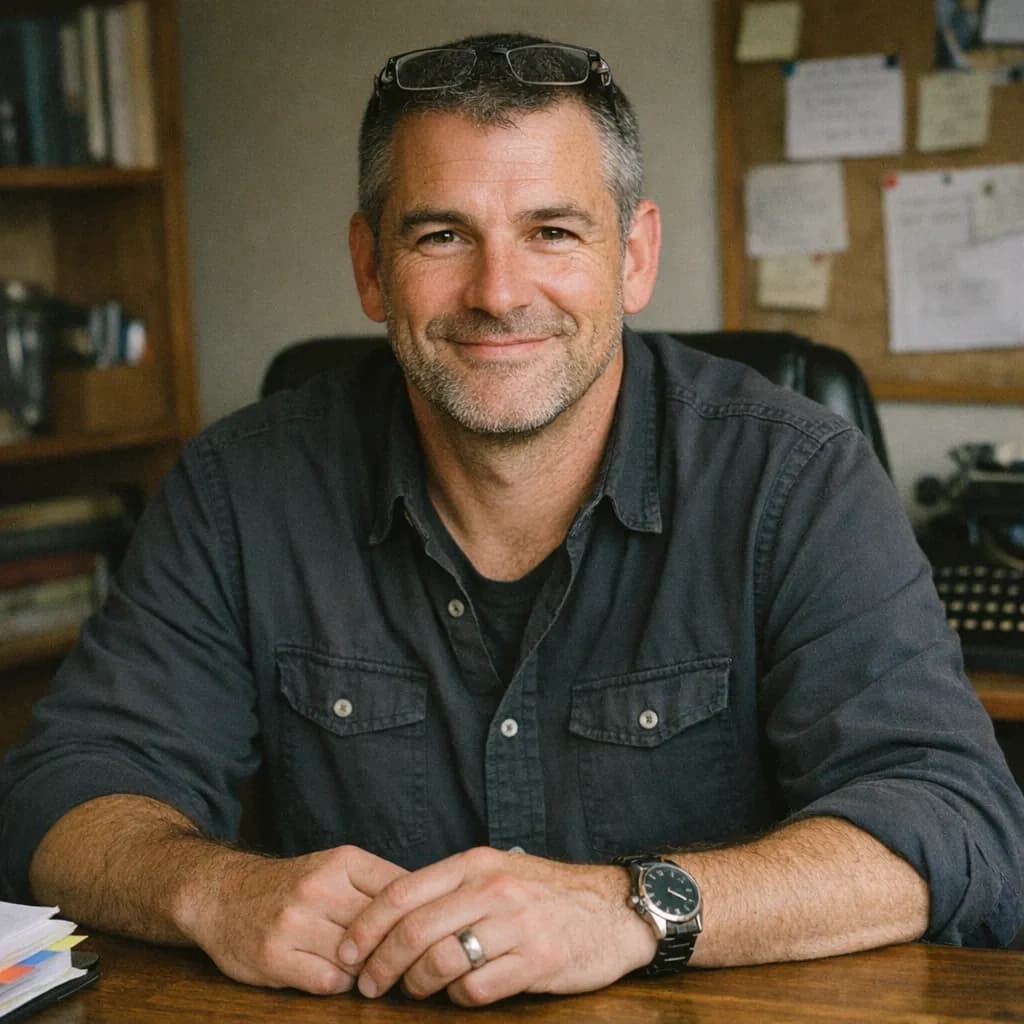
Callum Rhys Mahoney
Developmental Fiction Editor and Manuscript CoachI grew up between Wagga and my aunt’s place out near Narrandera, in a family that could argue for sport and then feed you like nothing happened. Books were around, but not in a precious way. My old man liked stories where people did what they said they’d do, even if it cost them. I still hear that voice when a character “can’t” make a decision because the plot needs another chapter. I didn’t set out to be an editor. I studied teaching, worked a few rough years in classrooms, and then left after a run of short contracts and one admin reshuffle that made it clear I was replaceable. A mate pulled me into doing learning materials and assessments because I could spot where people were gaming the question. That work taught me to watch for what the text rewards versus what it claims to reward - which is the same problem in a lot of manuscripts. I also spent a couple of seasons doing night shifts at a servo when money got tight. I kept a notebook behind the counter and wrote scenes between customers, mostly to stay awake. I remember one bloke coming in every Thursday, buying the same pie, and telling me the same story about a dog he swore was smarter than his ex. I don’t know why I remember that, but I do. Editing started as favour-work. People in town found out I’d read their drafts and I’d send back long emails with scene-by-scene notes. Somewhere along the line it became my paid work, mostly because I was consistent and because I’m not afraid to say, “This turn doesn’t belong to your protagonist.” I’m biased toward decisive characters and I don’t plan to cure myself of it; I’d rather a story risk an ugly choice than drift into polite inevitability.

Danae Marcelline Brooks
Developmental Fiction Editor & Manuscript CoachI grew up between church basements, tidewater heat, and people who could tell a whole family story while stirring a pot and never looking up. My mom kept paperback romances in a shoebox like they were contraband, and my aunt kept a shelf of mystery novels with cracked spines. I read both. I learned early that readers forgive a lot, but they don’t forgive being bored or being lied to. I didn’t come up dreaming about editing. I wanted steadier work than “writer,” and I was the kid who could take notes fast, so I ended up in admin jobs where I got volunteered into fixing other people’s documents. Outside of that, I spent a couple years doing hair out of a friend’s kitchen. That part of my life doesn’t explain my editing, but it’s true: I still remember the sound of a cape snapping and how people tell you the most pointed truths when they think you’re not allowed to answer back. Sometimes I miss that kind of honesty. A storm took out power for a week when I was in my late twenties, and I agreed to help a neighbor organize a stack of workshop pages because there wasn’t much else to do at night. The pages were a mess, but the voice was alive. I wrote margin notes the way I talk, not the way school taught me, and the neighbor asked for more. That turned into being the person people handed drafts to. I still carry this old belief that if you “work hard enough,” the story will behave. I don’t defend it, but I catch myself acting like it’s true when I see a writer piling scenes on top of scenes. Now I’m a developmental editor because I’m impatient with pretty sentences that protect a story from making decisions. My bias is I’ll side-eye passive main characters harder than most editors will, even when the genre gives them excuses. I don’t correct that. It’s the lens I read through, and writers who want a gentler read should pick someone else. If you want a first reader who will point at the exact scene where your book starts dodging consequences, I’m your person.
Frequently Asked Questions
- What makes The Death of Artemio Cruz so compelling?
- A common assumption says the book grips you through plot surprises, but Fuentes hooks you with moral suspense and structural pressure. The deathbed frame forces every memory to function like evidence, and the rotating “I/you/he” viewpoints keep shifting the reader from empathy to judgment to accusation. That rhythm lets even quiet scenes feel consequential because they change what you believe about the protagonist’s power and responsibility. If you study it, track how each return to the sickroom raises the cost of denial.
- How long is The Death of Artemio Cruz?
- People often treat length as a difficulty metric, but the real challenge comes from density and structure, not page count. Most editions run roughly 300 pages, and Fuentes asks you to follow tense and pronoun shifts with attention. You can read it quickly if you accept partial understanding, or you can read it well by noting how each memory answers a present-day pressure. Give yourself permission to slow down when the viewpoint changes, because clarity matters more than speed here.
- How do the shifting viewpoints work in The Death of Artemio Cruz?
- Many readers think viewpoint shifts signal “experimental style,” but Fuentes uses them as a control panel for intimacy and blame. First person locks you in bodily sensation; third person turns Artemio into a subject under observation; second person confronts him like an inner prosecutor who refuses excuses. The alternation creates a steady pulse rather than randomness. If you borrow the technique, write explicit rules for when each mode appears and what emotional job it must perform, then enforce those rules scene by scene.
- What themes are explored in The Death of Artemio Cruz?
- A standard takeaway lists corruption, power, and revolution, but the sharper theme concerns the cost of self-mythology. Fuentes shows how a man narrates his rise as necessity, then exposes it as preference—especially when wealth and political access replace loyalty and love. He also ties personal decay to national disillusionment without turning Mexico into a mere metaphor. When you analyze theme here, focus on decisions in specific rooms, not slogans, and ask what each decision purchases and what it destroys.
- Is The Death of Artemio Cruz appropriate for beginners or young readers?
- A common rule says “advanced structure equals inappropriate,” but the real issue involves emotional and political complexity. The novel includes mature material, a cynical view of power, and a demanding narrative design that assumes you will tolerate ambiguity and moral discomfort. A motivated beginner can still learn a lot by reading slowly and mapping the viewpoint shifts and their effects. If you teach it or recommend it, set expectations: this book rewards attention more than it rewards momentum.
- How do I write a book like The Death of Artemio Cruz without confusing readers?
- Writers often assume readers get lost because nonlinear equals messy, but confusion usually comes from weak scene causality. Fuentes keeps orientation by tethering every memory to a present trigger and by making each section change the protagonist’s moral standing, not just add history. If you attempt something similar, keep one dominant present-time situation under pressure and treat every time jump as an answer to a question the present raises. After each jump, test comprehension with a concrete consequence in the now.
About Carlos Fuentes
Shift viewpoint mid-scene to make certainty collapse, then use a repeated image to restore control and keep the reader turning pages.
Carlos Fuentes writes like a novelist who refuses to let a single camera angle tell the truth. He builds meaning by moving the lens: voice to voice, time to time, mask to mask. The result feels like a courtroom where every witness lies in a different way—and you, the reader, must infer the real charge. That’s the engine: he turns interpretation into plot.
He manipulates your psychology through controlled disorientation. He withholds stable footing (who speaks, when “now” is, what history counts as) but he never withholds momentum. He gives you puzzles that feel personal: identity, power, desire, national myth. You keep reading because the page implies an answer exists, even when it delays the answer on purpose.
The technical difficulty sits in the layering. Fuentes doesn’t decorate a simple story with complexity; he composes complexity as the story. His best work makes arguments through scene, then contradicts them through structure. He uses repetition like a legal brief, symbolism like a trapdoor, and shifting pronouns like a change in weather. If you imitate only the surface—long sentences, grand ideas—you get fog.
Modern writers need him because he proves you can write intellectually without writing cold. He shows how to make form carry meaning: the shape of the narration becomes the subject. He reportedly planned rigorously, then revised to sharpen the pattern—echoes, returns, and reversals—so the book feels inevitable even when it feels unstable.














Ready to improve your draft with direction?
Open Draftly, bring your draft, and move from stuck to a stronger draft without losing your voice. Editors are on standby when you want a deeper pass.
Free welcome credits included. No credit card needed.