A Tale of Two Cities
Book Summary & Analysis
Book summary and writing analysis of A Tale of Two Cities by Charles Dickens.
Dickens makes A Tale of Two Cities work by building a story engine out of symmetry and threat. He asks one central dramatic question and refuses to let you dodge it: when history turns people into a mob, can an ordinary private life survive without moral cost? He doesn’t answer with speeches. He answers with consequence, repetition, and the steady tightening of a legal noose.
You can treat Charles Darnay as the protagonist in terms of external jeopardy: he wants a lawful, decent life despite the stain of his aristocratic name. You can treat Sydney Carton as the protagonist in terms of internal change: he wants relief from self-contempt, and he keeps choosing numbness until he can’t. The primary opposing force shifts shapes but stays coherent: the machinery of public vengeance—first English suspicion, then Revolutionary “justice,” and always the idea that a person equals their class. Dickens gives that force faces like the Defarges, but the real villain acts like a system.
The setting does not float in a vague “olden time.” Dickens pins you to London and Paris in the late 1770s through the French Revolution. He uses specific social rooms—Old Bailey courtrooms, Soho streets, wine-shop doorways, prison cells—to show how a crowd thinks. He also uses the coach road between cities as a physical metaphor: people and secrets travel, and the past always catches the carriage.
The inciting incident doesn’t look like an explosion. It looks like a summons. Jarvis Lorry tells Lucie Manette that her father lives, and she must go to Paris. That decision drags a private family wound into public history. Dickens then performs a craft move you should notice: he doesn’t “start the plot.” He starts the pressure. The moment Lucie reaches the garret and says “I am your daughter,” Dickens establishes a bond the entire novel will later attempt to sever.
From there, Dickens escalates stakes through mirrored trials and shifting jurisdictions. Darnay faces a treason trial in England and escapes by a technicality and a look-alike; later, he faces an ideological trial in France and finds that technicalities now kill. Each cycle teaches you the same lesson at higher voltage: law protects you when a society believes in the individual, and law destroys you when a society believes in categories.
Dickens also uses “rescues” as structural steps, not episodic thrills. The rescue of Dr. Manette from the Bastille aftermath sets a pattern: someone retrieves a person from dehumanization. When Darnay returns to Paris out of duty, Dickens triggers the mid-structure turn from danger-at-a-distance to danger-in-the-room. You watch the story swap from melodrama to trap. You can’t write this off as coincidence; Dickens earns it by making Darnay’s decency the lever that pulls him into the gears.
If you imitate this book naively, you will copy the set dressing—guillotines, crowds, big speeches—and miss the actual mechanism. Dickens makes every emotional high depend on a prior low that he staged on purpose. He also keeps the moral accounting strict. He doesn’t let love solve politics. He doesn’t let virtue exempt anyone from consequences. That discipline, not the French Revolution, gives the ending its force.
At the structural peak, Dickens doesn’t “twist.” He cashes a debt he has collected for hundreds of pages: one man’s wasted life must finally buy something real. Carton’s final choice answers the central question in the only currency the book respects—action. If you want to learn from Dickens, study how he makes the last act feel both shocking and unavoidable, then ask yourself where your own story’s inevitability actually comes from.
Story Structure & Narrative Arc
Story structure and emotional arc in A Tale of Two Cities.
The emotional trajectory runs like a hybrid of Man-in-a-Hole and Redemption. Externally, the story starts with anxious uncertainty and rises into safety in London—then plunges into political terror in Paris. Internally, Sydney Carton starts as a man who treats his own life as disposable and ends as a man who assigns it a clear price and pays it on purpose.
Key sentiment shifts land because Dickens makes “good news” temporary and “bad news” specific. Every lift comes with a visible hook attached: a trial acquittal depends on a resemblance, domestic peace depends on secrets staying buried, and mercy depends on institutions remaining stable. The low points hit hard because Dickens forces you to watch characters argue for their humanity inside systems that refuse to recognize it, and the climax lands because he plants the logic of substitution early and then drives it to its final, terrifyingly clean conclusion.

Studying this book—and stuck on your pages?
Put your draft in Draftly. Fix scenes and dialogue in the text—not in another tab. When you want sharper feedback, AI editors are ready.
Free welcome credits included. No credit card needed.Writing Lessons from A Tale of Two Cities
What writers can learn from Charles Dickens in A Tale of Two Cities.
Dickens builds propulsion with deliberate patterning: doubles, echoes, and reversals. Two cities, two men who resemble each other, two trials, two forms of imprisonment, two kinds of crowds. You feel inevitability because Dickens teaches your brain the pattern and then tightens it. Modern writers often chase “unpredictable twists” and forget that readers trust a story that keeps its promises. Dickens keeps his promises loudly, then makes the fulfillment hurt.
He also controls viewpoint like an editor with a scalpel. He stays omniscient, but he doesn’t stay vague. He zooms into a specific room—the wine shop in Saint Antoine, the Old Bailey, the Manettes’ Soho home—and then pans out to the social machine those rooms feed. That technique creates scale without confusing you. A common modern shortcut relies on a single character’s internal monologue to explain the world; Dickens instead makes the world speak through repeated public rituals: trials, rumors, marches, lists, sentences.
Watch his dialogue for status and subtext, not quips. In the Old Bailey scenes, Stryver performs confidence while Carton punctures it with controlled contempt; Carton’s laziness masks razor precision. Later, when Carton speaks to Lucie—quietly, without bargaining—he frames devotion as an act, not a line. Dickens makes talk change the social temperature of a scene. Many modern drafts treat dialogue as “character voice showcase.” Dickens treats it as leverage.
For atmosphere, Dickens uses concrete places as moral instruments. The broken shoemaker’s bench in Dr. Manette’s room shows trauma as a habit you can touch. The grindstone scene in Paris turns civic fervor into physical horror through sound and repetitive motion, not gore. He earns dread by showing how normal objects gain new meanings inside a new regime. If you settle for generic darkness—rain, blood, shouting—you miss the craft. Dickens gives you one clean image and then lets your mind do the screaming.
How to Write Like Charles Dickens
Writing tips inspired by Charles Dickens's A Tale of Two Cities.
You want the big, rolling authority of Dickens. Earn it with control, not costume. Pick a narrative stance and keep it steady: you comment, you judge, you joke, but you never lose the thread of cause and effect. Write sentences that carry moral weight without preaching. When you turn lyrical, you attach the lyric to a physical detail in a real room. And cut any line that performs cleverness without changing the reader’s expectation of what comes next.
Build characters in pairs, then make the pair matter to the plot. Dickens doesn’t just give you Carton and Darnay as “foils.” He makes resemblance a tool the story can use under pressure. Do the same. Give each major character a private wound, a public mask, and one behavior that leaks the truth. Then test them in public systems: courts, workplaces, family gatherings. If you only test them in private feelings, you never discover what they cost other people.
Historical or political fiction tempts you into pageantry. You can research yourself into paralysis, or you can sermonize. Dickens avoids both by converting history into personal jeopardy with paperwork, accusations, and rules. The terror comes from procedure. So don’t write “the revolution was chaotic.” Write the document that condemns someone, the neighbor who denounces them, the rule that changes overnight. And don’t treat the crowd as a villain-monster; treat it as a logic that spreads.
Steal Dickens’s engine with a substitution exercise. Draft two characters who share one visible trait that others can mistake, and one invisible difference that defines their moral spine. Write an early scene where the resemblance saves one of them in a small way. Later, write a second scene where the same mechanism could save them again, but the cost multiplies. Finally, write the scene where someone chooses to pay that cost without asking for applause. Make the choice irreversible.
Who Would Edit This Book?

Callum Rhys Mahoney
Developmental Fiction Editor and Manuscript CoachI grew up between Wagga and my aunt’s place out near Narrandera, in a family that could argue for sport and then feed you like nothing happened. Books were around, but not in a precious way. My old man liked stories where people did what they said they’d do, even if it cost them. I still hear that voice when a character “can’t” make a decision because the plot needs another chapter. I didn’t set out to be an editor. I studied teaching, worked a few rough years in classrooms, and then left after a run of short contracts and one admin reshuffle that made it clear I was replaceable. A mate pulled me into doing learning materials and assessments because I could spot where people were gaming the question. That work taught me to watch for what the text rewards versus what it claims to reward - which is the same problem in a lot of manuscripts. I also spent a couple of seasons doing night shifts at a servo when money got tight. I kept a notebook behind the counter and wrote scenes between customers, mostly to stay awake. I remember one bloke coming in every Thursday, buying the same pie, and telling me the same story about a dog he swore was smarter than his ex. I don’t know why I remember that, but I do. Editing started as favour-work. People in town found out I’d read their drafts and I’d send back long emails with scene-by-scene notes. Somewhere along the line it became my paid work, mostly because I was consistent and because I’m not afraid to say, “This turn doesn’t belong to your protagonist.” I’m biased toward decisive characters and I don’t plan to cure myself of it; I’d rather a story risk an ugly choice than drift into polite inevitability.
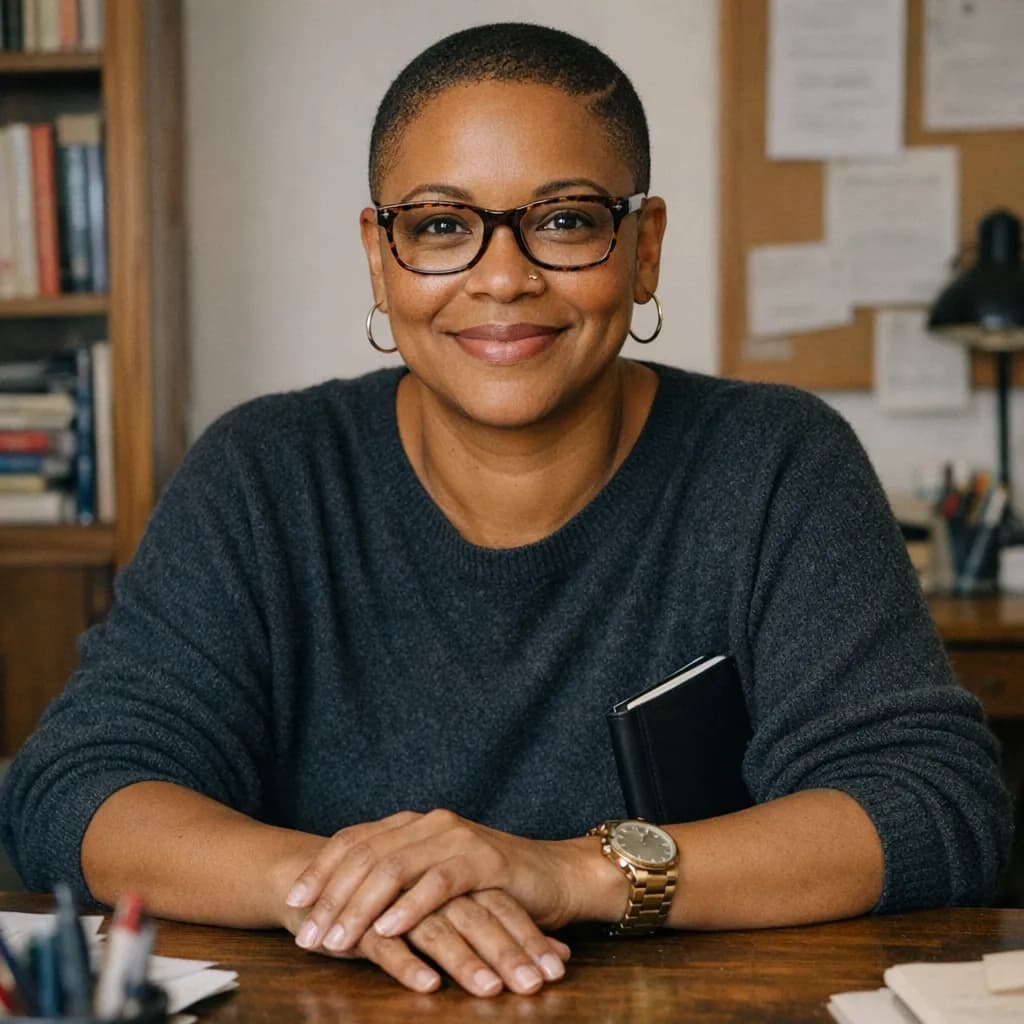
Danae Marcelline Brooks
Developmental Fiction Editor & Manuscript CoachI grew up between church basements, tidewater heat, and people who could tell a whole family story while stirring a pot and never looking up. My mom kept paperback romances in a shoebox like they were contraband, and my aunt kept a shelf of mystery novels with cracked spines. I read both. I learned early that readers forgive a lot, but they don’t forgive being bored or being lied to. I didn’t come up dreaming about editing. I wanted steadier work than “writer,” and I was the kid who could take notes fast, so I ended up in admin jobs where I got volunteered into fixing other people’s documents. Outside of that, I spent a couple years doing hair out of a friend’s kitchen. That part of my life doesn’t explain my editing, but it’s true: I still remember the sound of a cape snapping and how people tell you the most pointed truths when they think you’re not allowed to answer back. Sometimes I miss that kind of honesty. A storm took out power for a week when I was in my late twenties, and I agreed to help a neighbor organize a stack of workshop pages because there wasn’t much else to do at night. The pages were a mess, but the voice was alive. I wrote margin notes the way I talk, not the way school taught me, and the neighbor asked for more. That turned into being the person people handed drafts to. I still carry this old belief that if you “work hard enough,” the story will behave. I don’t defend it, but I catch myself acting like it’s true when I see a writer piling scenes on top of scenes. Now I’m a developmental editor because I’m impatient with pretty sentences that protect a story from making decisions. My bias is I’ll side-eye passive main characters harder than most editors will, even when the genre gives them excuses. I don’t correct that. It’s the lens I read through, and writers who want a gentler read should pick someone else. If you want a first reader who will point at the exact scene where your book starts dodging consequences, I’m your person.
Frequently Asked Questions
- What makes A Tale of Two Cities so compelling?
- Many readers assume the book succeeds because it uses a famous historical backdrop and high drama. Dickens actually wins you through structure: he repeats a few narrative mechanisms—doubles, trials, rescues—and escalates the cost each time. He also frames political violence as a system that rewards symbolic guilt over evidence, which keeps tension moral, not just physical. If you study it as craft, track how each “victory” depends on a condition that later fails, and you’ll see why the ending feels earned.
- How long is A Tale of Two Cities?
- People often treat length as the main difficulty, as if endurance automatically equals depth. Most editions run roughly 350–450 pages depending on formatting, but the real workload comes from Dickens’s pacing style: long setup, then relentless compression in the final act. For writers, measure it by structural density rather than pages. Notice how Dickens uses recurrent set pieces—court, home, street, prison—to move fast without skipping emotional steps. When you draft, ask whether each scene changes the terms of danger, not just the word count.
- What themes are explored in A Tale of Two Cities?
- A common assumption says the book “is about the French Revolution,” full stop. Dickens uses the Revolution to explore substitution, guilt by association, private love under public threat, and the way institutions redefine what a person “counts as.” He also explores trauma as repetition through Dr. Manette’s relapse into shoemaking, which turns theme into behavior. If you want to write thematic fiction, stop stating ideas and start dramatizing them through procedures—trials, documents, accusations—that force characters to pay for the world’s beliefs.
- Who is the protagonist of A Tale of Two Cities?
- Many guides pick a single name and move on, but the novel splits protagonist functions across characters. Charles Darnay carries the external jeopardy and the plot’s legal stakes, while Sydney Carton carries the internal arc that delivers the book’s final meaning. Dickens then binds them through resemblance so the split never feels like a cheat. If you try a similar approach, you must link your dual leads with a mechanism the story can use under pressure, not just a thematic contrast you admire.
- Is A Tale of Two Cities appropriate for students or young readers?
- People often worry only about violence or “mature content,” but the bigger hurdle involves syntax, irony, and moral complexity. The book includes executions and mob violence, yet Dickens often renders horror through implication and atmosphere rather than graphic description. For students, the challenge comes from tracking social systems—law, class, revolutionary ideology—and seeing how they shape character choice. If you teach or assign it, pair chapters with focused questions about cause and effect, and remind readers that confusion usually signals a missed motivation, not low intelligence.
- How do I write a book like A Tale of Two Cities?
- A lot of writers think they need ornate style, a big historical setting, and a tragic ending. Dickens’s real method involves pressure engineering: he builds repeating structures, then changes the rules around them so the same move costs more each time. He also gives every major emotional beat a concrete object or place—the bench, the letter, the wine shop—so the reader feels theme as matter. Draft your own doubles, your own tribunal, your own irreversible choice, and keep revising until each escalation changes what survival even means.
About Charles Dickens
Use recurring character “tells” (voice, gesture, pet logic) to make a huge cast instantly legible and keep readers oriented at speed.
Dickens writes like a stage manager with a stopwatch: he blocks the scene, plants the prop, and times the laugh so it lands just as the dread arrives. His pages run on contrast—light against dark, sentiment against satire, comfort against threat. He builds meaning by making you feel two things at once, then forcing you to choose which one you trust.
His real engine is social pressure. He turns institutions into characters (courts, schools, factories), then makes individual people collide with them in public. That “publicness” matters: Dickens wants witnesses. He wants you to watch someone perform virtue or cruelty under the eyes of a crowd. The reader becomes part juror, part accomplice.
The technical difficulty hides in the apparent ease. The long sentences still steer cleanly. The jokes still point. The sentiment still earns its keep. He uses recurring motifs, repeated phrasing, and character “tells” like musical cues, so you feel coherence across hundreds of pages without noticing the scaffolding.
Modern writers should study him because he solved problems we still have: how to serialize tension, how to make a large cast readable, how to turn abstract injustice into felt experience, how to mix entertainment with moral force without preaching. His working life pushed him toward strict output and constant shaping—writing to deadlines, revising in performance, and designing chapters to end with a turn of the screw. He didn’t just tell stories; he engineered reader momentum.














Ready to improve your draft with direction?
Open Draftly, bring your draft, and move from stuck to a stronger draft without losing your voice. Editors are on standby when you want a deeper pass.
Free welcome credits included. No credit card needed.