Americanah
Book Summary & Analysis
Book summary and writing analysis of Americanah by Chimamanda Ngozi Adichie.
Americanah works because it never treats “identity” as a topic. It treats it as a pressure test. The central dramatic question stays practical and brutal: can Ifemelu build a life that feels true—romantically, socially, and artistically—without amputating parts of herself to fit the room? Adichie designs the book to keep that question alive across continents, not through plot gymnastics, but through choice after choice that costs something.
You might assume the primary opposing force equals racism in America. That reading stays too soft. The opposing force operates more like a machine: the demand to perform acceptable versions of Blackness, Africanness, womanhood, and success depending on who watches. In Princeton in the 2000s, Ifemelu can feel “safe” and still feel invisible. In Lagos, she can feel “seen” and still feel trapped. The antagonist shifts shape, but it always asks the same thing: edit yourself or pay.
The inciting incident doesn’t arrive as a single explosion. It arrives as a decision that changes her operating system. Watch the early U.S. section: Ifemelu hits the wall of money, status, and accent; she watches doors close; and then she makes the kind of choice young writers often skip because it feels “unlikeable.” The specific mechanics matter: she takes an action to survive, feels the aftertaste, and that aftertaste becomes a new internal problem she must manage in every later scene. If you imitate this book naively, you’ll try to “raise issues” without staging the private cost that forces the issue onto the page.
Adichie escalates stakes with controlled reversals. Ifemelu earns external wins—education, a relationship, social fluency—but she pays with distance from herself and from the people who knew her before the performance started. Then she creates the blog voice, and she regains power. That power doesn’t solve her life; it changes the kind of trouble she attracts. She can now tell the truth in public, which means she must face what truth does to intimacy.
Structure-wise, the book runs on a braid: Nigeria in the 1990s, America in the 2000s, and the later return to Lagos. The time jumps don’t decorate the narrative. They function like cross-examination. Each new setting supplies evidence that contradicts the last one, and you, the reader, keep revising what you think “home,” “love,” and “freedom” mean. That constant revision creates momentum without a single villain twirling a mustache.
The romance plot doesn’t sit on top of the “immigrant story.” It serves as the story’s lie detector. Obinze represents not just love but an earlier self that remembers her before she learned the American performance. Other relationships test different compromises: desire versus belonging, comfort versus honesty, status versus tenderness. Adichie makes the reader feel how political forces enter the bedroom, the salon, the job interview—then she lets the characters pretend, for a moment, that they don’t.
The book’s set pieces (hair-braiding salons, small talk with liberal acquaintances, diasporic parties, Lagos’s traffic and hustle) do one job: they turn abstract critique into social choreography. People interrupt. People talk around what they mean. People “praise” you in ways that shrink you. If you only copy the surface—witty observations about race, smart cultural commentary—you’ll write an essay with character names. Adichie writes scenes where the commentary rises like steam because the pot actually boils.
By the end, the plot question (“Will she end up with X?”) never outranks the craft question (“Will she stop editing herself to survive?”). Adichie resolves the story by forcing Ifemelu to choose the kind of life she can live inside, in a specific place, among specific people, with no guarantee that anyone applauds. That’s the real engine: not a message, but a series of decisions that sharpen the reader’s sense of what selfhood costs.
Story Structure & Narrative Arc
Story structure and emotional arc in Americanah.
Americanah follows a subversive Man-in-a-Hole arc: Ifemelu starts with youthful certainty and social ease in Nigeria, drops into dislocation and self-editing in America, then climbs toward a tougher, less performative honesty after she returns to Lagos. She doesn’t end “happier” in a tidy way. She ends clearer, which feels like fortune because she stops bargaining away her voice for approval.
Key sentiment shifts land because Adichie ties every rise to a hidden cost and every fall to a choice, not a coincidence. The lows punch because the book refuses melodrama; it shows ordinary humiliations—money, hair, accents, job hunger—stacking until a single decision changes who Ifemelu thinks she is. The climactic force comes from convergence: public voice, private desire, and homecoming collide, and she must decide what she will stop pretending about.

Studying this book—and stuck on your pages?
Put your draft in Draftly. Fix scenes and dialogue in the text—not in another tab. When you want sharper feedback, AI editors are ready.
Free welcome credits included. No credit card needed.Writing Lessons from Americanah
What writers can learn from Chimamanda Ngozi Adichie in Americanah.
Adichie solves a problem you probably underestimate: how to write a “big ideas” novel that still feels like gossip you can’t stop reading. She does it by welding commentary to social micro-physics. Ifemelu doesn’t “reflect on race” in a vacuum; she navigates a room, hears a phrase, notices who relaxes, watches who stiffens, and then decides what mask to wear. That cause-and-effect chain gives the prose authority. You don’t need louder opinions. You need clearer behavioral triggers.
The book’s signature device—the blog posts—could have turned into detachable essays. Adichie prevents that by using them as plot levers and character reveals. The blog voice sharpens Ifemelu’s public self, and that public self changes how friends and lovers handle her. You see this dynamic in her relationship with Curt: charm and comfort coexist with a silent bargain about what gets named. The blog makes naming unavoidable, which means it also makes love harder.
Dialogue carries double duty because Adichie writes it as status negotiation, not information exchange. Pay attention to scenes with Aunty Uju: they talk about men, work, and “being sensible,” but they really argue about survival strategies and the price of respectability. Each line presses on a bruise. Adichie lets characters dodge, correct, and reframe in real time, which creates subtext without fog. A modern shortcut would slap a “toxic” label on a character and call it depth. Adichie makes you feel why the behavior tempts them.
Atmosphere comes from specificity with an agenda. The hair-braiding salon in Princeton doesn’t exist to add “texture”; it stages a chorus of women whose talk turns private insecurity into public performance. Lagos doesn’t exist as a postcard; it arrives through heat, traffic, and professional hustle that rewards boldness and punishes pretense differently than America does. Adichie uses place as an ethical instrument: each location pressures Ifemelu into a different version of herself, and the reader learns craft’s oldest trick—setting equals strategy, not scenery.
How to Write Like Chimamanda Ngozi Adichie
Writing tips inspired by Chimamanda Ngozi Adichie's Americanah.
Write the voice as if you hold two loyalties at once: you want to entertain, and you refuse to flatter the reader. That balance gives Americanah its snap. You can sound witty without sounding cute if you aim every observation at a concrete moment of social friction. Don’t generalize about “society.” Report the exact line someone says, the pause after it, the social reward it buys them, and the small humiliation it costs your protagonist. Let the joke sting because it tells the truth.
Build characters as bundles of adaptations, not traits. Ifemelu shifts selves across Nigeria, campus life, relationships, and work, but Adichie never loses her because the underlying need stays constant: she wants dignity without distortion. Do the same. Define what your protagonist refuses to beg for, then force them into environments where they must beg in subtler ways. Give every major character a coherent survival theory. Aunty Uju doesn’t “sell out.” She protects her child. That motive makes her compromises legible.
Don’t fall into the genre trap of turning the novel into a pamphlet with dialogue tags. This kind of book invites you to announce themes, explain systems, and “educate” the reader. Adichie teaches by dramatizing how systems recruit people through pleasure, not just pain. She shows the seduction of belonging, the relief of being praised, the ease of letting someone else define the terms. If you only write oppression as constant obvious cruelty, you’ll lose the psychological truth and the reader’s trust.
Steal the mechanics, not the surface. Draft an “observation ledger” for your protagonist: ten moments where they code-switch, self-edit, or get translated by others. For each moment, write the scene twice. First, as pure action and dialogue with no commentary. Second, as a short public-facing artifact your protagonist could publish, like a blog post or letter. Then rewrite the original scene so one sentence of that artifact’s clarity leaks into the moment, raising the stakes without turning the scene into an essay.
Who Would Edit This Book?

Callum Rhys Mahoney
Developmental Fiction Editor and Manuscript CoachI grew up between Wagga and my aunt’s place out near Narrandera, in a family that could argue for sport and then feed you like nothing happened. Books were around, but not in a precious way. My old man liked stories where people did what they said they’d do, even if it cost them. I still hear that voice when a character “can’t” make a decision because the plot needs another chapter. I didn’t set out to be an editor. I studied teaching, worked a few rough years in classrooms, and then left after a run of short contracts and one admin reshuffle that made it clear I was replaceable. A mate pulled me into doing learning materials and assessments because I could spot where people were gaming the question. That work taught me to watch for what the text rewards versus what it claims to reward - which is the same problem in a lot of manuscripts. I also spent a couple of seasons doing night shifts at a servo when money got tight. I kept a notebook behind the counter and wrote scenes between customers, mostly to stay awake. I remember one bloke coming in every Thursday, buying the same pie, and telling me the same story about a dog he swore was smarter than his ex. I don’t know why I remember that, but I do. Editing started as favour-work. People in town found out I’d read their drafts and I’d send back long emails with scene-by-scene notes. Somewhere along the line it became my paid work, mostly because I was consistent and because I’m not afraid to say, “This turn doesn’t belong to your protagonist.” I’m biased toward decisive characters and I don’t plan to cure myself of it; I’d rather a story risk an ugly choice than drift into polite inevitability.
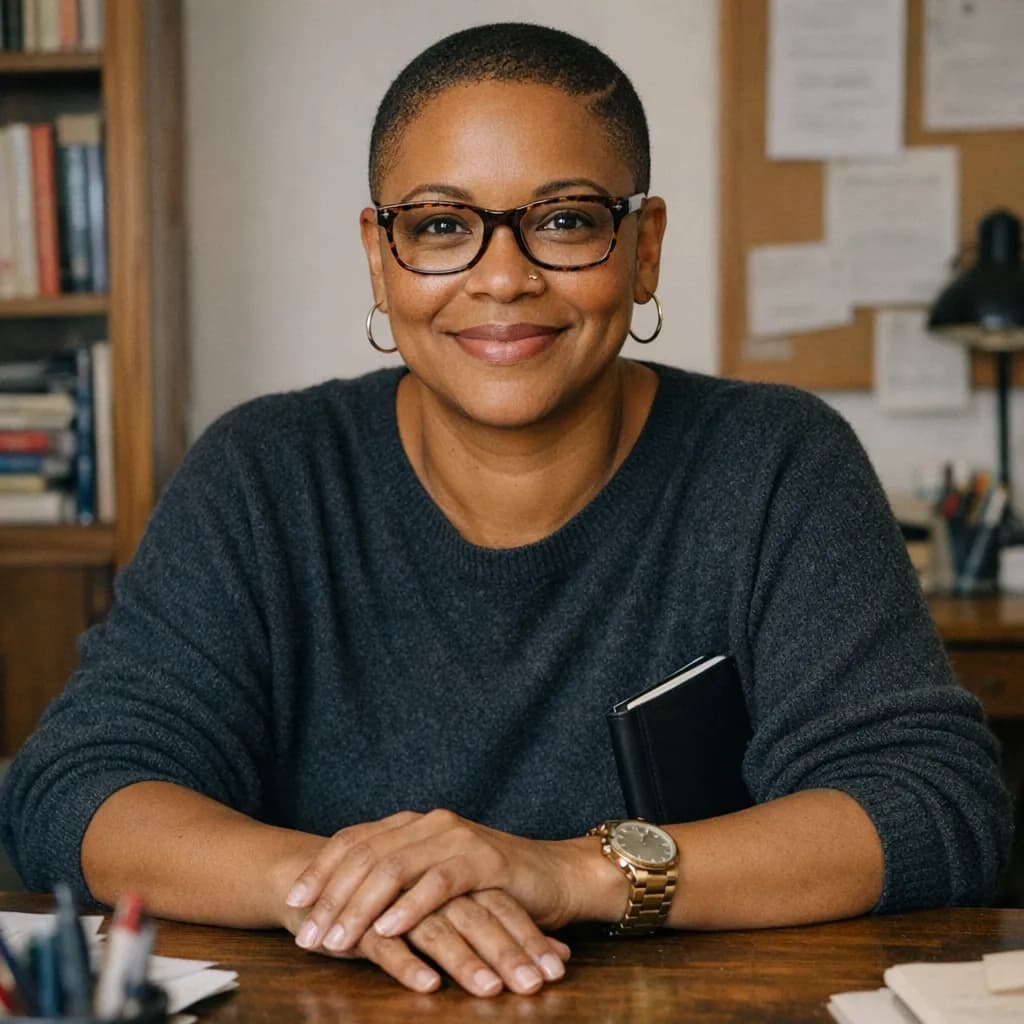
Danae Marcelline Brooks
Developmental Fiction Editor & Manuscript CoachI grew up between church basements, tidewater heat, and people who could tell a whole family story while stirring a pot and never looking up. My mom kept paperback romances in a shoebox like they were contraband, and my aunt kept a shelf of mystery novels with cracked spines. I read both. I learned early that readers forgive a lot, but they don’t forgive being bored or being lied to. I didn’t come up dreaming about editing. I wanted steadier work than “writer,” and I was the kid who could take notes fast, so I ended up in admin jobs where I got volunteered into fixing other people’s documents. Outside of that, I spent a couple years doing hair out of a friend’s kitchen. That part of my life doesn’t explain my editing, but it’s true: I still remember the sound of a cape snapping and how people tell you the most pointed truths when they think you’re not allowed to answer back. Sometimes I miss that kind of honesty. A storm took out power for a week when I was in my late twenties, and I agreed to help a neighbor organize a stack of workshop pages because there wasn’t much else to do at night. The pages were a mess, but the voice was alive. I wrote margin notes the way I talk, not the way school taught me, and the neighbor asked for more. That turned into being the person people handed drafts to. I still carry this old belief that if you “work hard enough,” the story will behave. I don’t defend it, but I catch myself acting like it’s true when I see a writer piling scenes on top of scenes. Now I’m a developmental editor because I’m impatient with pretty sentences that protect a story from making decisions. My bias is I’ll side-eye passive main characters harder than most editors will, even when the genre gives them excuses. I don’t correct that. It’s the lens I read through, and writers who want a gentler read should pick someone else. If you want a first reader who will point at the exact scene where your book starts dodging consequences, I’m your person.
Frequently Asked Questions
- What makes Americanah by Chimamanda Ngozi Adichie so compelling?
- Many readers assume the book succeeds because it tackles big themes like race and immigration. It works because Adichie turns those themes into moment-by-moment choices that affect love, money, hair, language, and belonging. She builds scenes where the protagonist must decide how much of herself to translate for the room, and that decision creates consequences that ripple forward. If you want similar pull in your own work, test every “idea” by asking what it forces your character to do next.
- How long is Americanah by Chimamanda Ngozi Adichie?
- People often treat length as a proxy for difficulty, as if a long novel must feel slow. Americanah runs roughly 500+ pages in many editions, but Adichie earns that space by braiding timelines and places so each section revises the last. The size supports accumulation: small social costs add up until they change a life. When you draft, don’t chase length; earn it by making every chapter change the protagonist’s options in a measurable way.
- What themes are explored in Americanah by Chimamanda Ngozi Adichie?
- A common assumption says the themes equal “race, identity, and love,” and that list stays too broad to help a writer. Adichie explores how people perform themselves for safety, how class travels differently than culture, and how “home” can become a moving target once you leave. She also examines power in intimate spaces, not just institutions. If you write theme-forward fiction, keep themes as questions your scenes argue over, not slogans your narrator delivers.
- Is Americanah appropriate for young readers or classroom use?
- Some assume literary acclaim automatically makes a book suitable for all ages or all classrooms. Americanah includes explicit sexual content and adult situations, and it speaks bluntly about race, politics, and relationships. Those elements serve the book’s honesty rather than shock value, but they still require context and maturity. If you teach or recommend it, match the audience to the conversations it will provoke, and remember that discomfort can teach when you frame it with craft.
- How does Americanah handle point of view and voice?
- Many writers think “strong voice” means constant sarcasm or constant lyricism. Adichie uses a flexible close third that stays intimate with Ifemelu’s mind while allowing crisp social observation, and she inserts blog posts that shift into a public, performative voice. That contrast creates texture: private feeling versus public argument. If you try this, control the boundary. Make each voice do a different job in the story, and keep both tethered to character consequences.
- How do I write a book like Americanah?
- A common misconception says you can copy the ingredients—immigration, romance, cultural commentary—and get the same effect. Adichie succeeds because she builds an engine of escalating social costs: every setting forces a new compromise, and every compromise changes the protagonist’s relationships. Start by defining what “self-betrayal” looks like for your character, then design scenes that tempt them with real rewards for doing it. After each scene, check whether the character’s future options narrowed or widened.
About Chimamanda Ngozi Adichie
Use calm, specific scenes to smuggle big arguments into the reader’s bloodstream—so they feel the idea before they can resist it.
Chimamanda Ngozi Adichie writes with a rare kind of control: she keeps the sentence clean while the ideas stay thorny. She builds meaning through contrast—private desire against public pressure, belonging against exile, what people say against what they can’t afford to admit. The surface reads smooth. Under it, every scene runs on social physics: status, shame, pride, and the tiny negotiations that decide who gets to be “normal.”
Her engine works through specificity that doesn’t show off. A brand name, a prayer style, a food smell, a classroom rule—small details that act like receipts. They certify the world so you trust her when she asks you to hold two truths at once. She uses this trust to move you into uncomfortable moral clarity: you start by judging, then you notice the cost of your judgment, then you revise yourself.
The technical difficulty: her prose refuses to announce its cleverness. The voice often sounds plain, but the structure rarely is. She shifts distance with surgical timing—close enough for intimacy, far enough for critique. And she embeds argument inside lived moments, so the story never turns into a lecture even when it carries a thesis.
Modern writers need her because she proved you can write politically without writing propaganda, and you can write globally without smoothing away local texture. In interviews she has described drafting and redrafting with rigor—staying loyal to clarity, cutting explanation, and revising until the emotional logic feels inevitable. You don’t imitate her by copying her calmness. You imitate her by earning it.














Ready to improve your draft with direction?
Open Draftly, bring your draft, and move from stuck to a stronger draft without losing your voice. Editors are on standby when you want a deeper pass.
Free welcome credits included. No credit card needed.