The Left Hand of Darkness
Book Summary & Analysis
Book summary and writing analysis of The Left Hand of Darkness by Ursula K. Le Guin.
The Left Hand of Darkness runs on a deceptively simple dramatic question: can Genly Ai earn enough trust on a planet that reads gender, honor, and loyalty through a different operating system to complete first contact? If you try to imitate this novel by “inventing a cool society” and sprinkling lectures through a travelogue, you’ll write a brochure. Le Guin builds a conversion story under diplomatic stakes, then hides the gears inside voice, documents, and weather.
The inciting incident doesn’t arrive as an explosion. It arrives as a decision that quietly pins the protagonist to the wall. Genly Ai, an envoy from the Ekumen, chooses to reveal his mission to Estraven—Therem Harth rem ir Estraven, a powerful Gethenian statesman—in Karhide’s capital of Erhenrang. Genly thinks information equals persuasion. On Gethen, information triggers status games. That one choice sets the opposing force in motion: not a villain, but a whole political climate of suspicion—King Argaven’s paranoia, court intrigue, and the planet’s reflex to treat outsiders as instruments.
Le Guin escalates stakes by narrowing Genly’s options rather than piling on action. The setting does half the work: Winter (Gethen) sits in a near-ice-age, with cities like Erhenrang and Orgoreyn’s Mishnory built for cold, scarcity, and long memory. Travel costs. Messages lag. Hospitality becomes a weapon. Every scene forces Genly to misread a social cue, then pay for it physically. You watch him confuse “shifgrethor” (face, prestige, the whole etiquette economy) with mere politeness, and the plot punishes him on schedule.
The primary opposing force changes masks across the structure, which keeps the book from feeling like “politics, then travel.” In Karhide, the opposition looks like court power and Argaven’s fear of betrayal. In Orgoreyn, it looks like bureaucracy, surveillance, and ideological certainty. Underneath both sits Genly’s internal opposition: his need to categorize people into familiar gendered scripts so he can predict them. Le Guin uses that blind spot as a throttle. The more Genly insists on certainty, the more the world denies him it.
Mid-structure, Le Guin executes the move most writers miss: she doesn’t “reveal the world.” She reveals the protagonist’s interpretive failure. When Orgoreyn shifts from apparent rational refuge to apparatus of control, the story doesn’t twist for shock; it twists because Genly finally faces the cost of treating diplomacy as a pitch instead of a relationship. Stakes jump from political (will the Ekumen gain an ally?) to existential (will Genly survive? will any alliance mean anything if it rests on coercion?).
The later escalation turns outward conflict into a two-person crucible. Le Guin strips away courtrooms and committees and leaves Genly and Estraven against the ice on the Gobrin Glacier. That design choice matters: you can’t hide behind plot machinery when the only engine left runs on trust, endurance, and the slow revision of belief. Each hardship forces a micro-decision—share supplies, share truth, risk sleep, risk pride—and those decisions build the only alliance that can carry the mission.
By the end, the novel answers its dramatic question in a way that warns ambitious writers: you can’t “theme” your way to power. You must architect scenes that force the theme to become behavior. Le Guin makes the political outcome feel earned because she makes the personal outcome costly. If you copy the surface—an androgynous society, invented customs, appended myths—without copying the pressure system (misunderstanding → consequence → re-interpretation), you’ll get a clever premise and a dead book.
Story Structure & Narrative Arc
Story structure and emotional arc in The Left Hand of Darkness.
The book follows a Man-in-the-Hole arc disguised as an ethnographic report: Genly starts confident in his mission and certain in his categories, then sinks into isolation, political failure, and bodily danger before climbing toward hard-won trust and clarity. He ends with fewer illusions, a deeper respect for Gethen, and a relationship-based understanding of what “alliance” actually costs.
Le Guin lands her low points because she makes them cumulative and specific. Each setback doesn’t just raise danger; it proves Genly wrong in a new way, so his worldview collapses in layers. The emotional peaks arrive quietly—shared labor, shared truth, a decision to return for someone—because the book trains you to value earned intimacy over spectacle. When the climax comes, it feels like release from a long, controlled compression rather than a sudden fireworks show.

Studying this book—and stuck on your pages?
Put your draft in Draftly. Fix scenes and dialogue in the text—not in another tab. When you want sharper feedback, AI editors are ready.
Free welcome credits included. No credit card needed.Writing Lessons from The Left Hand of Darkness
What writers can learn from Ursula K. Le Guin in The Left Hand of Darkness.
Le Guin earns authority by splitting the book’s voice into instruments. Genly’s field-report narration gives you a practical, occasionally impatient mind. Interleaved myths, folktales, and “documents” don’t decorate the world; they argue with Genly’s interpretation. You feel the gap between what an outsider thinks he sees and what a culture tells itself about what matters. If you want to reuse this move, don’t paste in lore. Write secondary texts that change how the reader judges the main narrator.
She designs scenes around miscommunication, not misunderstandings as cute flavor. Watch how Genly and Estraven talk past each other early—Genly pushes for direct commitments; Estraven answers in a way that protects face and long-term position. The dialogue doesn’t sparkle with quips. It creates pressure through what each person refuses to say. That restraint makes later bluntness land like a door finally opening. Many modern novels shortcut this with instant “banter chemistry.” Le Guin instead makes trust a craft problem that characters must solve.
She builds atmosphere with logistics. In Erhenrang’s drafty halls, in Mishnory’s administrative corridors, and on the Gobrin Glacier, the cold controls behavior: who can travel, who can hide, who can help, who can betray. Weather stops feeling like backdrop and starts acting like a constant editor, cutting scenes down to essentials. That choice also lets Le Guin dramatize politics without endless meetings. Your characters can’t posture forever when their lips crack and their fuel runs out.
Most importantly, Le Guin turns theme into structure. The book doesn’t “explore gender” through speeches; it forces Genly to confront how his binary assumptions sabotage his mission. She keeps the philosophical questions alive by attaching them to stakes you can measure—access, shelter, safety, alliance. If you try to imitate the novel by making your world a metaphor first, you’ll preach. If you build a protagonist whose default reading of people fails in scene after scene, you’ll create the same eerie, persuasive power.
How to Write Like Ursula K. Le Guin
Writing tips inspired by Ursula K. Le Guin's The Left Hand of Darkness.
Control your narrator the way Le Guin controls Genly. Give him competence, then limit what he can interpret. Let him sound practical, even a little irritated, and then let the prose admit wonder only when it costs him something. You don’t need lyrical overflow; you need steady observational sentences that leave room for the reader to notice what the narrator misses. Make your voice consistent under stress. If your tone turns “poetic” only at sunsets, you’ve written decoration, not authority.
Build characters as cultural algorithms, not personality stickers. Estraven doesn’t exist to “teach” Genly. Estraven pursues a political and moral strategy that stays coherent even when it looks evasive. Give every major character a private definition of honor, risk, and loyalty, then let that definition shape their speech rhythm and their choices. Track how Genly changes by tracking what he stops assuming. If you can’t name your protagonist’s default misread in one sentence, you can’t build the corrective arc.
Avoid the genre trap Le Guin sidesteps: the idea that a strange society counts as a plot. A premise doesn’t escalate on its own. You must attach cultural difference to consequences that bite. Le Guin makes etiquette matter because it controls access to power, shelter, and truth. She also refuses the tidy “one villain” shortcut; institutions and norms create conflict even when individuals act reasonably. If you solve everything with an antagonist speech, you’ll flatten the book into a morality play.
Try this exercise. Write three short scenes between the same two characters: first in a court-like setting with hidden status rules, second inside a bureaucratic system that pretends to stay neutral, and third in a survival setting where bodies keep score. In each scene, force one character to misinterpret the other’s core value and pay a tangible cost within five paragraphs. After each scene, add a 150-word “document” from that culture—a myth, memo, or report—that reframes what just happened without contradicting facts. Then revise the scenes until the document changes the reader’s judgment.
Who Would Edit This Book?

Callum Rhys Mahoney
Developmental Fiction Editor and Manuscript CoachI grew up between Wagga and my aunt’s place out near Narrandera, in a family that could argue for sport and then feed you like nothing happened. Books were around, but not in a precious way. My old man liked stories where people did what they said they’d do, even if it cost them. I still hear that voice when a character “can’t” make a decision because the plot needs another chapter. I didn’t set out to be an editor. I studied teaching, worked a few rough years in classrooms, and then left after a run of short contracts and one admin reshuffle that made it clear I was replaceable. A mate pulled me into doing learning materials and assessments because I could spot where people were gaming the question. That work taught me to watch for what the text rewards versus what it claims to reward - which is the same problem in a lot of manuscripts. I also spent a couple of seasons doing night shifts at a servo when money got tight. I kept a notebook behind the counter and wrote scenes between customers, mostly to stay awake. I remember one bloke coming in every Thursday, buying the same pie, and telling me the same story about a dog he swore was smarter than his ex. I don’t know why I remember that, but I do. Editing started as favour-work. People in town found out I’d read their drafts and I’d send back long emails with scene-by-scene notes. Somewhere along the line it became my paid work, mostly because I was consistent and because I’m not afraid to say, “This turn doesn’t belong to your protagonist.” I’m biased toward decisive characters and I don’t plan to cure myself of it; I’d rather a story risk an ugly choice than drift into polite inevitability.
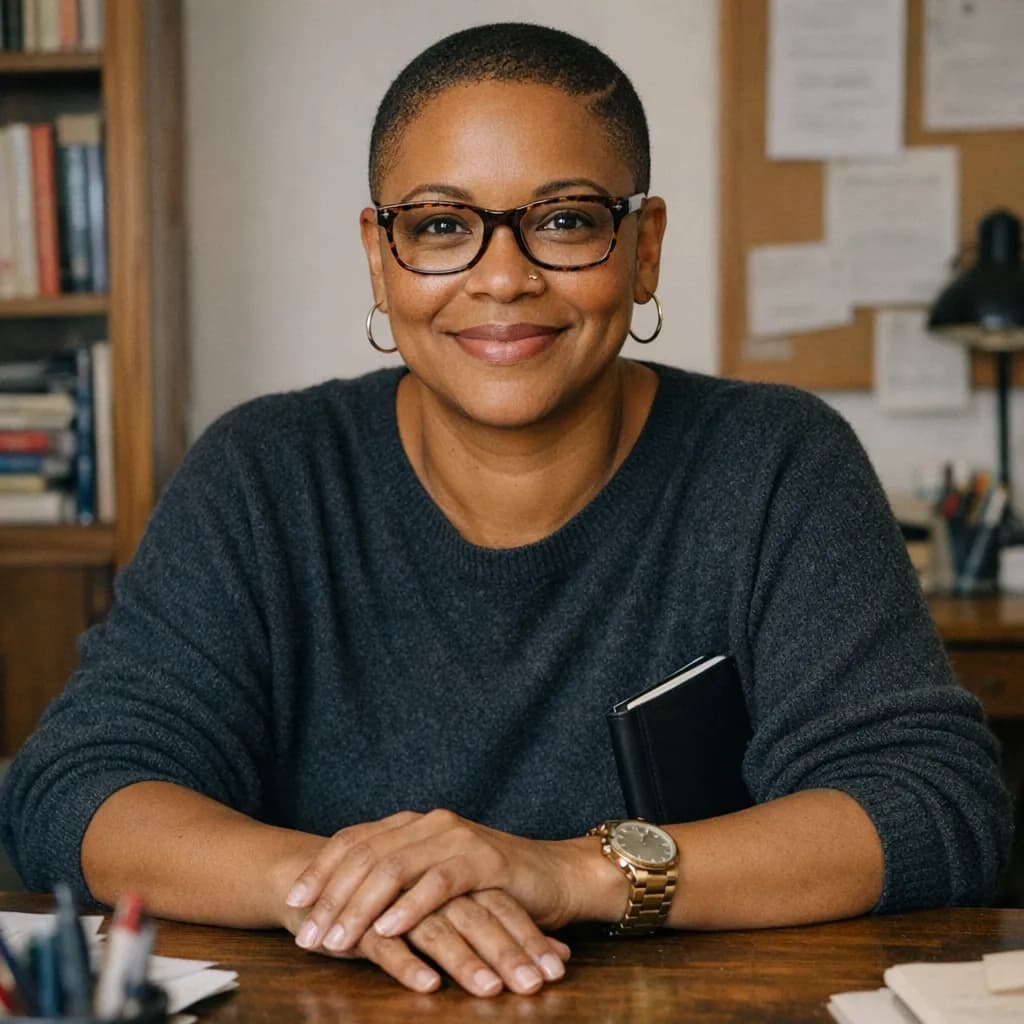
Danae Marcelline Brooks
Developmental Fiction Editor & Manuscript CoachI grew up between church basements, tidewater heat, and people who could tell a whole family story while stirring a pot and never looking up. My mom kept paperback romances in a shoebox like they were contraband, and my aunt kept a shelf of mystery novels with cracked spines. I read both. I learned early that readers forgive a lot, but they don’t forgive being bored or being lied to. I didn’t come up dreaming about editing. I wanted steadier work than “writer,” and I was the kid who could take notes fast, so I ended up in admin jobs where I got volunteered into fixing other people’s documents. Outside of that, I spent a couple years doing hair out of a friend’s kitchen. That part of my life doesn’t explain my editing, but it’s true: I still remember the sound of a cape snapping and how people tell you the most pointed truths when they think you’re not allowed to answer back. Sometimes I miss that kind of honesty. A storm took out power for a week when I was in my late twenties, and I agreed to help a neighbor organize a stack of workshop pages because there wasn’t much else to do at night. The pages were a mess, but the voice was alive. I wrote margin notes the way I talk, not the way school taught me, and the neighbor asked for more. That turned into being the person people handed drafts to. I still carry this old belief that if you “work hard enough,” the story will behave. I don’t defend it, but I catch myself acting like it’s true when I see a writer piling scenes on top of scenes. Now I’m a developmental editor because I’m impatient with pretty sentences that protect a story from making decisions. My bias is I’ll side-eye passive main characters harder than most editors will, even when the genre gives them excuses. I don’t correct that. It’s the lens I read through, and writers who want a gentler read should pick someone else. If you want a first reader who will point at the exact scene where your book starts dodging consequences, I’m your person.
Frequently Asked Questions
- What makes The Left Hand of Darkness so compelling?
- Many readers assume the book hooks you through a bold gender concept and a famous premise. It compels because it runs a tighter engine: an outsider’s misreadings keep creating real consequences, so every chapter forces reinterpretation instead of repeating “world rules.” Le Guin also makes survival logistics and political etiquette share the same stakes, so philosophy never floats free of scene. If you want the same pull, make your theme produce choices that cost your protagonist something measurable.
- How long is The Left Hand of Darkness?
- A common rule says length matters less than pacing, and that holds here. Most editions land around 300 pages (often a bit under or over depending on formatting), but the book feels longer because Le Guin uses reports, myths, and shifts in setting to create a layered texture. Don’t confuse that texture with slowness; she keeps turning the screw on trust and access. Use page count as a planning guide, then audit whether each section changes the power balance.
- What themes are explored in The Left Hand of Darkness?
- People often reduce the themes to gender, and that reduction misses the book’s working parts. Le Guin writes about duality, loyalty, nationalism, and the limits of perception—especially how a supposedly “neutral” observer smuggles bias into every conclusion. She also examines how institutions turn fear into policy. If you write thematically, don’t announce the theme; stage it as a recurring decision pattern. The reader trusts your meaning when characters pay for it in action.
- How does The Left Hand of Darkness handle world-building without info-dumps?
- A standard technique says you should “show, don’t tell,” but Le Guin mixes showing with curated telling on purpose. She lets Genly tell you what he thinks, then she undercuts him with myths, local terms, and scenes where etiquette or climate proves him wrong. The result feels authoritative because it includes uncertainty. If you want this effect, don’t dump facts to prove you did your homework. Reveal facts at the moment they change what a character can safely do.
- Is The Left Hand of Darkness appropriate for younger readers or new sci-fi readers?
- Many assume classic science fiction reads like an action-driven gateway, but this novel asks for patience with politics, anthropology, and quiet tension. Younger or brand-new readers can handle it if they enjoy character psychology and moral ambiguity more than constant spectacle. The sexual content stays mostly conceptual rather than explicit, yet the emotional material can feel mature. If you write for accessibility, keep your sentences clear like Le Guin does, but don’t sand down the complexity that creates meaning.
- How do I write a book like The Left Hand of Darkness without copying it?
- A common misconception says you replicate the concept—an unusual biology, a remote planet, a diplomatic mission—and the book will feel similar. You want to replicate the mechanism: give your protagonist a confident interpretive frame, then design a society and plot that punish that frame until the protagonist updates it under pressure. Build opposition through institutions and norms, not moustache-twirling villains. Then let a relationship, not a revelation speech, carry the turning point. Draft boldly, then revise for consequence chains.
About Ursula K. Le Guin
State one cultural rule early, then show its human cost through a small choice to make your world feel real and your theme hit harder.
Le Guin writes like an anthropologist with a poet’s ear and a moralist’s patience. She doesn’t “build worlds” so you can sightsee; she builds systems so you can watch yourself behave inside them. The trick is restraint. She gives you just enough surface clarity to earn trust, then uses that trust to smuggle in questions about power, gender, language, and belonging—without turning the story into a lecture.
Her engine runs on clean sentences and controlled omissions. She states the rule of the society, then lets character choices expose the cost of that rule. You feel the pressure because she refuses to dramatize it on cue. She’ll summarize a year in a paragraph, then slow down for a single conversation where a relationship tilts. That time-control makes her work feel both mythic and intimate.
The hard part for modern writers: her simplicity is engineered. “Plain” in Le Guin isn’t bare; it’s measured. Every concrete noun carries culture. Every abstract term earns its place. She avoids the easy seductions—constant conflict, flashy violence, ornamental lore—and still keeps you turning pages because the real tension sits in ethics, identity, and consequence.
She drafted with discipline and revised with authority: she treated revision as re-seeing, not polishing. She cut explanations that performed anxiety instead of meaning. Study her now because she proved speculative fiction can do serious philosophical labor while staying readable. After her, “worldbuilding” stopped being décor and started being argument—made through story, not speeches.














Ready to improve your draft with direction?
Open Draftly, bring your draft, and move from stuck to a stronger draft without losing your voice. Editors are on standby when you want a deeper pass.
Free welcome credits included. No credit card needed.