Character relationship chart maker
A cast list tells you who is in the book. A chart tells you who owes whom, who wants what from whom, and which single line takes four scenes down with it if it snaps. Add names and join them up, and the busiest character drifts to the middle.
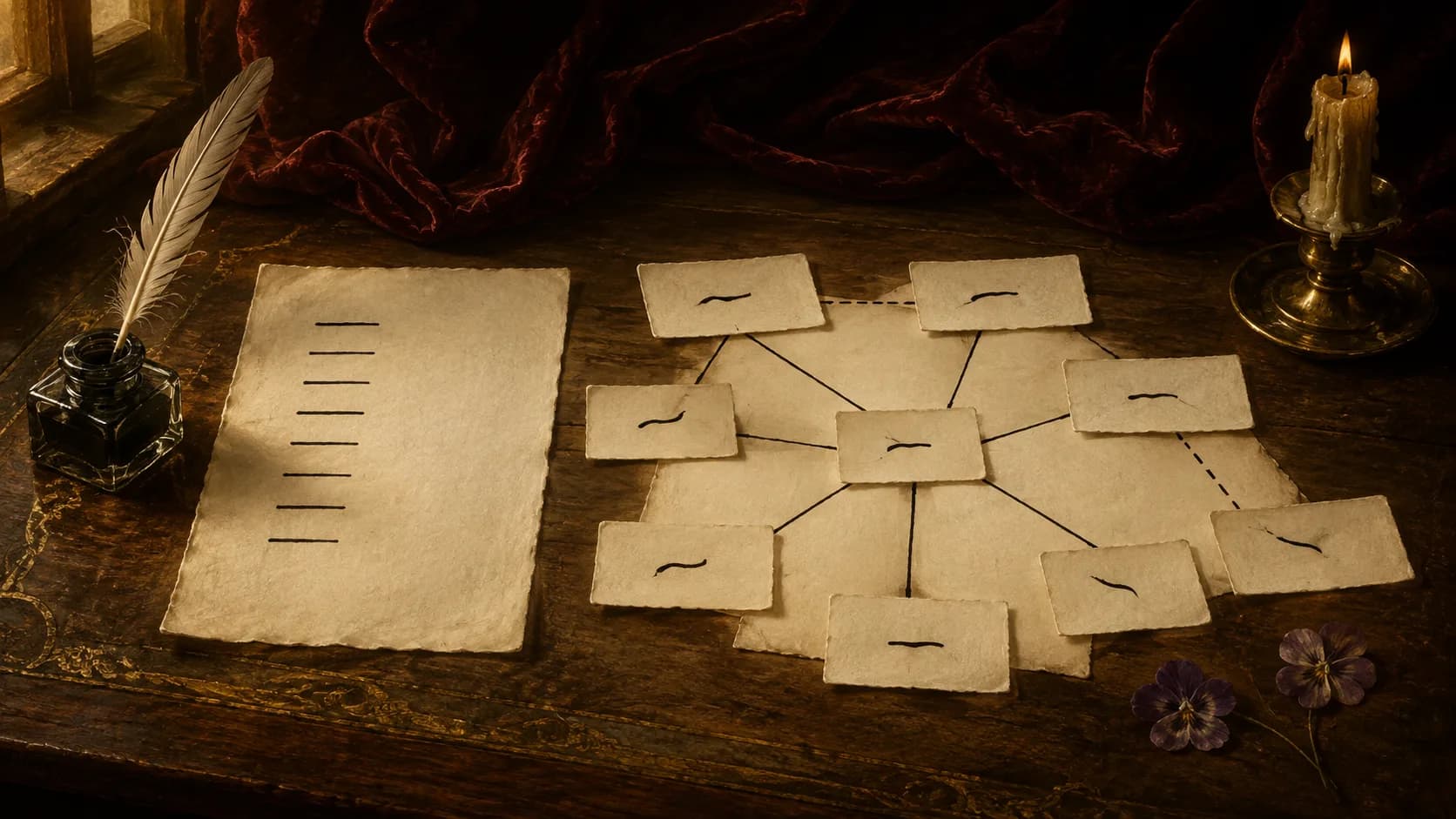
Start with a cast you already know
A chart is easiest to read when you already know the people in it. This one holds nine characters from an 1897 novel and the twelve ties that carry its plot, so you can see a finished chart before you clear it and put your own cast in.
It opens filled in for Dracula — Bram Stoker, 1897. Barely a blood relative among them. These characters chose each other, which is why one refused proposal and one forced bond carry the plot.
The Dracula example, written out
- Mina Murray — Schoolmistress. Keeps the journals that let the others see the whole shape of it.
- Jonathan Harker — Solicitor, sent to Transylvania to close a property sale.
- Lucy Westenra — Mina's closest friend, and the one three men propose to in a day.
- Arthur Holmwood — Engaged to Lucy. Gives the first transfusion.
- John Seward — Runs the asylum. Proposed to Lucy the same day and was refused.
- Quincey Morris — Texan. Lost to Arthur and stayed his friend anyway.
- Van Helsing — Seward's old teacher, sent for when the case stops making sense.
- Renfield — Seward's patient. Eats flies to earn lives.
- Count Dracula — The buyer of the London property.
- Jonathan Harker and Mina Murray: engaged, then married
- Mina Murray and Lucy Westenra: closest friend
- Arthur Holmwood and Lucy Westenra: engaged
- John Seward → Lucy Westenra: proposed, refused
- Quincey Morris → Lucy Westenra: proposed, refused
- Quincey Morris and Arthur Holmwood: friends, after losing to him
- Van Helsing → John Seward: his old teacher, now in charge
- Van Helsing → Lucy Westenra: knows what is wrong
- John Seward → Renfield: doctor and patient
- Renfield → Count Dracula: in thrall
- Count Dracula → Jonathan Harker: host, then jailer
- Count Dracula → Mina Murray: forced bond
The kinds of line worth drawing
- Marriage or engagement
- Jonathan and Mina are engaged when the book opens and married before the middle of it, which is what puts her in the room later.
- Desire, one way
- Seward proposes to Lucy on the same day Arthur does, and she refuses him.
- Friendship that survived a loss
- Quincey stays close to Arthur after losing to him. It is the least likely line here and the one that holds longest.
- Who can give an order
- Van Helsing takes command the moment he arrives, and Seward, who runs an asylum of his own, does as he is told.
- Who taught whom
- Seward writes to his old teacher because he is out of his depth, and that letter is how the book acquires its expert.
- Care and custody
- Seward keeps Renfield under lock and reads him as a symptom for months before reading him as a witness.
- Thrall, debt, obligation
- Renfield calls the Count his Master and eats flies to earn lives, which makes this the one bond in the novel with a stated price.
- The line that flips
- Dracula forces his blood on Mina to own her, and the bond becomes the compass the hunting party steers by.
- Captor and captive
- Dracula receives Jonathan as a guest and keeps him as a prisoner, and the footing changes without either of them saying so.
How to draw one you will keep using
These are the calls that decide whether you open the chart again in chapter twenty. Most of the work is deciding what to leave out: a tie earns its line when breaking it would cost you a scene.
Drawing the chart
Decisions to make once, before the lines multiply.
- Who goes in the middle.
- The person the plot happens to, not the person you like best. Put Lucy in the centre for the first half and Mina for the second.
- How many names.
- Nine is comfortable and fifteen is the ceiling. Past that the lines cross more than they connect.
- Which way the arrow points.
- From the one who wants or owes towards the one who is wanted or owed. An arrow both ways means it is mutual, and most are not.
- What to write on the line.
- Three or four words naming the tie, not a summary of the subplot. "Proposed, refused" beats a sentence.
- When to draw a second chart.
- The moment a change would make you redraw more than three lines. Keep the before and the after side by side.
Reading it back
The shape is the point. These five are what the common shapes mean.
- A star.
- Every line runs to one person and none run between the others. Any scene without the centre will feel thin.
- A chain.
- A knows B, B knows C, and the links hold in order. Information travels one step at a time, which is slow to write and easy to break.
- Two clusters and one bridge.
- The bridge is the most valuable person in the book. In Stoker it is Seward, the only line between the asylum and the hunt.
- A pair with no line.
- Two people with no scene together. Ask whether the book is avoiding the meeting on purpose.
- The same line, three times.
- Three suitors, one woman, one refusal each. Repetition on a chart is structure, not accident.
Secrets and things unsaid
The half of a cast that a plain diagram loses.
- Who knows.
- Draw a dashed line from the knower to the subject. Van Helsing knows what is wrong with Lucy long before anybody else does.
- Who suspects.
- A dotted line. Suspicion behaves differently from knowledge and turns into it at a moment you should choose.
- Unreciprocated.
- A single arrow, not a pair. Two of Lucy's three lines are this, and the book runs on them.
- What one refuses to know.
- At Buda-Pesth Jonathan hands Mina the journal and asks not to read it again. She seals it unopened. A tie can rest on something deliberately unread.
- Lies both believe.
- Mark the pair, not one of them. A shared wrong belief is the hardest thing to keep straight over four hundred pages.
What to leave off
Everything here belongs somewhere else in your notes.
- Appearance.
- Eye colour does not explain why two people cannot be in a room together. It belongs on the character sheet.
- Backstory.
- The chart holds the current state. Where a tie came from goes in the entry for the person.
- Every acquaintance.
- If nothing would change when the line breaks, the line is furniture.
- Your own opinion of them.
- Write the tie as the characters would describe it, not as you judge it. You will need theirs when you write the scene.
- Plot beats.
- An outline holds the order things happen in. A chart holds what is true between people while they happen.
Blank, with the kinds of line down the side. No account, no email.
What the chart is actually for
A cast list is not the problem. You know who is in your book. What you lose, somewhere around the third draft, is which ties are load-bearing: which one, if you cut it, takes four scenes down with it.
That is why the useful chart is small. Three of Stoker's dozen lines are one event seen three times, because three men propose to the same woman on the same day and she turns two of them down. A refused proposal is not a dead line. It is why Arthur asks Seward to look at Lucy, which is how Van Helsing arrives at all, and why Quincey is standing there at the end.
Draw the ties that are under pressure and leave the rest. When a scene refuses to work, look at which line it is standing on.
Mira cómo encaja todo.
Pon a tu reparto en un tablero y traza las líneas: quién conoce a quién, quién quiere qué, qué hilo lleva a dónde. El mapa que vuelves a dibujar siempre, esta vez guardado.
Why most relationship charts get abandoned
Charts are cheap to draw and expensive to keep. A stale one is worse than none, because it goes on answering questions with last month's truth.
Drawn once and left
- Made during planning and not opened again while drafting
- No date, so you cannot tell which draft it describes
- Kept in a file format you need a subscription to reopen
- Redrawn from scratch each time instead of edited
- Beautiful enough that changing it feels like damage
Too much on the page
- Every character in the book, including the innkeeper
- A line between every pair that has ever spoken
- Full sentences written along the lines
- Four colours with no key
- Portraits on the nodes, so the names stop being readable
Nothing you did not know
- Only the ties the reader learns in chapter one
- Family trees where nothing is inherited or disputed
- No direction on any arrow
- Ties that no event in the book ever tests
- A chart of the cast list rather than of the pressure
A matter of taste
- Colour-coding romance separately from everything else
- Photographs of actors standing in for the characters
- Symbols instead of words on the lines
- One enormous chart rather than one per act
- Charting before a word of the draft exists
Questions & Answers
- What is a character relationship chart?
- A diagram of who your characters are to each other: one node per person, one line per tie that matters, and a few words on each line naming the tie. It is not a family tree, because your characters pick most of these ties rather than inheriting them.
- How do I make a character relationship chart?
- Add your cast, then add a line for each pair where something is at stake. Point the arrow from the one who wants or owes towards the other, tap it to make the tie mutual, and put three or four words on the line. Dashed means one of them knows something. Dotted means they only suspect it.
- How many characters should be on one chart?
- Nine is comfortable and fifteen is the practical ceiling. Past that, chart the households or crews instead and give the one you are writing a chart of its own. Walk-on parts belong on a list.
- Is a character map the same as a character relationship map?
- Close, and people use the names loosely. A character map usually means a study aid for a set text, summarising a book somebody else wrote. A character relationship map or relationship chart is a working document for the book you are writing, so you edit it as the draft changes. Fanfiction writers call the same diagram an OC relationship chart.
- Do I need software to make one?
- No. Index cards in a ring with string between them work, and so does a notebook page. The reason to use the maker above is editing: a tie that changes in chapter twenty means redrawing a paper chart, and here it means changing one line.
- Is this character relationship chart maker free?
- Yes, and there is no account. Your browser keeps what you type, so the chart is still here tomorrow. Export it as an image or clear it whenever you like, and the blank worksheet downloads without an email address.
Un solo lugar para todo el libro.
Abre un capítulo y todo lo que necesita ya está al lado: el reparto, los lugares, las reglas que inventaste, la nota que te dejaste en noviembre. Nada que buscar, nada que sincronizar a mano — y sin esa fricción, los días que escribes empiezan a sumar.