Save the Cat beat sheet
Fifteen beats, and a question at each one. Snyder wrote the marks as screenplay pages. Here they are as word counts, and five of them read close in a novel that hits them.
What the Save the Cat beat sheet is
A beat sheet lists the moments a story has to hit, in the order it hits them. Snyder's version has fifteen. He published it in 2005 in a book for screenwriters, and because the fifteen turned out to describe the shape of a satisfying story rather than the shape of a film, novelists took it off them within a few years.
The name comes from a scene rather than a beat. Snyder argued that a hero needs an early moment that buys the reader's goodwill, and his example was a character who stops to save a cat. That scene is not one of the fifteen. It sits inside the Set-Up. The confusion is common enough to be worth saying plainly: nothing on the sheet is called Save the Cat.
Each beat is a question about your draft rather than an instruction about your plot. Theme Stated asks whether anyone has said out loud what the book is arguing about, and Midpoint asks whether anything has reversed by the time the reader is halfway through it. Neither one tells you what happens. They tell you what has to be true by then, and leave the scene to you.
The awkward part for a novelist is that Snyder wrote the marks as pages of a screenplay. A screenplay runs to about 110 pages and a page is roughly a minute of film, which is a unit you do not have and cannot convert by feel, so the table below gives every mark as a word count in a 90,000-word novel instead. Jessica Brody wrote the licensed novel version. The FAQ says where.
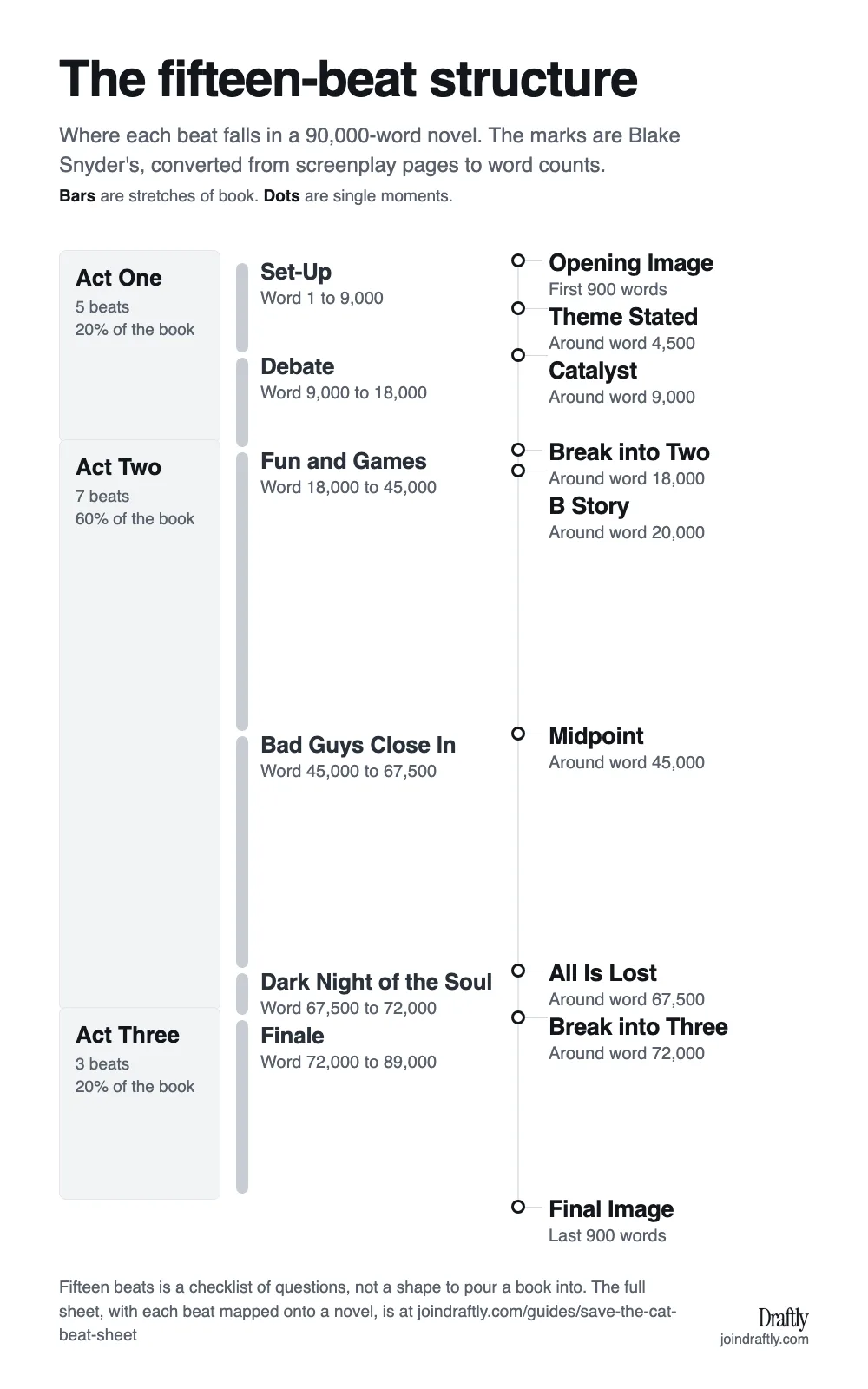
The fifteen beats, and where each one lands in a novel
| Beat | Where it lands | What it has to do | In Pride and Prejudice |
|---|---|---|---|
| Opening Image | First 900 words | Show the world and the person in it before either one changes | The Bennets at Longbourn, five daughters and no money to leave them |
| Theme Stated | Around word 4,500 | Let somebody say the thing the book will spend itself arguing with | The first sentence, on single men and the wives they must be wanting (word 1) |
| Set-Up | Word 1 to 9,000 | Establish what is wrong here and who would like it fixed | Meryton, the assembly ball, and Darcy refusing to dance |
| Catalyst | Around word 9,000 | Deliver the news that makes the old routine impossible | Mrs Bennet's news that Netherfield is let at last (4 percent) |
| Debate | Word 9,000 to 18,000 | Let the character resist, so that choosing costs her something | Whether Bingley will do for Jane, and whether Darcy is bearable |
| Break into Two | Around word 18,000 | Send her into the new world by her own choice | Elizabeth walks three miles to Netherfield through the mud (11 percent) |
| B Story | Around word 20,000 | Start the second line, usually a relationship, that carries the theme | Jane and Bingley, the courtship running ahead of Elizabeth's |
| Fun and Games | Word 18,000 to 45,000 | Deliver what the premise promised, before the bill arrives | Collins, Rosings, the militia, and Wickham being charming |
| Midpoint | Around word 45,000 | Reverse the direction of the book with a win that is not one | Darcy proposes, and Elizabeth refuses him (49 percent) |
| Bad Guys Close In | Word 45,000 to 67,500 | Tighten the pressure from outside and from inside at once | Darcy's letter, the truth about Wickham, Lydia sent to Brighton |
| All Is Lost | Around word 67,500 | Take the thing away, and let her have had a hand in losing it | Lydia elopes with Wickham (70 percent) |
| Dark Night of the Soul | Word 67,500 to 72,000 | Stay in the loss long enough for the reader to feel the floor | Elizabeth believes she has lost Darcy and ruined her sisters |
| Break into Three | Around word 72,000 | Bring the two lines together and hand over the missing piece | A letter reveals that Darcy paid Wickham to marry Lydia (82 percent) |
| Finale | Word 72,000 to 89,000 | Spend the new knowledge and settle the question out loud | Lady Catherine's visit, and the second proposal |
| Final Image | Last 900 words | Show the same world, changed | Pemberley, with the Gardiners welcome in it |
The percentages behind these marks are Snyder's and they come from a 110-page screenplay, so a novel that hits all fifteen to the word will show the joins. Use them to find the beat you are missing. Not to move the beat you have. When you know which one is missing, the novel outline template is where the scene to fill it gets written.
The three acts, and what each one owes you
The fifteen divide five, seven and three. The middle act is half the book. That is why it is the one that collapses, and why the Midpoint is the beat worth checking first: reversing the direction of the plot only works if it also reverses something in the person walking through it, which is [[page:guides/character-arc|the arc]] rather than the structure.
Act One, beats 1 to 5
The first fifth. It owes you a reason to care before it owes you a plot, and it ends on a choice rather than an event. When an opening feels slow the cause is usually a Catalyst that arrives late, or one built as an incident where one line of somebody saying it out loud would have landed harder.
Act Two, beats 6 to 12
Half the book, and where drafts die. Two beats keep it upright. The Midpoint stops the middle being a corridor by turning the direction of travel around, and All Is Lost gives the second half of it somewhere to fall to. A middle that sags is usually a middle with neither.
Act Three, beats 13 to 15
The last fifth, and the shortest. It opens on information, not resolve, which is the part writers skip. Something your character did not know at the end of act two has to arrive here, because without it the finale is only her trying harder than she tried the first time and losing anyway.
Five beats, read close in Pride and Prejudice
Where a beat falls in a novel is argued, not measured, and a reader who knows this book may put Break into Two somewhere else. The positions below are measured. Austen's Midpoint lands at 49 percent of the text and her Break into Three at 82, against Snyder's 50 and 80. Her Catalyst arrives at 4 percent, less than half the prescribed mark. Both halves of that are useful.
1Catalyst: the news that starts everything
Mrs Bennet comes into her husband's study with the only piece of news in the county.
Nothing happens here. A woman asks her husband a question at home, and the plot of the novel is running. Worth noticing if your own catalyst feels thin: Austen does it with a piece of gossip, four percent into Pride and Prejudice, where Snyder's mark is ten. The beat is information, not incident.
Try this. Write down the sentence somebody says that makes your story unavoidable. If you cannot find one, your catalyst is an event, and a line of dialogue might carry it further.
"My dear Mr. Bennet," said his lady to him one day, "have you heard that Netherfield Park is let at last?"
2Break into Two: the crossing, made physical
Jane has fallen ill at Netherfield. There is no carriage to be had. Elizabeth goes on foot.
The beat asks the character to enter the new world by choice, and Austen makes the choosing literal. Three miles of field. She arrives with her petticoat six inches deep in mud, which the Bingley sisters hold against her for the rest of the visit, and that is the beat doing its second job. The new world is not friendly, and the walk is what buys her way into it.
Try this. Find the moment your character could still turn back and does not. If that decision happens in her head, give it a body and a cost.
Elizabeth continued her walk alone, crossing field after field at a quick pace, jumping over stiles
3Midpoint: the win she refuses
Darcy has come to the parsonage at Hunsford to make the last offer Elizabeth expected.
This falls at 49 percent of the text, against Snyder's 50, and it is the strongest evidence on this page that the beat describes something real. It is also a false victory. The proposal is the best thing to happen to Elizabeth's prospects in the whole novel, she turns it down flat, and every page after it is given over to her discovering how wrong she has been about him. Austen reverses the book without altering its plot.
Try this. Look at the halfway mark of your draft. If nothing there changes the direction of the reader's sympathy, that is the beat you are missing.
In vain have I struggled. It will not do. My feelings will not be repressed. You must allow me to tell you how ardently I admire and love you.
4All Is Lost: the disaster she can blame herself for
Lydia has gone off with Wickham. Elizabeth is telling Darcy, and she has known what Wickham is since his letter ten chapters back.
The beat is not bad luck. Because the elopement arrives from outside and indicts Elizabeth's own silence in the same breath, it does the one thing an obstacle cannot, which is to make the loss partly hers. Read what she says. She is not describing her sister at all. She is describing ten chapters of her own quiet, which is where a flaw stops being a word you assigned and starts costing her something.
Try this. Ask what your character could have done and did not. If the answer is nothing, the loss is happening to her rather than through her, and it will read as weather.
"When I consider," she added, in a yet more agitated voice, "that I might have prevented it! I who knew what he was."
5Break into Three: the two stories meet
Mrs Gardiner's letter answers a question Elizabeth had asked about something else, and tells her who paid for her sister's marriage.
This is the beat that resists definition, so here it is working. The romance and the disaster have run apart for two hundred pages, and this sentence welds them: the man Elizabeth misjudged has quietly repaired the thing that ruined her family. It lands at 82 percent against Snyder's 80. Austen delivers the turn of her whole book as an itemised bill.
Try this. Check whether your third act opens on new information or only on new resolve. Resolve on its own is not news, and a reader can feel the difference.
His debts are to be paid, amounting, I believe, to considerably more than a thousand pounds, another thousand in addition to her own settled upon her, and his commission purchased.
The mistake that makes a beat sheet feel like a formula
One beat, filled in twice. All Is Lost, in a novel where a chef loses her restaurant. The first version answers the template. The second asks what she is doing while it happens.
All Is Lost: Marguerite loses the restaurant and hits her lowest point.
She realises everything she built is gone, and questions whether she was ever good enough for it.
The bailiff is early and Marguerite is still wearing her apron.
She asks him to wait while she takes the pass down, because it was her mother's and it is screwed to the wall.
He says he cannot let her remove fixtures. She says her mother put it up by hand in 1998.
They stand in the empty dining room and argue about whether a shelf is a fixture.
She loses that too, and signs where he points, and asks him if he has eaten.
- The beat, answered
- Accurate, and not a scene. It reports the outcome the sheet asked for and then stops, and fifteen of these in a row is where the complaint about formula comes from and why the complaint is fair.
- Two abstractions in one sentence
- Realises and questions both happen inside her, so there is nothing to watch. The sentence also tells you how to feel about it, which the version below leaves entirely alone.
- The same beat, given a room
- The apron carries it. She is still mid-shift when the restaurant stops being hers, and that one detail says more about what she has lost than the word lowest managed in the version above.
- The line the template could not have asked for
- Nothing on the beat sheet says put a shelf in it, or have her offer the bailiff dinner. The sheet asked what she loses. Everything else came out of writing the scene, and that is the part the method cannot do for you.
Is it too formulaic?
The complaint is real and it deserves stating at full strength. Will Storr surveys the structural recipes and grants that they work, then objects that anything you follow like a recipe will keep giving you the same cake. Stephen King goes further. He calls plot the good writer's last resort and the dullard's first choice, and he means the whole apparatus, outlines included.
Some of that lands. The marks are pages of a screenplay, so a novel that obeys them exactly will feel machined. Fifteen beats is also fifteen chances to write the beat instead of the book, which is what the two versions above are about.
What survives the complaint is narrower and more useful. The two beats that hold up under pressure are the two that were already in the Poetics. Aristotle's reversal is a change by which the action veers round to its opposite, which is the Midpoint, and his recognition is a change from ignorance to knowledge, which is Break into Three. He held that the best recognition arrives together with a reversal, which is what the two lines meeting amounts to. John Yorke gets to the same place from Greek and Shakespearean drama: he argues every working story turns on an event near its middle that changes both the story and the person in it past recovery, and his example is Lear on the heath. Austen, who read neither of them, puts hers at 49 percent.
So treat the fifteen as a diagnostic and not a mould. Run them against a draft and they will tell you which questions your book has not answered yet. Run them ahead of the draft and you get a synopsis with fifteen headings. Writers who complain about formula are usually describing the second thing. They are right about it.
The fifteen beats, as a sheet
Blank, with the word marks already on it, so you can fill it in against your own draft rather than copying the table out. Both files are generated from the table above, so they say the same thing it does.
The marks are for a 90,000-word novel. Scale them to your own target before you fill anything in.
A beat sheet filled in, and the same beats read back
A writer sends the three middle beats of her outline. The note is from Danae Marcelline Brooks, a developmental editor inside Draftly.
Drag to compare original and revised text

Questions & Answers
- Is the Save the Cat beat sheet too formulaic?
- Sometimes. It is formulaic when you use it to plan rather than to check, because the marks come from a 110-page screenplay and a novel that obeys all fifteen to the word will read as built to a spec. Turn it around. Run the fifteen against a draft you have already written and they become fifteen questions, and the ones your book has not answered are the useful part.
- Why is it called Save the Cat?
- Blake Snyder argued that a hero needs an early scene that earns the reader's goodwill, and because his example was a character who stops to save a cat, the book took its title from a moment that is not one of the fifteen beats. It belongs inside the Set-Up. A reader hunting for it among the fifteen will not find it there.
- What is the B Story in Save the Cat?
- The second line of the book, usually a relationship. Its job is to carry the theme the main plot is too busy to state, which is why it starts just after Break into Two, around word 20,000 of a 90,000-word novel, and pays off at Break into Three when the two lines finally meet. In Pride and Prejudice it is Jane and Bingley.
- Does the Save the Cat beat sheet work for novels?
- Yes, once the marks are converted. Snyder wrote them as screenplay pages, and the table above gives the same positions as word counts in a 90,000-word novel instead. If you want a book-length treatment rather than a sheet, Jessica Brody wrote the licensed novel version of the method under the title Save the Cat Writes a Novel.
- What is the difference between a beat sheet and an outline?
- A beat sheet is fifteen questions about the shape of a story. An outline is the list of scenes that answers them. The sheet can tell you that a reversal belongs near the halfway mark, but it cannot tell you the reversal is a proposal in a parsonage, and working out that it is a proposal in a parsonage is what you do in the novel outline template.
- Who created the Save the Cat method?
- Blake Snyder, in a 2005 book for screenwriters called Save the Cat! The Last Book on Screenwriting You'll Ever Need. Save the Cat is a trademark of Blake Snyder Enterprises, which runs savethecat.com. This page describes the method and has no affiliation with them.
Turn fifteen beats into scenes
A beat sheet stops at what has to be true by then. The novel outline template is where you write what actually happens, scene by scene, with the beats as the spine.
Open the novel outline templateOne place for the whole book.
Open a chapter and everything it needs is already beside it: the cast, the places, the rules you invented, the note you left yourself last November. Nothing to hunt for, nothing to keep in sync by hand — and with the friction gone, the days you write start adding up.