How to write dialogue
Good news first. The punctuation is a short list, it has not changed in a century, and you can have it down by the end of this page. Get the marks wrong and an agent stops reading before your first scene. Get them right and nothing else about your dialogue is fixed yet. The hard part is not punctuation at all. It is working out what your characters refuse to say out loud, and no table will hand you that.
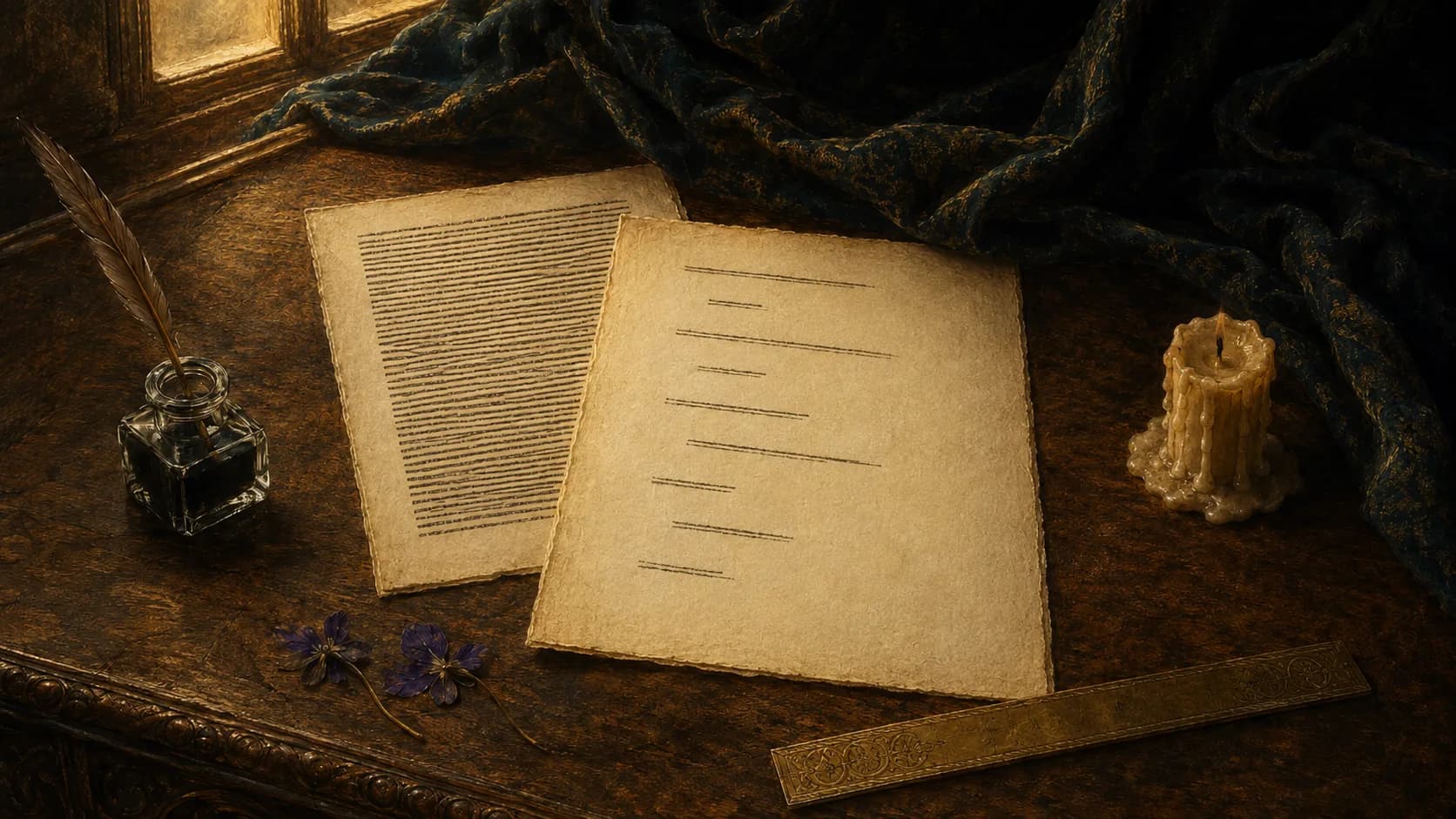
What dialogue looks like on the page
Here is a scene set the way a manuscript sets it. Read it once for the argument between them, then read it again for the shape on the page. Two of the notes are about what the lines are doing. Two are about the marks, and those two you can learn today and stop thinking about.
"You told her, then," Marta said.
Owen set the cup down. "She asked me directly."
"That isn't an answer."
"It's the only one I have."
"Then say the other thing." She waited. "Say the thing you have been not saying since June."
"I'd rather --"
"I know what you'd rather."
- A comma doing a full stop's job
- Marta's line is a finished sentence. It ends in a comma anyway, because the tag finishes it instead, and cutting the tag turns that comma back into a full stop, and either way the mark stays inside the quotes.
- One speaker, one paragraph
- Owen's line starts a new paragraph. His name appears nowhere in it, and that break is your only signal that somebody new is speaking.
- What he does instead of answering
- Owen reaches for the cup because he does not want to answer, and the gesture tells you that before his line does. Mechanically it is simple: the action sits in his own paragraph, which is what attaches it to him, and it does a tag's work without a word about how he spoke.
- The line she will not let him finish
- Marta cuts him off, and what he was about to say stays unsaid, which is doing more than the finished sentence would. Two hyphens mark the cut. Look down the left edge too, where each paragraph after the first is indented and no blank line sits between speakers, and the full spec is on the manuscript format page.
Five exchanges, and what each one is doing
These come from real books, not from a writer inventing an example for the occasion, and each one shows a different way to get two people talking without ever saying the thing.
1The answer that isn't one
A character refuses to answer, and the refusal tells you about both of them. The information still arrives. It arrives with the marriage attached.
Mrs Bennet asks a direct question and gets a sentence about herself. Austen tells you three things in one line. He has heard this before, he will let her have it anyway, and letting her have it while refusing to ask a single question of his own is the whole shape of his resistance. Rewrite him as a man who answers and you keep the plot and lose the marriage. Look two lines earlier as well, where Austen lets him make no answer at all. Silence counts as a line of dialogue whenever the writer has built enough pressure into the room for you to hear it land.
Try this. Find a question in your draft that gets answered. Swap the answer for a sentence about the person who asked. See whether the scene loses anything.
"Do not you want to know who has taken it?" cried his wife, impatiently."You want to tell me, and I have no objection to hearing it."
2The subject neither will name
Two people circle a thing neither will say. The words on the page are about an earlier remark, and the pressure comes from the gap between the remark and what it stands for.
Not one of these lines carries a tag, and none of them needs one. The two voices want opposite things, which is the only reason taking turns is enough to tell them apart, and Hemingway runs long stretches of the story with nothing else holding it up. Later he calls it a simple operation, and then he says it is not an operation at all. That is a man talking himself into something in front of the person it will happen to. Here he only agrees that she was bright. Watch what she does with the word when it comes back.
Try this. Take a scene where your characters discuss the real problem. Give them something else to talk about. Let your reader hear the first thing underneath the second.
"Well, let's try and have a fine time.""All right. I was trying. I said the mountains looked like white elephants. Wasn't that bright?""That was bright."
3Two voices you cannot confuse
Two speakers set so far apart that neither line needs a tag, and an honest problem with the method that did it.
Neither line is tagged, and you cannot mistake who is speaking. What separates them on the page is spelling. That is the uncomfortable half of the example. Twain writes Jim phonetically. It slows you down and it has aged badly. Most editors will now tell you to carry a character's background in word order and word choice instead. Twain survives it because Huck narrates in his own dialect too. Huck is written down as closely as Jim is. Read past the spelling and the real difference is what each man accepts as settled. Huck takes the widow's word. Jim goes straight at Solomon.
Try this. Cover the tags on a page of your own dialogue and hand it to someone else. If they cannot tell who is speaking, the difference was in your tags and not in your characters.
"Does you know 'bout dat chile dat he 'uz gwyne to chop in two?""Yes, the widow told me all about it.""Well, den! Warn' dat de beatenes' notion in de worl'?"
4The confession inside the small talk
A conversation whose real content is one admission, buried mid-sentence, in a voice that lets the speaker miss what she has given away.
Two letters carry the scene. Wharton gives Archer one syllable and then tells you his heart stopped, and the gap between the sound he makes and what is happening inside him is the whole marriage. May keeps working while he reels. She hurries, she blushes, and she buries the name in the middle of a long sentence about how dear Ellen had been to her, which is where a person puts the word they most want you to walk past. A few lines on, she admits she went to Ellen with news she did not have yet.
Try this. Take your character's most important line and cut it to one syllable. Move what they cannot say into the narration round it. Read the scene again.
"Only Mamma and your mother." She paused, and then added hurriedly, the blood flushing up to her forehead: "That is--and Ellen. You know I told you we'd had a long talk one afternoon--and how dear she was to me.""Ah--" said Archer, his heart stopping.He felt that his wife was watching him intently. "Did you mind my telling her first, Newland?"
5The conversation that cannot hold
Three people who cannot hold a subject for four lines. The exchange agrees to something and never quite arrives at it, which is what a great deal of real conversation does on any given evening and what almost no written dialogue is willing to admit about itself.
Miss Baker proposes a plan and does not name one. Daisy agrees to it, asks what it is, then asks the narrator what people plan at all. That is three sentences of enthusiasm with nothing inside them. Fitzgerald then drops the subject for her own finger one line later, so the character of the whole room reaches you through a conversation failing to happen rather than through a word of description. The yawn carries what an adverb would have ruined. A verb this specific earns its place, because it reports a body rather than a mood.
Try this. Write an exchange where your characters agree on something. Give them four lines to name it. If they cannot manage it, ask what they are avoiding.
"We ought to plan something," yawned Miss Baker, sitting down at the table as if she were getting into bed."All right," said Daisy. "What'll we plan?" She turned to me helplessly: "What do people plan?"Before I could answer her eyes fastened with an awed expression on her little finger.
Three passes over a scene you have already drafted
Dialogue is easier to repair than to write. The order matters. Your first pass changes lines the other two would have caught.
Read it aloud, flat
No performance, no emphasis, no doing the voices. What survives a monotone is what the words carry on their own. Anything that needed your acting needs a rewrite.
Ask what each one wants
Write it in the margin for both speakers, four words each. If they want the same thing, or if one wants nothing, the scene has no engine, and better lines will not start it.
Cut the throwaways
You see, anyway, well, I mean, sort of. Delete them all. Then put back only the ones a particular character says out of habit. Those are characterisation. The rest was transcription.
The same scene with an editor on it
Drag the handle across. On the left is a draft where both characters say how they feel. On the right is the rewrite. Elena is one of Draftly's line editors, and she reads for how your pages sound when you say them out loud.
Drag to compare original and revised text

You wrote both drafts. Elena found the apology and the adverbs and told you what they were costing you, which is the same note she keeps giving across a whole manuscript until you stop needing to hear it. Her own list of what she does not want to read opens with apology language that undercuts authority.
How to punctuate dialogue, in eight cases
Most of these are settled. Two are regional. British houses often set single marks, and they put a comma outside the closing mark when it belongs to the sentence rather than the speech. The table below follows American practice, which is what a US agent expects to see.
| The case | Wrong | Right | Why |
|---|---|---|---|
| Speech, then narration | "I'm leaving" She reached for her coat. | "I'm leaving." She reached for her coat. | The speech is its own sentence and takes its own full stop, inside the marks. |
| Speech, then a tag | "Sit down." He said. | "Sit down," he said. | The tag completes the sentence, so the speech ends in a comma and the tag stays lowercase. |
| A question with a tag | "Are you coming," she asked. | "Are you coming?" she asked. | The question mark replaces the comma. The tag after it is still lowercase. |
| A second speaker | "Where were you?" "Out." | Each line in a paragraph of its own. | A paragraph break is your only signal. Shared, both lines read as one voice. |
| An action used as a tag | "Not tonight," she poured the wine. | "Not tonight." She poured the wine. | Pouring wine is not a way of speaking, so it cannot take the speech comma. |
| Cut off by someone else | "But I thought we agreed ..." | "But I thought we agreed --" | Two hyphens for a line somebody stops. Manuscripts type hyphens and a typesetter sets the dash. |
| Running out of words | "I suppose, if you think it over --" | "I suppose, if you think ..." | Three dots for a speaker who fades rather than one who is interrupted. |
| One speaker, two paragraphs | Closing marks at the end of the first paragraph. | No closing marks until the speech ends. | An opening mark on the second paragraph, and none closing the first, tells you the same person is still talking. |
Cormac McCarthy breaks the first rule. He sets dialogue with no quotation marks at all. It works because he pays for it. The tags go too. Most scenes hold two speakers, and no line runs long enough to lose track of who is talking. Read McCarthy before you borrow it, because the rule he removed was doing a job and he pays for it elsewhere.
Questions & Answers
- How do you punctuate dialogue?
- Put the speech in quotation marks. End it with a comma when a tag follows, and with a full stop when none does. Keep that mark inside the quotes. A question mark or an exclamation mark replaces the comma, and the tag after it still starts lowercase. Each new speaker starts a new paragraph, indented, with no blank line between them.
- Do you start a new paragraph after dialogue?
- Start a new paragraph when the speaker changes. Narration that belongs to the speaker stays in their paragraph. Narration that moves to somebody else starts a new one. You lean on that break to track who is talking, and that is why the rule holds.
- Do you indent dialogue?
- Yes. A line of dialogue is a paragraph like any other, so it takes the same first-line indent, and no extra blank line goes between speakers. Draftly's manuscript format template carries the depth agents expect, along with the rest of the submission spec.
- What is a dialogue tag?
- A dialogue tag is the short attribution after a line of speech, as in she said or he asked. Its job is to name the speaker and vanish, and that is why said beats a more colourful verb. An adverb after the tag usually means the line below is not carrying what you wanted, so the work belongs in the line.
- How do you write dialogue between two characters?
- Give each of them something different to want. Then let them chase it instead of answering each other. Two characters who cooperate produce information, and two at cross purposes produce a scene. Once they are taking turns you can drop most of the tags.
- What are the five rules of writing dialogue?
- There is no agreed set of five. Style guides list anywhere from four rules to a dozen, and the count sorts the same material rather than describing it. Treat the eight cases in the table above as what publishers enforce. The craft on the rest of this page is where the real argument sits.
Read these five writers at length
Each exchange above comes from a book with a page of its own, working through how that writer builds the rest of it. 253 more authors get the same reading.
Browse the authorsUn posto solo per tutto il libro.
Apri un capitolo e tutto quello che gli serve è già accanto: il cast, i luoghi, le regole che hai inventato, la nota che ti sei lasciato a novembre. Niente da cercare, niente da sincronizzare a mano — e senza quell'attrito, i giorni in cui scrivi cominciano a sommarsi.