The best book writing software in 2026
Most software sold for writing a book is a word processor with a folder tree attached. It will hold the chapters. It will not hold the cast, the places, the order things happened in, or hand you a file a retailer will take. That is the line these nine tools fall either side of, and it is worth knowing which side before you spend a year inside one.
The short answer
For a novel with a cast to keep track of, Draftly keeps the chapters, a Codex of characters and places, boards, timelines and an editorial read of the full draft behind one login, in any browser. Scrivener still has the deepest export engine if you write on one machine. Atticus is the tool to reach for once the writing is finished, and Dabble if you would rather buy a browser tool outright.
- Writing a novel and tired of keeping the cast in a second file: Draftly, or Novelcrafter if you already hold an AI key.
- Wanting all that in a browser without a monthly bill: Dabble's Lifetime Author Access at $699. We have no equivalent.
- Writing on one computer and happy to own the software outright: Scrivener at $59.99 per platform.
- The manuscript is done and the next job is a paperback interior: Atticus at $147.
- Spending nothing: Reedsy Studio, bibisco's Community edition, or Draftly's free tier.
Nine worth a look
Ours is first because it is ours. After that, roughly by how much of the book each tool holds, with the two word processors last because they hold the least of it. Every entry says where the tool falls short as well as what it does.
1. Draftly
- Best for
- A writer who wants the manuscript, the cast and the notes behind one login
- Price
- Free to start. Starter $10, Pro $20, Studio $50 a month, or the same amounts bought once as a credit pack.
- Runs on
- Browser, Mac and Windows
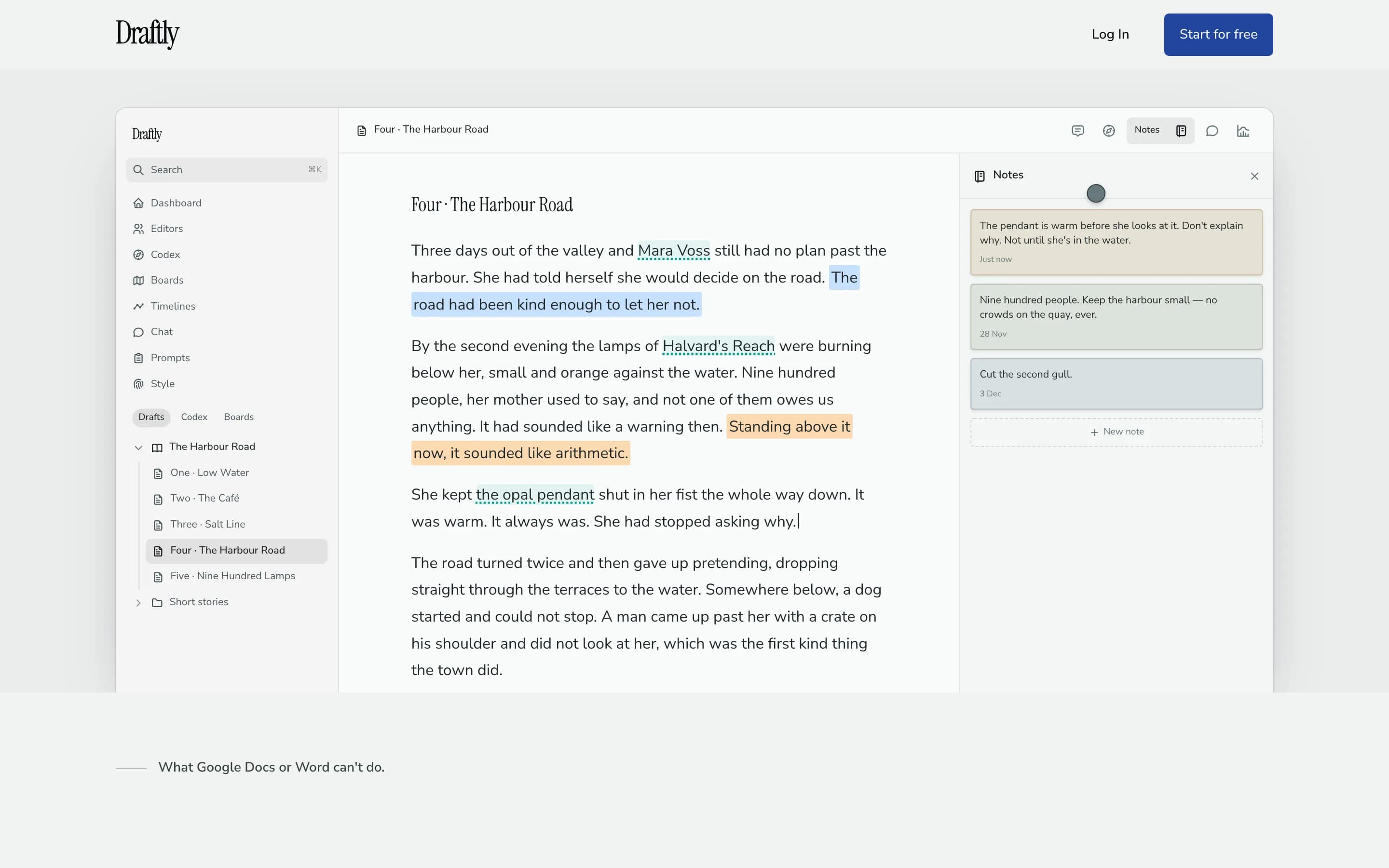
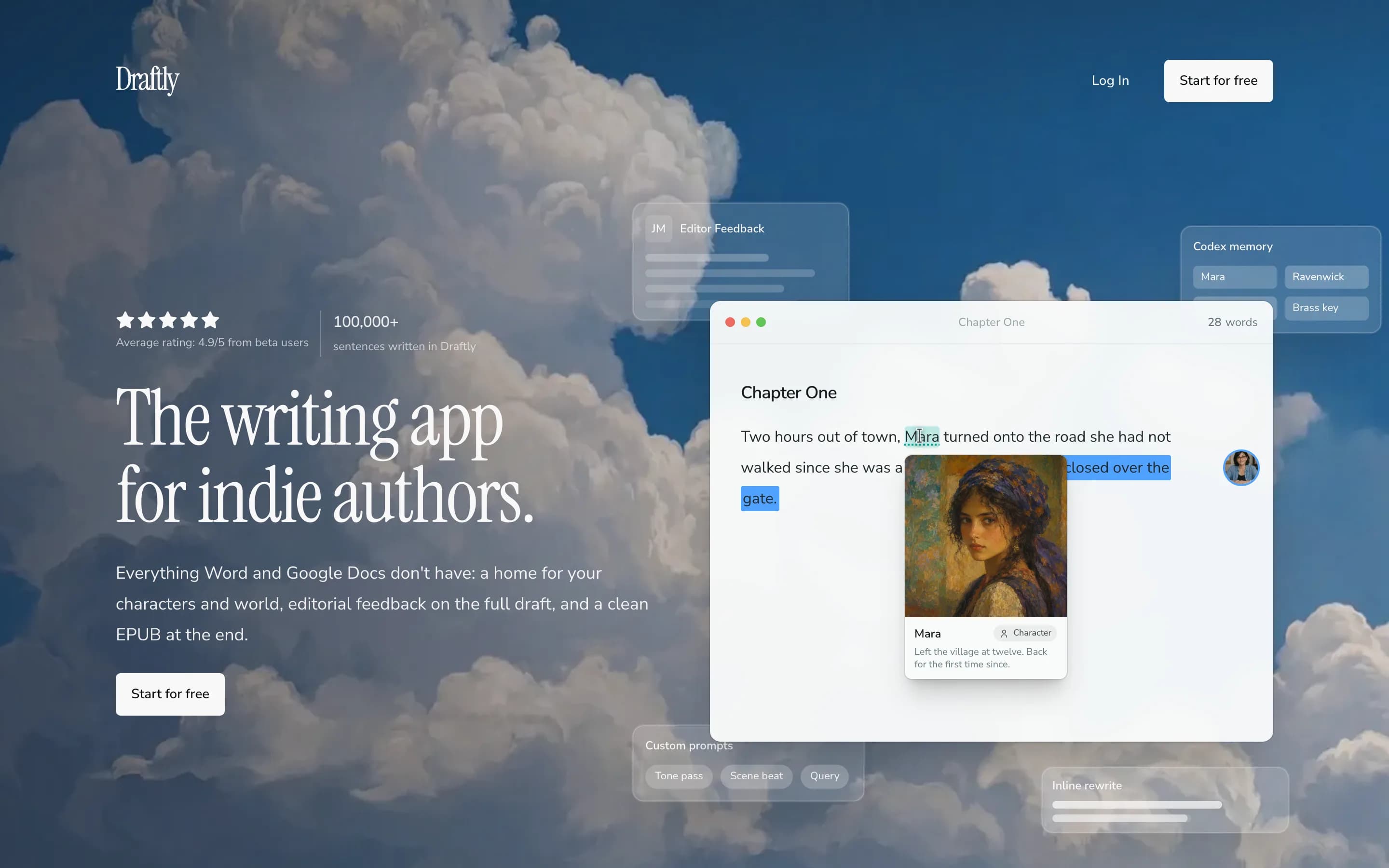
A Codex holds one entry per character, place and object, and that entry opens against the chapter where the name appears, so a detail invented in book one is on screen when book three contradicts it. Boards draw the relationships between those entries: who knows whom, who wants what. Timelines put the order events happened in next to the order the book tells them. When a draft is ready to be read, AI editors go through the whole manuscript and leave notes in the margin, against the paragraph that prompted them.
Imports take .docx, .odt, .rtf, .pdf and Markdown, plus a whole Scrivener project as a .scriv file, and pull straight from Google Drive, OneDrive, Notion, Dropbox and reMarkable. Exports reach EPUB for retailers, Word for an editor, a print-ready PDF in a book or manuscript layout, and Markdown, RTF, ODT and plain text. The free tier takes no card and has no time limit: the editor, the Codex, imports and exports, with 200 welcome credits to try a read. Boards, timelines, version history, prose analysis and custom editors sit on the paid plans.
What it does well
- Opens a Scrivener .scriv project directly, so moving over is an upload
- Codex, boards and timelines hold the book rather than only the text
- AI editors read the full manuscript and answer in minutes
- Free tier with no card covers the editor, Codex, imports and exports
- EPUB, Word and a print-ready PDF come out of the same draft
Where it falls short
- No Final Draft or Pandoc export
- No mobile app (yet)
- Margin comments and version history instead of .docx track changes
2. Scrivener
- Best for
- One computer, one licence, and no wish to rent anything
- Price
- $59.99 for one platform, bought once. iOS is US$23.99 and is a separate purchase. No subscription.
- Runs on
- macOS, Windows and iOS, licensed separately
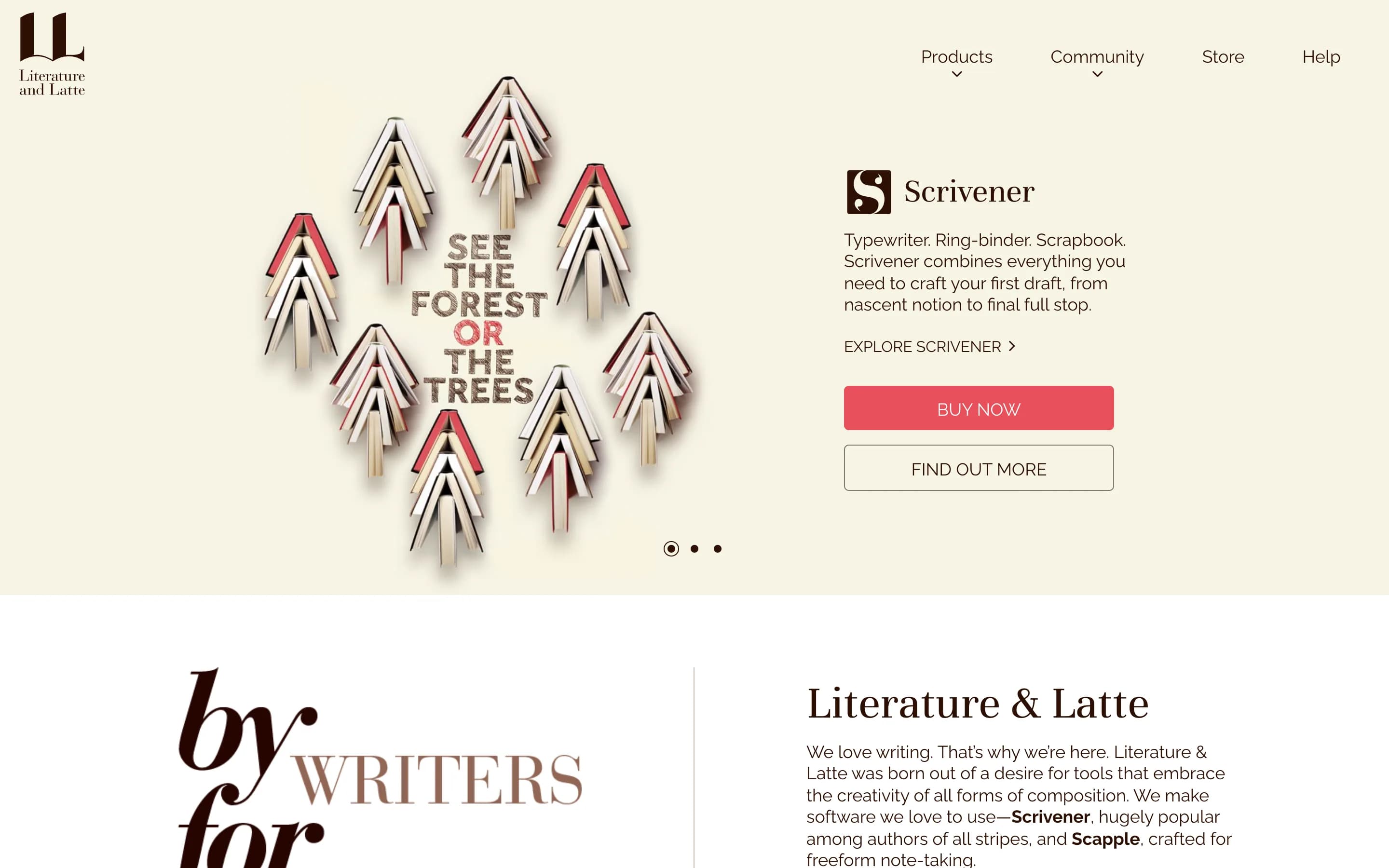
Twenty years of development sit behind the Binder, the corkboard and Compile, and no browser tool on this page matches what Compile does on the way out. It writes Word, RTF and OpenOffice files, PDFs, EPUB ebooks, Final Draft screenplays with the script notes intact, and MultiMarkdown for a LaTeX pipeline. The research folder takes anything you point at it, including PDFs, images, web pages and audio, and keeps all of it inside the project beside the draft.
The licence is where writers hit the wall. Literature and Latte state it plainly: each licence covers one platform, so a macOS licence will not unlock the Windows version, and iOS is bought on its own. There is no browser version, which rules out a Chromebook, an Android tablet and any machine you do not administer. Moving a project between a Mac and an iPad runs through Dropbox, set up and maintained by you. One thing the trial gets right is the counting: 30 days of use rather than 30 calendar days, so writing every other day makes it last sixty.
What it does well
- Compile writes Word, RTF, PDF, EPUB, Final Draft and MultiMarkdown
- Research folder keeps PDFs, images and audio inside the project
- One payment, with no subscription and nothing to renew
- The trial counts 30 days of use, not 30 calendar days
Where it falls short
- Each licence covers one platform, and iOS is bought separately
- No browser version, so a Chromebook cannot open the project at all
- Syncing to an iPad runs through Dropbox and is yours to maintain
3. Atticus
- Best for
- The manuscript is finished and the next problem is a print interior
- Price
- $147 once, with future updates included and a 30-day money-back guarantee.
- Runs on
- Browser, plus Windows, Mac, Linux and Chromebook
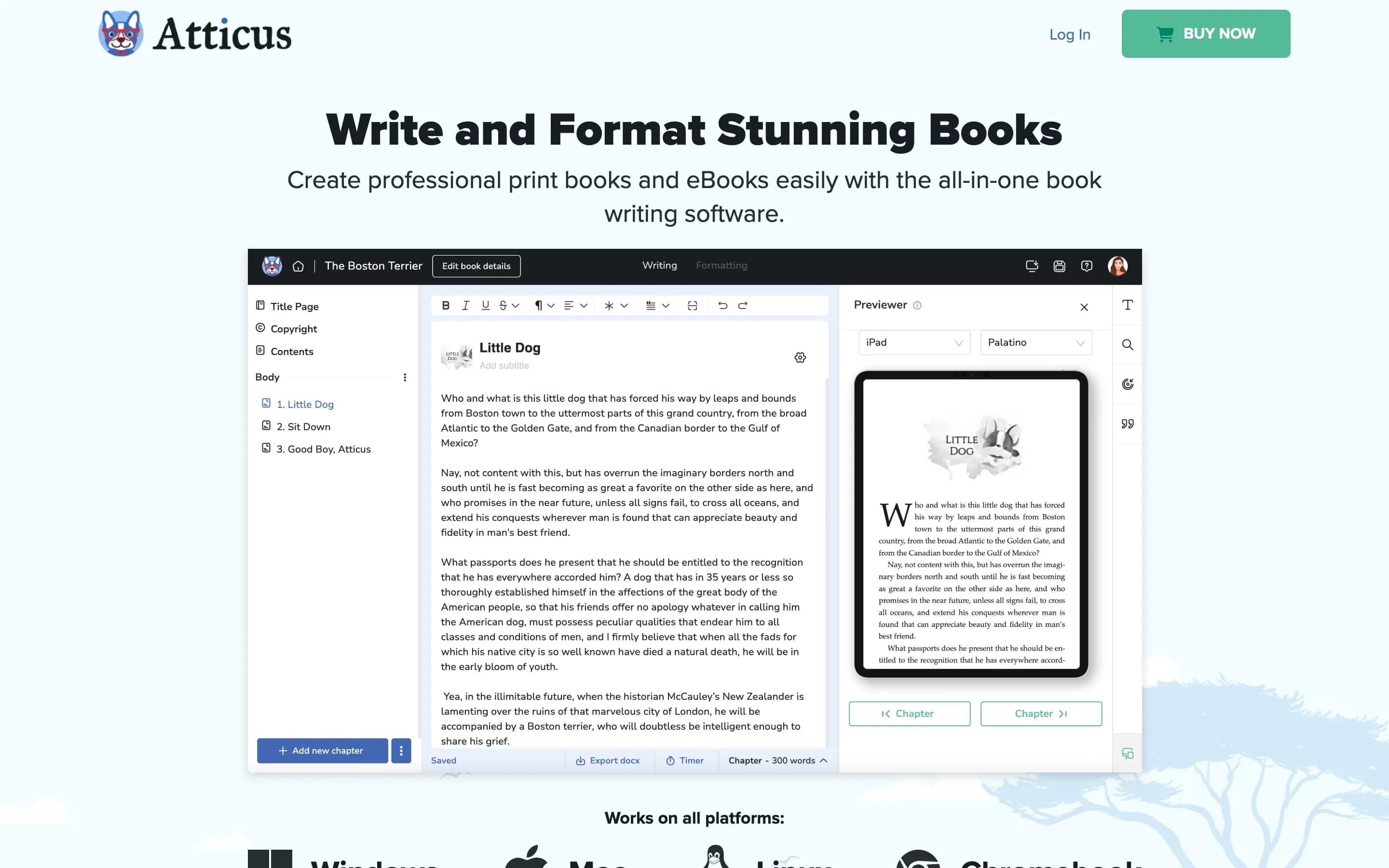
Atticus takes a finished manuscript and turns it into files a shop will accept. Seventeen templates combine into more than a thousand interiors, a theme builder covers anything they do not, and a previewer puts the result on a Kindle, an iPhone, an iPad and a Galaxy before you commit to it. One file produces EPUB, PDF and DOCX. It runs as a progressive web app in the browser and installs on Windows, Mac, Linux and Chromebook, and $147 buys it outright with future updates included.
The writing half is deliberately thin. Atticus's own pages list a word counter, a goal and habit tracker and drag-and-drop chapter reordering, and they describe no character database, no world bible and no plotting view. That is a design decision rather than an oversight, and it decides where the tool sits in a year of work: the drafting months happen somewhere else and Atticus picks the book up at the end. If you are choosing between paying once and paying monthly, this and Scrivener are the two that let you pay once.
What it does well
- Seventeen interior templates plus a custom theme builder
- Previewer shows the page on Kindle, iPhone, iPad and Galaxy
- One file produces EPUB, PDF and DOCX
- One payment of $147, with future updates included
- Runs in a browser and installs on Windows, Mac, Linux and Chromebook
Where it falls short
- Atticus's pages describe no character database and no plotting view
- Built for the finished manuscript rather than the drafting months
- A 30-day refund instead of a free tier or a trial
4. Dabble
- Best for
- Someone who liked how Scrivener organised a book and wanted it in a browser
- Price
- Writer $19, Author $29, Bestseller $49 a month. Lifetime Author Access $699. 14-day trial, no card.
- Runs on
- Any browser, plus Windows, Mac and Linux
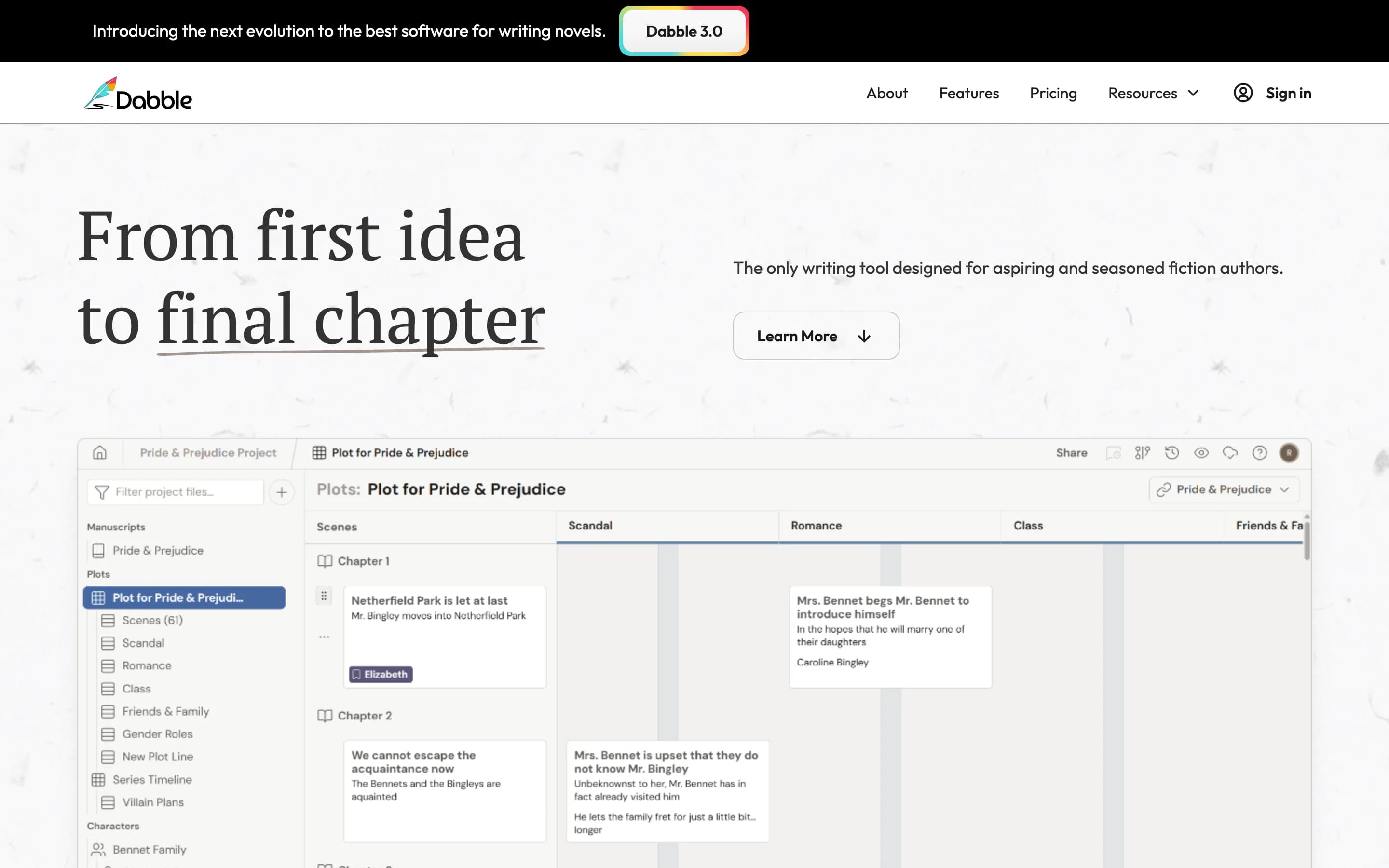
Dabble rebuilds the organising half of Scrivener for the browser. The $19 Writer plan carries unlimited manuscripts, cloud backup and sync across devices, the Plot Grid where the corkboard was, a story notebook, character profiles, goals and stats, focus mode and spell check. Version history sits on that same entry tier, along with co-authoring and shared access for a writing group, so a second writer can be in the document with you for $19.
The revision tools sit a tier up. Comments, track changes, sticky notes, text highlighting, read-to-me, advanced grammar and style checks and beta-reader support all need the $29 Author plan, so a writer who wants a second pair of eyes marking up the draft starts at $29 rather than $19. Export is the thing to check before you commit: their features page names Word and a text file, so turning a finished manuscript into an ebook happens somewhere else. There is no free plan either, only fourteen days, though the trial takes no card. Against the monthly tools here, the $699 Lifetime Author Access is the alternative on offer: about three years of the Writer plan, bought once.
What it does well
- Plot Grid, character profiles and a story notebook in the browser
- Cloud backup and sync across devices on the entry plan
- Co-authoring and writing group sharing from $19
- Lifetime Author Access at $699 instead of a monthly bill
Where it falls short
- No free plan, only a fourteen-day trial
- Comments, track changes and beta-reader support need the $29 tier
- The $19 entry price is the highest starting figure on this page
5. Ulysses
- Best for
- A writer on Apple hardware who wants the interface out of the way
- Price
- $5.99 a month or $39.99 a year. Reduced pricing for students. Subscription only.
- Runs on
- Mac, iPad and iPhone
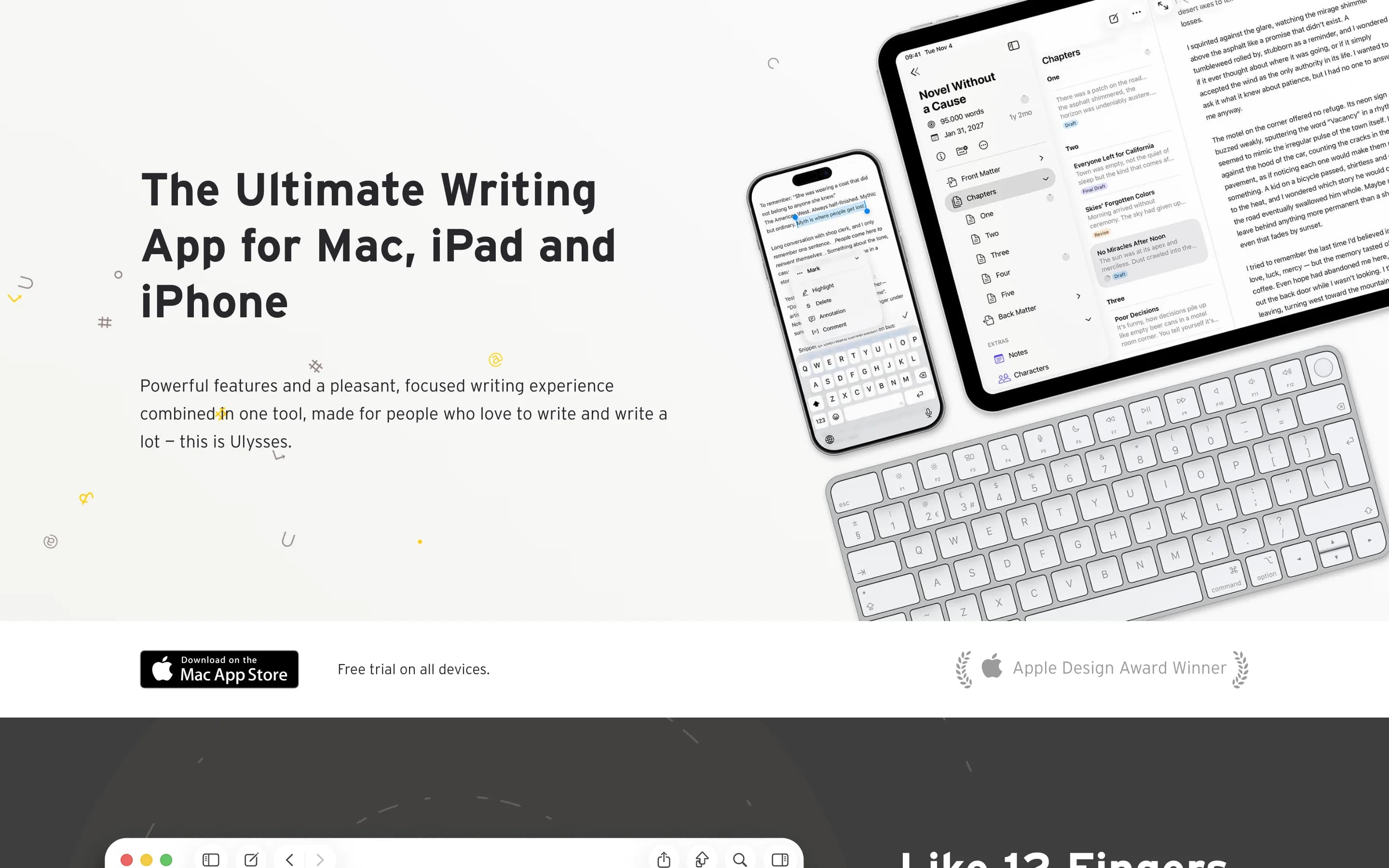
Ulysses answers the complaint about too many panels by removing them. One markup surface, a library holding every draft, and sync across Macs, iPads and iPhones that arrives switched on. Around it sits a grammar and style check across more than twenty languages, character-count goals and deadlines, a live preview of how an export will look, and publishing straight to WordPress, Ghost, Medium and Micro.blog. Students pay a reduced rate.
The trade is the entire organising layer. Ulysses's own pages sell a writing environment and a library, and a plot grid, a character database and anywhere to keep world notes are absent from them. The hardware limit is sharper still: Macs, iPads and iPhones only, which is the same wall that sends writers looking for something else in the first place. Payment is a subscription, and the pricing page offers no one-off purchase.
What it does well
- One writing surface with the panels removed
- Sync across Mac, iPad and iPhone is included
- $39.99 a year, with reduced pricing for students
Where it falls short
- Apple hardware only: no Windows, no Android, no browser
- Subscription with no one-off purchase offered
- The pricing page describes no plot grid or character database
6. Novelcrafter
- Best for
- You already hold an API key and would rather keep that bill separate
- Price
- Scribe $4, Hobbyist $8, Artisan $14, Specialist $20 a month. 21-day trial, no card.
- Runs on
- Any browser
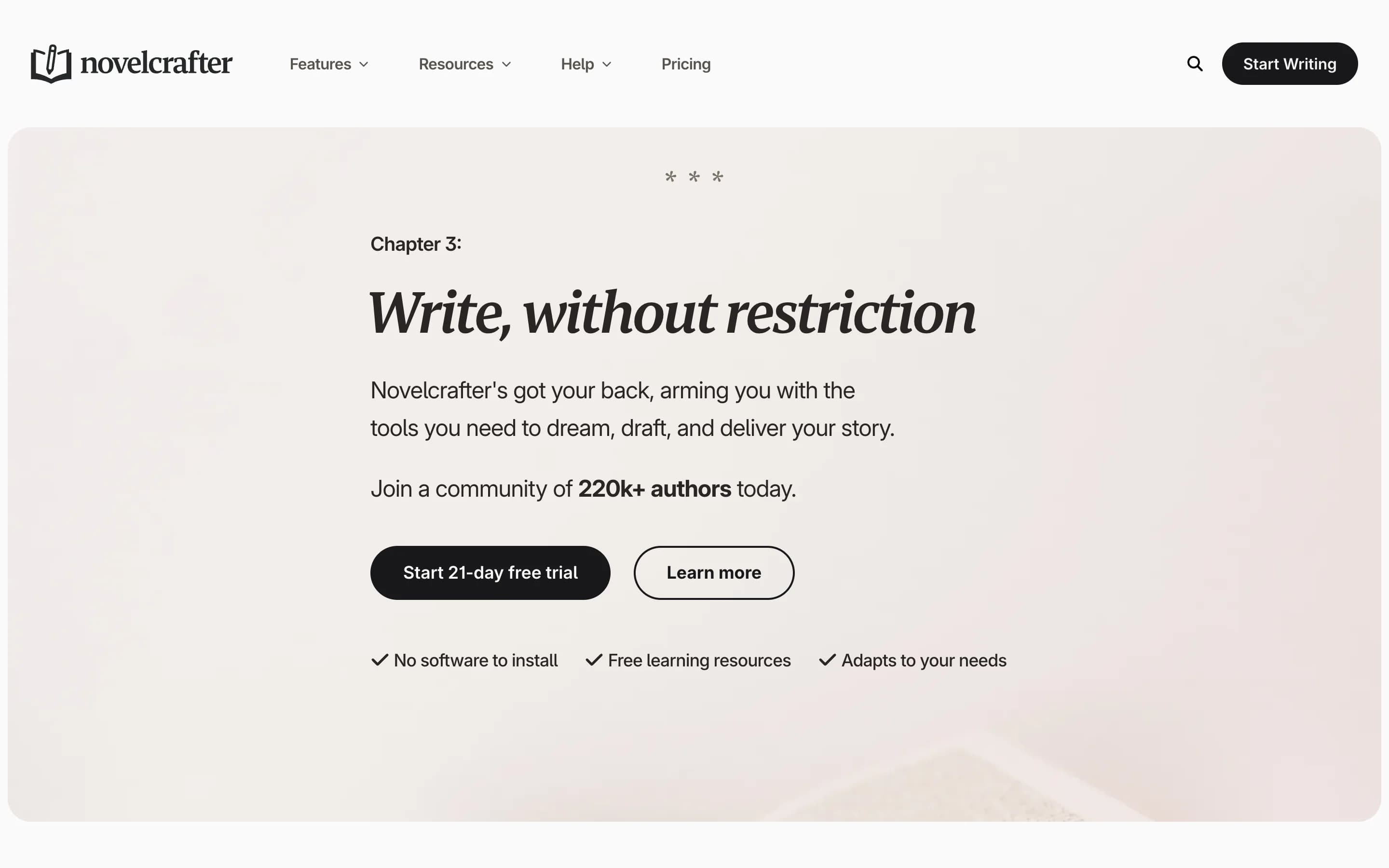
Novelcrafter puts a story bible at the centre of the app. Its codex holds characters, locations and lore and links them into the prose, and a series shares one codex across every book in it. Planning views lay the same material out as a grid of scene cards, which is where a hole in the plot tends to become visible. Unlimited books and series are on every tier, and the twenty-one day trial takes no card.
The AI is the part to read carefully, because you supply it. Bring your own key starts at the $8 Hobbyist plan, so the $4 Scribe tier has no AI integration at all. Above it, every token you spend is billed by the model provider rather than by Novelcrafter, which means the figure on the pricing page is not the cost of the month. For a writer already holding a key that works out cheaper than a bundled allowance. For a writer without one it is a second account to open before anything happens.
What it does well
- Codex links characters, locations and lore into the prose
- One codex shared across a whole series
- Twenty-one day trial with no card
- Unlimited books and series on every tier
Where it falls short
- The $4 Scribe tier includes no AI integration
- AI runs on a key you supply, billed by the model provider
- The subscription figure is not what the month costs
7. Sudowrite
- Best for
- Stuck at a blank page and wanting something to push against
- Price
- Hobby and Student $10, Professional $22, Max $44 a month. No card to start.
- Runs on
- Any browser
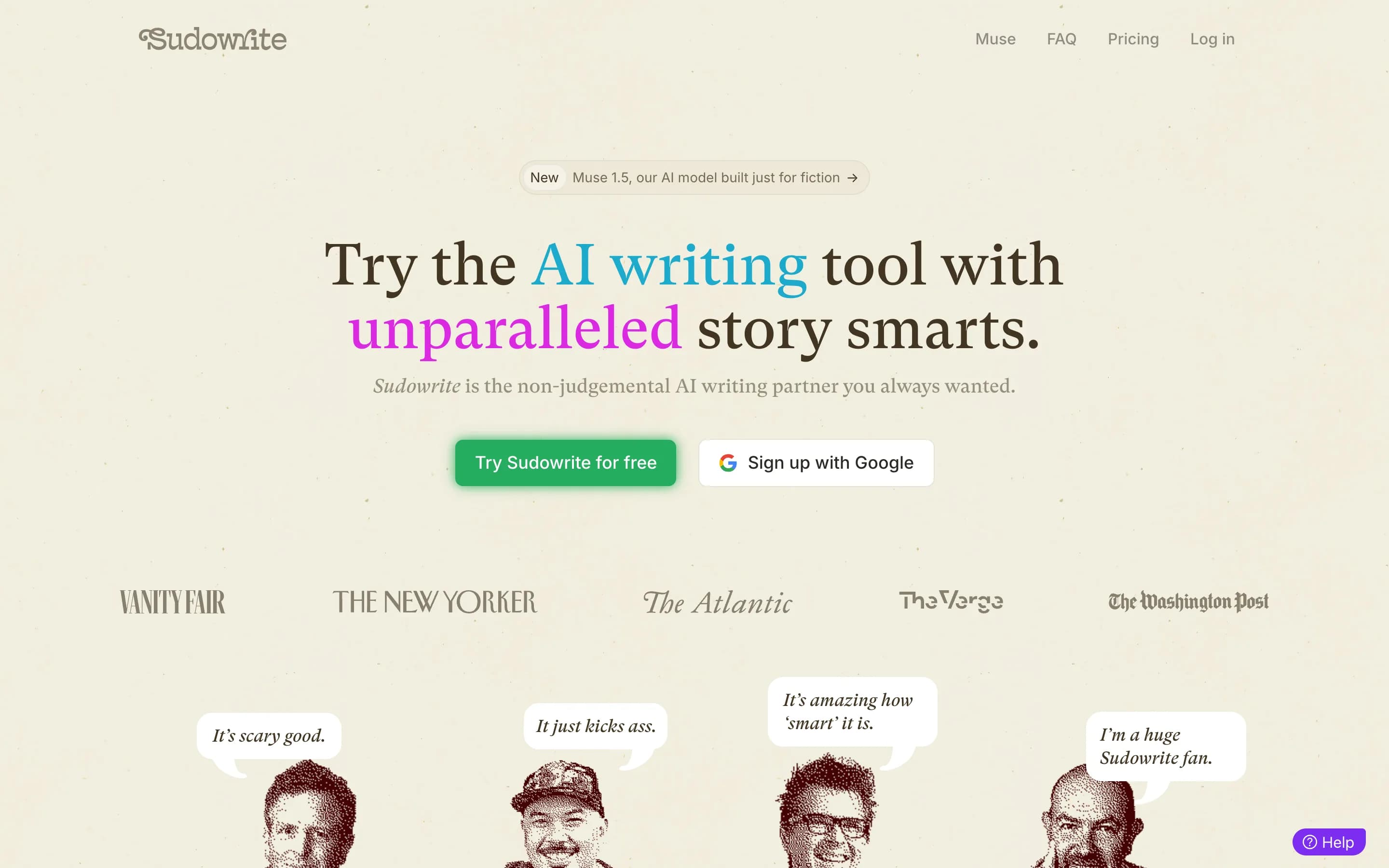
Sudowrite produces prose, and it is well equipped for that job. Hobby and Student is $10 a month for 225,000 credits, Professional $22 for 450,000, and Max $44 for two million, with rollover of unused credits for twelve months on the Max plan. Every tier starts without a card. A story bible runs from idea to outline to chapter beats, and the writing tools work at the line: continue a passage, describe a room, slow down a rushed section, offer alternatives a sentence at a time.
Credits are the unit of everything here, which makes a month hard to budget for. The pricing page states an allowance in tokens and nothing on it converts that into chapters. The wider gap is that there is nowhere for the book to live. Drafts and chapters sit inside a project, and Sudowrite's own pages take the organising no further than that: no board of who knows whom, and no timeline to check the order against. Its Story Bible is built to feed the generator rather than to be the place you keep a world.
What it does well
- 225,000 credits a month at $10, two million at $44
- Unused credits roll over for twelve months on the Max plan
- Story bible runs from idea to outline to chapter beats
- Every tier starts without a card
Where it falls short
- A credit allowance is hard to translate into chapters written
- No board or timeline, and the Story Bible feeds the generator
- Rollover of unused credits is on the $44 plan only
8. Microsoft Word
- Best for
- A manuscript that has to reach an editor or an agent in the format they expect
- Price
- Free in a browser with a Microsoft account. Microsoft 365 Personal $9.99 a month or $99.99 a year, Family $12.99 or $129.99. Office Home 2024 is $179.99 once.
- Runs on
- Windows, Mac and any browser
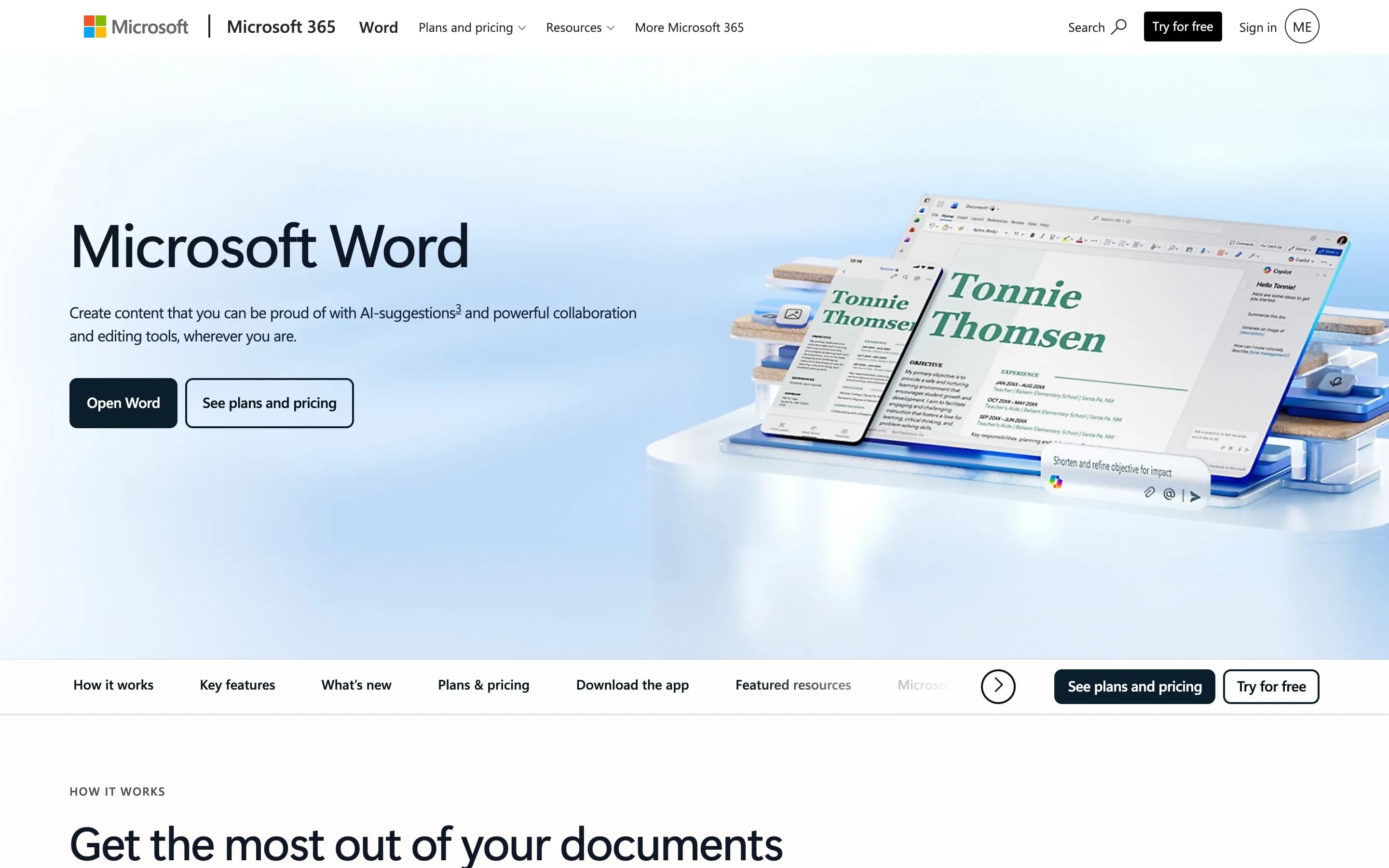
Word is where a manuscript ends up whether or not it started there. Editors and agents ask for a .docx, track changes is the revision language publishing already speaks, and anyone you send a chapter to can open it. Microsoft 365 for the web gives you Word free with a Microsoft account, covering writing, reading and real-time collaboration in a browser. The desktop apps come with Microsoft 365 Personal at $9.99 a month or $99.99 a year, Family at $12.99 or $129.99 for up to six people, and Office Home 2024 is a $179.99 one-off for a single PC or Mac.
Microsoft sells Word as a word processor for documents. Their pages describe no chapter structure beyond the navigation pane, nowhere to keep a character or a place, no record of when an event happened in the story, and no read of a finished draft. Writers who work in it end up running the book as a folder of chapter files, with the navigation pane standing in for the structure. Reviewers on this page's competitors also raise how a very long single document behaves, though Microsoft publishes no figure for it. That gap is the reason Draftly exists, and we are saying so in the entry about the tool we were built against.
What it does well
- Free in a browser with a Microsoft account
- Produces the .docx that agents and editors ask for
- Track changes is the revision workflow publishing already uses
- Office Home 2024 is a $179.99 one-off if you would rather not subscribe
Where it falls short
- Microsoft's pages describe no chapter structure beyond the navigation pane
- Nowhere to keep a character, a place or a date
- A book ends up run as a folder of chapter files with no view of the whole
9. Google Docs
- Best for
- A draft that two or three people need to read and mark up at once
- Price
- Free with a Google account.
- Runs on
- Any browser
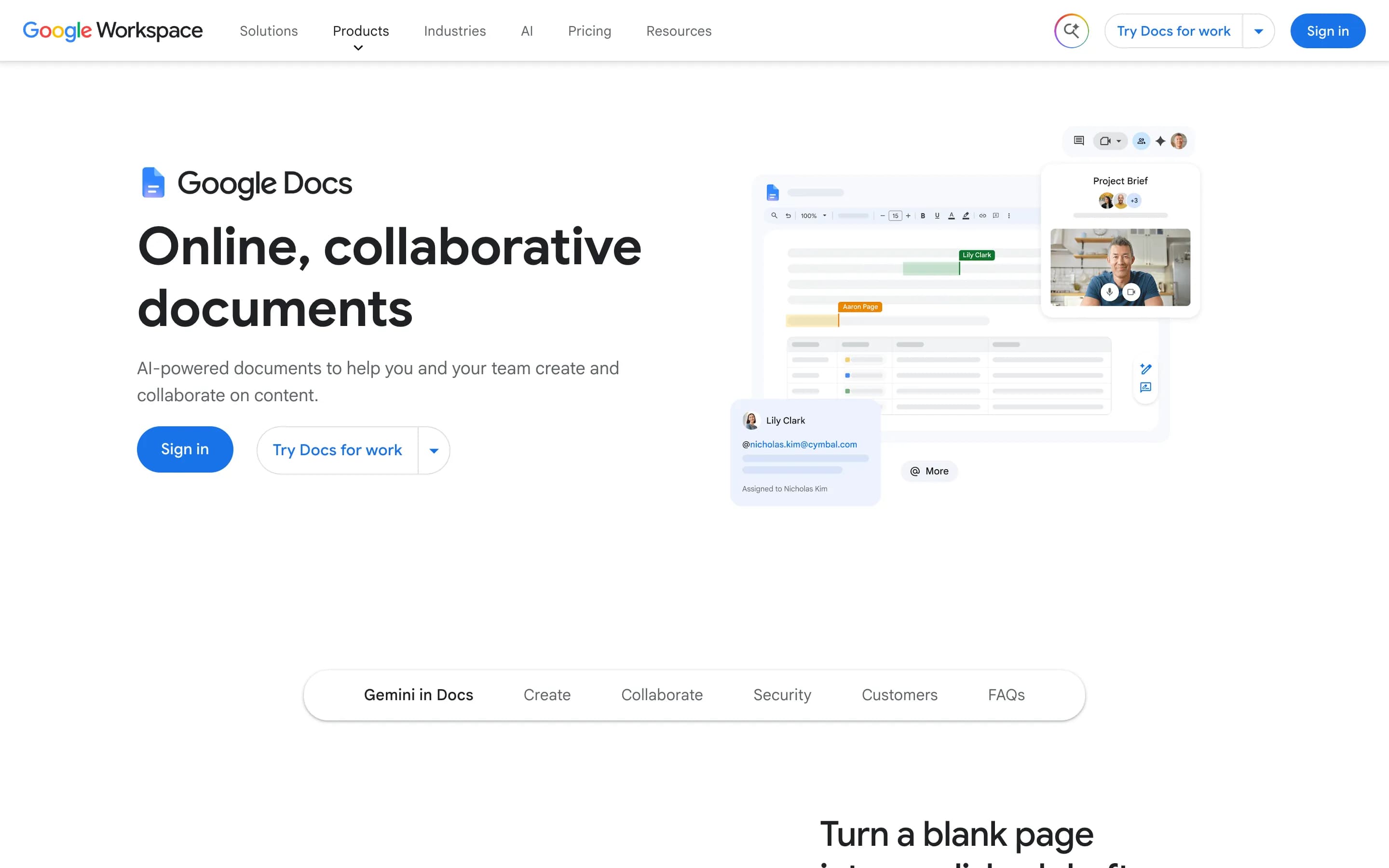
Plenty of finished novels were written in Google Docs, and the reason is sharing. Anyone with a Google account can create a document, it costs nothing, and a reader can sit in the same file leaving comments while you write in it. Google's own product page states that documents can be opened, created and edited without an internet connection, so the offline objection people raise about browser tools does not land here.
Google sells Docs as document creation, editing and collaboration, and their pages describe nothing past that. A chapter structure and a record of the cast are not among the features. A long draft in Docs ends up split across a folder of documents, and nothing in the product gives you a single view of the book those documents add up to.
What it does well
- Free with a Google account
- Documents open, create and edit without a connection
- Comments and live collaboration are the core of the product
Where it falls short
- Google's pages describe no chapter structure and no character record
- No single view of a book that has been split across documents
Free options, if you would rather spend nothing
Reedsy Studio
The core of it costs nothing, and what it does with a finished draft is the reason to look: EPUB, and a typeset print-ready PDF for any major print-on-demand service. A co-author, editor or proofreader can be invited into the book with track changes and comments. Paid tiers add advanced outlining, writing stats and dark mode. There is no dedicated mobile app, though it works in a phone browser.
bibisco Community edition
Built for novels from the start: characters, scenes, chapters and storylines with a structural overview, in fifteen languages, running on Linux, macOS, Windows, Android and iOS. The character work is unusual, organised around qualities, defects and contradictions. A paid Supporters edition funds development. It installs on the machine rather than opening in a browser.
Manuskript
Open source, and of the free options the closest to what Scrivener is for: a hierarchical outliner, character and plot tools that link to each other, world-building notes, a distraction-free mode and an assistant that walks the snowflake method. Windows, macOS and Linux, with no browser version.
yWriter
Written by Simon Haynes, a programmer with around thirty published novels, and the model shows it: the book breaks into chapters and scenes, and every scene carries its viewpoint character, goal, conflict and outcome. There is a storyboard view, drag-and-drop reordering and automatic daily backups. The Mac and mobile builds come from another developer and are paid.
Draftly free tier
No card and no time limit. The editor, the Codex, imports and exports are free, with 200 welcome credits to try an editorial read. Boards, timelines, version history, prose analysis and custom editors need a paid plan.
Every tool at a glance
| Tool | Price | Payment | Runs on | Free tier | Best for |
|---|---|---|---|---|---|
| $0 to $50 a month | Monthly, or a one-off credit pack | Any browser, plus Mac and Windows apps | Yes, no card | Holding the whole book in one place | |
| Scrivener | $59.99 per platform | One payment | macOS, Windows, iOS | 30 days of use | Drafting on one machine you own |
| Atticus | $147 | One payment | Any browser, plus Windows, Mac, Linux, Chromebook | No, 30-day refund | The print interior at the end |
| Dabble | $19 to $49 a month | Monthly, or $699 lifetime | Browser, Windows, Mac, Linux | 14-day trial only | Scrivener's organising in a browser |
| Ulysses | $5.99 a month or $39.99 a year | Subscription only | Mac, iPad, iPhone | No, free trial only | Writing with the panels gone |
| Novelcrafter | $4 to $20 a month | Monthly, plus your own AI bill | Any browser | 21-day trial | AI on a key you already hold |
| Sudowrite | $10 to $44 a month | Monthly credit allowance | Any browser | Trial, no card | Generating prose at the line |
| Microsoft Word | Free on the web, or $99.99 a year | Monthly, yearly, or $179.99 once | Windows, Mac, web | Yes, in a browser | The .docx an editor asks for |
| Google Docs | Free | None | Any browser | Yes | A draft several people comment on |
What a book needs that a word processor does not have
| Feature | Microsoft Word | |
|---|---|---|
| A chapter structure built for a book | A navigation pane over one long document, or a folder of separate files. | |
| Characters, places and objects kept beside the page | Microsoft's pages describe a word processor. No character or place record appears in them. | |
| A timeline of when events happened | A table you build and maintain yourself, in a second document. | |
| A board showing how the cast connects | Not part of what Microsoft sells Word as. | |
| Editorial notes on the whole manuscript | Word checks spelling and grammar at the sentence. No read of a full draft is documented. | |
| EPUB and a print-ready PDF from the same draft | A .docx goes to Amazon and gets converted there. Word does not produce the EPUB itself. | |
| Track changes in a .docx an editor marks up | The revision workflow publishing already runs on. Draftly has margin comments and version history instead. |
Questions & Answers
- What writing software do authors use?
- Microsoft Word and Google Docs, by a distance, because that is what was already on the machine. Among writers who bought something on purpose, Scrivener has the longest history on desktop. Both defaults hold text and nothing else, which is why writers who stay in them keep the cast in a spreadsheet and the timeline in a third file.
- Is there free software for writing a book?
- Yes, and several are complete tools rather than trials. Reedsy Studio costs nothing to use and exports EPUB and a print-ready PDF. bibisco's Community edition is free and built for novels. Manuskript is open source, and yWriter is free on Windows. Draftly's free tier has no card and no time limit and covers the editor, the Codex, imports and exports.
- Is there anything better than Scrivener?
- It depends which part of Scrivener you mean. Nothing here matches Compile for export range, so if that is what you use it for, no. For everything else, a browser tool removes the three limits writers hit most: one platform per licence, no browser version, and Dropbox sync you maintain yourself. Dabble rebuilds the organising. Draftly adds the cast and a read of the full draft.
- What is the best app for writing a book?
- It depends on which half of the job is slowing you down. For drafting and organising a novel, Draftly, Scrivener and Dabble hold the chapters, the cast and the structure. For turning a finished manuscript into a paperback, Atticus. Word and Google Docs will hold the text and nothing else, which is fine until the book outgrows one file.
- Is Scrivener worth it in 2026?
- If you write on one computer, own your software and use Compile, yes. $59.99 once against $99.99 a year for Microsoft 365 is an easy sum. The answer flips the day the book has to open on a second machine, a phone or a Chromebook: one licence covers one platform, and there is no browser version to fall back on.
- What is the difference between book writing software and a word processor?
- A word processor holds the text of the book. Book writing software holds the book: the chapter structure, the characters and places, when things happened, and a file a retailer will accept at the end. That is the line the nine tools above fall either side of, with Word and Google Docs firmly on the word processor side.
Um só lugar para o livro todo.
Abre um capítulo e tudo o que ele precisa já está ao lado: o elenco, os lugares, as regras que inventaste, a nota que deixaste a ti mesmo em novembro. Nada para procurar, nada para sincronizar à mão — e sem essa fricção, os dias em que escreves começam a somar.