Writing styles: how many there are
There are four writing styles if you sort them by purpose: narrative, descriptive, expository and persuasive. Schools teach that count, and it answers one question: what is this piece of writing for. Sort instead by how the sentences behave and the number moves. Erich Auerbach, whose Mimesis is the founding study of prose style, counted two.
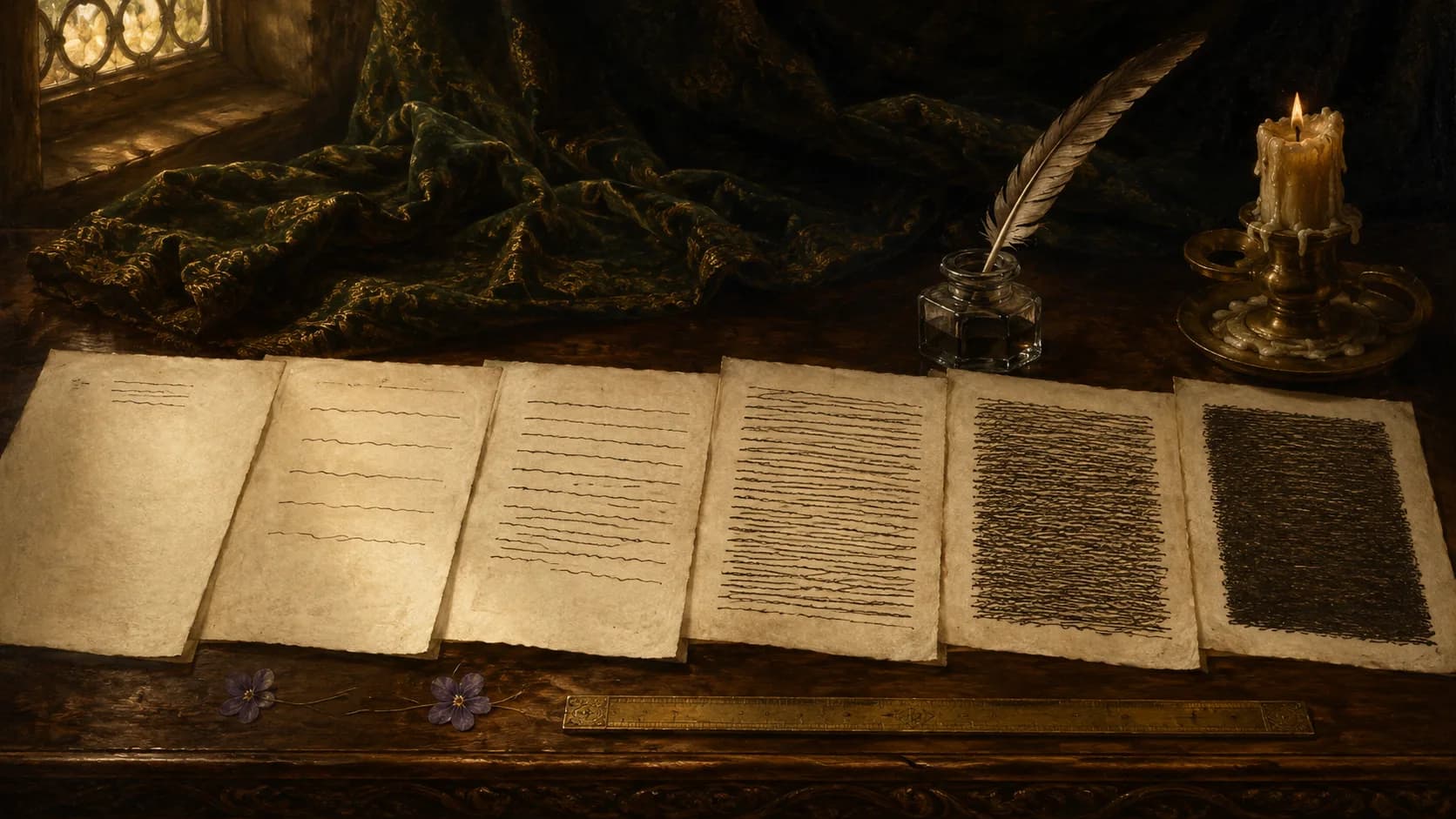
Six writing styles, with a real sentence each
They run from the most given to the most held back. The order ranks nothing, and the section after them explains the one question it comes from. Every specimen below is the real opening of the book named under it.
1Ornate
Sound carries the argument. The writer arranges the sentence so your mouth has to perform it, the performance carries part of the meaning instead of decorating it, and no style puts more on the surface: nothing hides, and the surface itself is the event.
Read it aloud and your tongue does exactly what the sentence describes. Three taps, three syllables, one name. Nabokov makes his claim about obsession by making your own mouth rehearse it, and a plainer sentence about a man fixated on a name could not do that work at any length. Nabokov pays for this with distance. A narrator this pleased with his own sound is a narrator you stop trusting, which the book is counting on.
Try this. Take one sentence you already like and read it aloud. Mark every place your mouth changes shape. If nothing changes, the sound is doing no work.
Lolita, light of my life, fire of my loins. My sin, my soul. Lo-lee-ta: the tip of the tongue taking a trip of three steps down the palate to tap, at three, on the teeth. Lo. Lee. Ta.
2Interior
Who is speaking? The narration borrows a character's words without announcing that it has. One sentence hands you the outside of a scene and the inside of one person, and the writer hides the seam between them on purpose.
Nine words, and they change hands halfway through. The first three report her from outside, the way a servant would. By the end the sentence has moved inside the decision, and the word herself carries a small satisfaction that belongs to Clarissa rather than to the narrator. James Wood's question for this technique is whose word is it, and the test case is right there in herself: a narrator with no stake in the errand would not have reached for it, so the word is Clarissa's and the sentence around it is the narrator's. Woolf fits her whole method into nine words.
Try this. Take a paragraph of your third-person narration and underline any word a character would have chosen, and if you find none, the narration is standing outside the scene and reporting it.
Mrs Dalloway said she would buy the flowers herself.
3Perception-bound
The sentence stays inside what one person can see, and that person cannot interpret it, so the context goes missing with them and the reader builds the scene out of evidence instead of taking it ready-made.
They are playing golf. Nothing in the sentence says so, because the narrator does not know the word, and the fence and the flower spaces arrive in the order his eye finds them, not in the order that would explain the scene. The cost is real, and the reader pays it on the first page: anyone who wants the situation named does not get it here. Faulkner accepted that cost to make the reader do the seeing.
Try this. Rewrite one paragraph so it contains only what your character can physically register, with every word they would not know removed. Read the result to someone and see whether they can name the situation.
Through the fence, between the curling flower spaces, I could see them hitting.
4Pared back
Short words, few subordinate clauses, and the emotion cut from the sentence that carries it, so the reader feels the cut as an absence instead of missing it as a gap.
Twenty-six words, one clause hooked to the next with and, and no adjective doing any lifting. The whole weight sits on a number. Eighty-four is specific enough to have been counted, and a man who has counted to eighty-four is a man in trouble, which the sentence declines to say. Hemingway called this leaving things out, and the rule he attached to it matters more than the technique: you can only omit what you actually know.
Try this. Find the sentence in your draft that names a feeling. Delete the name and put a countable fact in its place. If the paragraph now reads as flat instead of withheld, you did not know the fact.
He was an old man who fished alone in a skiff in the Gulf Stream and he had gone eighty-four days now without taking a fish.
5Flat
One thing happens, then the next, and the join between them is missing. The reader supplies the connection or notices that none is available. The style reads as affectless, and the affectlessness is the argument.
Three words, and the argument is in the grammar. French narration takes the simple past, and Camus used the compound past of ordinary speech instead, a tense that cannot reach forward to make one event the cause of the next. So the sentences sit next to each other without explaining each other, which is the book's whole position on whether events mean anything. Ward's Maman keeps the child's word for her and loses the coldness. Gilbert's Mother keeps the coldness and loses the child.
Try this. Take a page and cut every because, every therefore, and every which meant that. Read it back. If it still argues after that, the argument was living in the order of the events rather than in the joins, and the joins were decoration.
Maman died today.
6Spoken
The prose imitates a person talking, which lets it start in the middle, withhold the backstory for as long as a speaker would, and give a feeling to something that cannot have one.
A house number and a human motive, in three words, and the page explains neither. A speaker can do that. Written narration usually cannot, because a reader expects the page to introduce what it names, and Morrison withholds the introduction for pages while the voice carries the reader on trust alone. Criticism calls this skaz, from Huck Finn to Holden Caulfield.
Try this. Say your opening paragraph out loud to another person before you write it down, then write down what you actually said. The order will be wrong for an essay and right for a voice.
124 was spiteful.
How much goes on the surface
In the first chapter of Mimesis, Auerbach puts two ancient passages side by side: Odysseus recognised by his old nurse, and God telling Abraham to kill his son. From them he draws what he calls two basic and opposite types of representing reality. Homer externalises everything. He states the feelings, gives the causes and leaves nothing half in darkness, while the Genesis story does the reverse so completely that Auerbach's phrase for it has stuck to the whole idea: fraught with background. Where the two speakers are standing goes unsaid. What Abraham feels on the three-day walk goes unsaid.
You make that one decision in every paragraph you write. How much goes on the surface? A page that puts everything there reads clear and lies flat. A page that withholds too much reads as withholding. The six styles below are six settled answers to that one question, arranged from the most given to the most held back, and each one is a real sentence you can go and check.
Two ways to count writing styles
Two different questions hide inside the same words. One asks what a piece of writing is for, and it has four answers: narrative, descriptive, expository and persuasive. The other asks what the sentences themselves do, and there the count depends on how finely you want to sort. The second question is the one you answer at your desk, and the six styles below are one workable way to sort it.
| The question | How many | The styles | Use it when |
|---|---|---|---|
| What is this writing for? | Four | Narrative, descriptive, expository, persuasive | You are choosing a form. A cover letter and a short story have different jobs, and the job sets the rules. |
| What do the sentences do? | Six on this page. Auerbach counted two. | Ornate, interior, perception-bound, pared back, flat, spoken | You are writing a sentence and want to know which knob you are turning. |
Auerbach's two are the oldest serious answer and still the most useful, because his pair is an axis and not a list. The six below sit along it.
Three questions for your own sentences
Labels run out fast and most real prose sits between two of them, so these three questions do more work than a longer list of names would, and you can ask them of a sentence you wrote an hour ago.
How much is on the surface
Auerbach's axis. Homer states the cause, the feeling and the outcome. Genesis leaves the walk to the mountain in silence. Neither is better, and a draft that has drifted to one end without you deciding is the common failure.
Whose words the narration uses
Its own, or the character's. Woolf moves between them inside one sentence. A narrator that keeps its own vocabulary throughout holds the reader outside the scene, which is a choice and reads as one.
Whether the sentence names the feeling
Hemingway removes the name and leaves the countable fact. Nabokov names everything and lets the excess become the characterisation. Ask whether your reader can tell you what a character felt without using your word for it.
Questions & Answers
- How many writing styles are there?
- Four, if you are sorting by purpose: narrative, descriptive, expository and persuasive. Those four answer what a piece of writing is for. Sorting by how the prose behaves gives a different number, and the oldest serious answer is two. Auerbach's pair is an axis running from prose that puts everything on the surface to prose that holds most of it back, and the named textures sit along it.
- What is style in writing?
- Style is the set of decisions a writer repeats about how sentences behave: how long they run, how much they explain, whose words they use, and how much they leave out. Voice is who is speaking. Style is how a writer builds the sentences, and you can describe it precisely enough to copy one decision at a time.
- What are the different writing styles?
- The purpose-based four are narrative, descriptive, expository and persuasive. The texture-based ones have no fixed list, and six that a reader can hear the difference between are ornate, interior, perception-bound, pared back, flat and spoken. Each has a settled example on this page: Nabokov, Woolf, Faulkner, Hemingway, Camus and Morrison.
- Which writing style is best?
- None of them, and the question usually means which one suits the book in front of you. A thriller that keeps a motive back gets more from the flat register than from an ornate one, and a comic essay gets the opposite. Ask what your subject can afford to say out loud, because that is the decision these six disagree about.
- How do you develop your own writing style?
- Start by noticing what you already do. Print a page you wrote months ago and mark the habits you did not choose: the sentence length you fall into, the joins you reach for, the places you explain something you could have shown. Those habits are your style whether you meant them or not, and developing it means keeping the ones that work and testing the rest against a writer who does the opposite.
- How do you improve your writing style?
- Change one measurable thing and read the result aloud. The exercises on this page each do that: delete the name of a feeling and put a countable fact in its place, cut the becauses and therefores out of a page, underline the verbs you could have written without looking at the thing. A style problem is usually a stack of small habits, and they are easier to hear one at a time than to fix all at once.
Read one of these styles at length
The six sentences above are openings. Each writer has a page working through how they build the rest of the book, and 253 more authors get the same reading.
Browse the authorsUm só lugar para o livro todo.
Abre um capítulo e tudo o que ele precisa já está ao lado: o elenco, os lugares, as regras que inventaste, a nota que deixaste a ti mesmo em novembro. Nada para procurar, nada para sincronizar à mão — e sem essa fricção, os dias em que escreves começam a somar.