AI writing tools for fiction in 2026
AI writing tools for fiction do three different jobs. Some write pages for you. Some rework a line you have already written. Three read a finished manuscript and report what is wrong with it. One search covers all three, and the wrong choice costs a draft.
The short answer
If you want prose you have not written yet, Sudowrite and Squibler both generate it and both charge in credits rather than words. If you would rather pay a model provider directly, Novelcrafter runs on an API key you supply and keeps a story bible around it. If you already write in ChatGPT or Claude, prose quality is not what you are short of: what is missing is somewhere for the book to live between sessions. And if the draft is done, none of the six generators will read it back to you. That is the job of the three that read: ours at the top of the list, Fictionary and ProWritingAid at the foot of it.
- An empty page: Sudowrite for control at the line, Squibler if you want a whole draft generated in one pass.
- Your own API key: Novelcrafter, from the $8 tier upward.
- Fan fiction with art alongside it: NovelAI, which now leads with anime images.
- A finished draft no reader has seen: Draftly, Fictionary, or ProWritingAid story credits.
Nine tools, and what each does to your book
Three of the nine below we have run as paying customers, and the rest are read from their own pricing pages, which is why no entry carries a score. Four questions decide this one, and every entry answers them in the same order. What does it produce, a whole draft or a line at a time. What does it hold on to between chapters. Who pays for the tokens, you or the tool. And what comes out at the end, a file a shop will take or text in a chat window. Ours is first because we made it, which is worth knowing before you read a word of it. Then the six sold as generators, then the two others that read a finished manuscript. If what you are shopping for is a writing app rather than an AI, the nine tools compared on price, platform and export answer that question instead.
1. Draftly
- Best for
- A finished draft no reader has seen yet
- Price
- Free to start with 200 welcome credits. Starter $10, Pro $20, Studio $50 a month, or the same amounts bought once as a credit pack.
- Runs on
- Browser, Mac and Windows
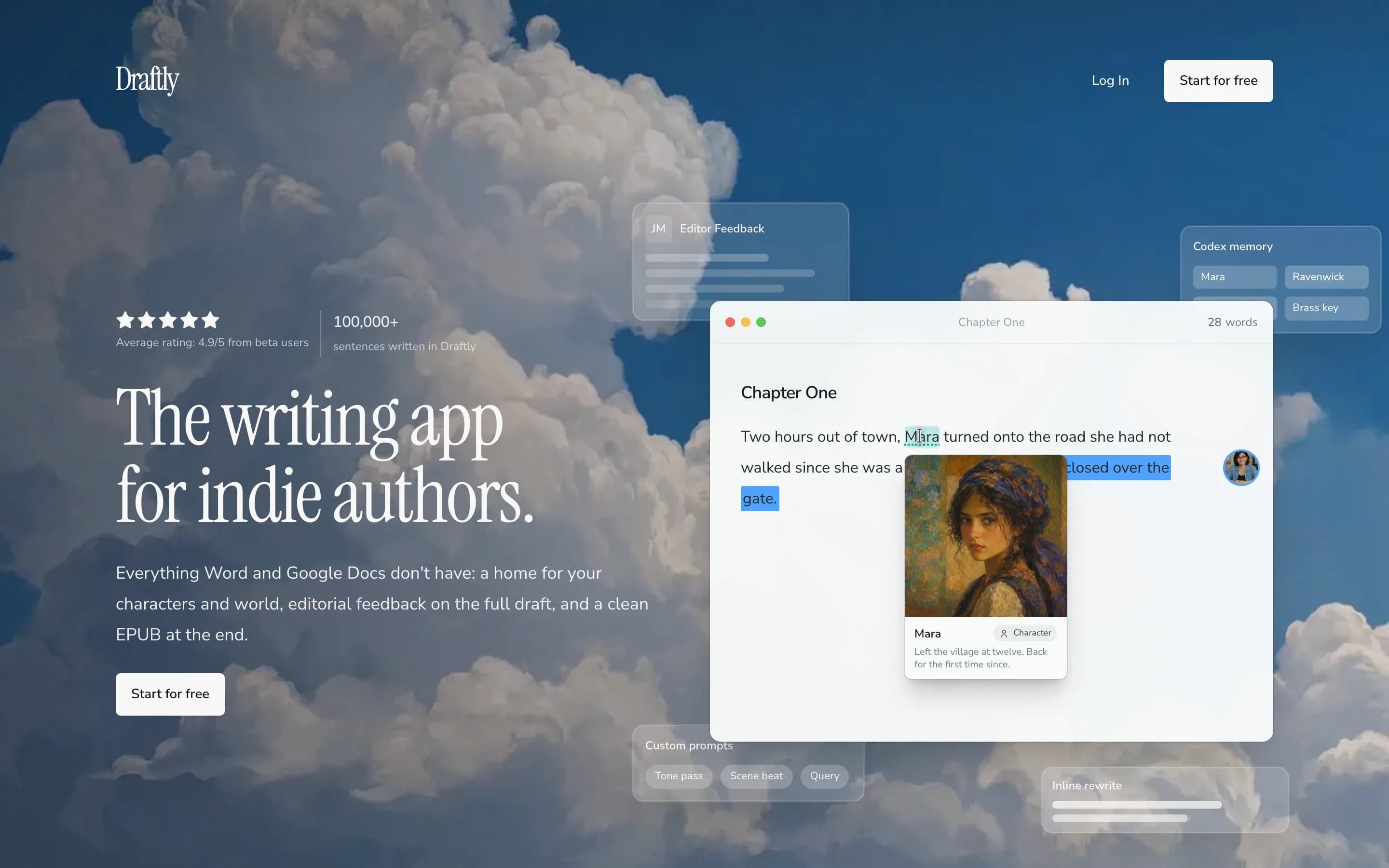
Draftly writes a passage at a time rather than a draft at a time. Twenty-four insertion actions open a scene, bridge two paragraphs or close a chapter, the codex feeds them, and a prompt box covers what they do not. The other half is the read. A whole manuscript goes through editors you pick by voice and remit, and the notes come back in the margin against the paragraph that caused each one: where the middle sags, which subplot is not paying for its pages, where a reveal arrives before a reader can want it. Around that sit the parts that hold a book. One codex entry per character, place and object, opening beside the chapter that names it. Boards for the lines between them. Two timelines, the order events happened and the order the book tells them.
The credits are worth the arithmetic before you sign up. A read of a 90,000 word manuscript costs around 309 credits. The 200 welcome credits are a sample rather than a full pass over a novel, so the first complete read is a paid action. Imports take a Scrivener project whole as a .scriv file, along with .docx, .odt, .rtf, .pdf and Markdown. Exports reach EPUB, Word, a print ready PDF and Markdown. The editor, the codex, imports and exports cost nothing on the free tier.
What it does well
- AI editors read the full manuscript and answer in the margin
- Opens a Scrivener project directly as a .scriv file
- Free tier with no card and no time limit
Where it falls short
- 200 welcome credits is a sample, and one 90,000 word read costs around 309
2. Sudowrite
- Best for
- Getting words onto a page that has stayed empty for a week
- Price
- Hobby and Student $10, Professional $22, Max $44 a month. No card to start, and up to 50% off when billed annually.
- Runs on
- Any browser
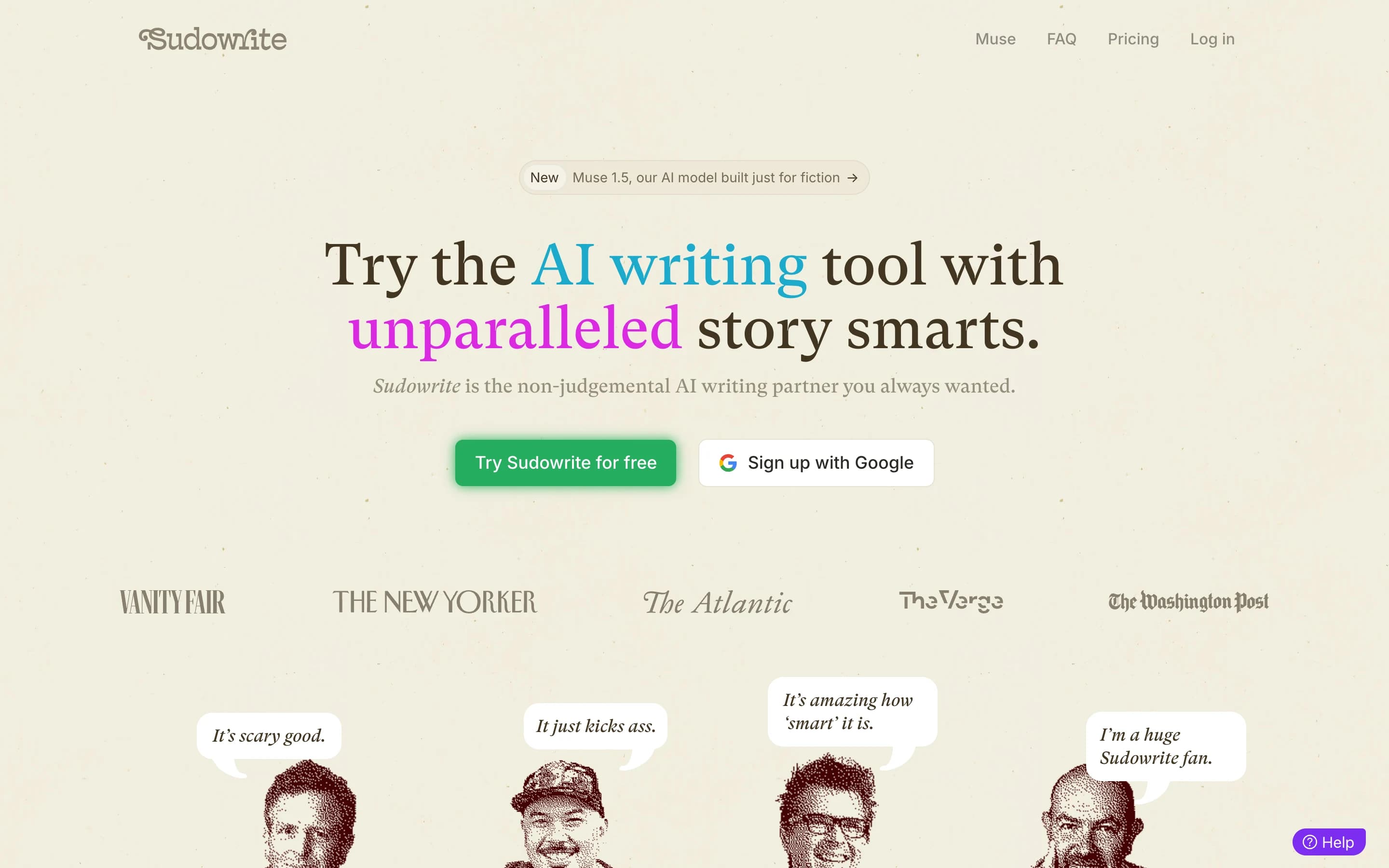
The allowances are stated plainly: 225,000 credits a month at $10, 450,000 at $22, and two million at $44, with unused credits carried for twelve months on the top plan. Sudowrite also names what it runs on, which few tools here do. Its pricing page lists Claude models from Anthropic, several OpenAI models, open source models, and Muse, which it built for fiction. A story bible carries an idea through outline to chapter beats, and the writing tools work at the line: continue this passage, describe this room, give me three other versions of this sentence.
The unit of everything is the credit, and no page on the site turns credits into chapters, so a first month is a guess. Generation is where the product invests and holding a book is not. A project keeps drafts and chapters, and past that there is no board of who knows whom and no second timeline to check the order of events against. What the money buys is prose on demand, and the pricing page is candid that this is where it goes.
What it does well
- 225,000 credits at $10, two million at $44
- Names the models it runs on, including one built for fiction
- Unused credits carry for twelve months on the top plan
Where it falls short
- Nothing on the site converts credits into chapters, so a month is hard to budget
- No option to supply your own API key, so the model bill is bundled
3. Novelcrafter
- Best for
- You hold an OpenAI or Anthropic key and want the model bill kept apart from the software bill
- Price
- Scribe $4, Hobbyist $8, Artisan $14, Specialist $20 a month. A 21 day trial with every feature unlocked and no card.
- Runs on
- Any browser
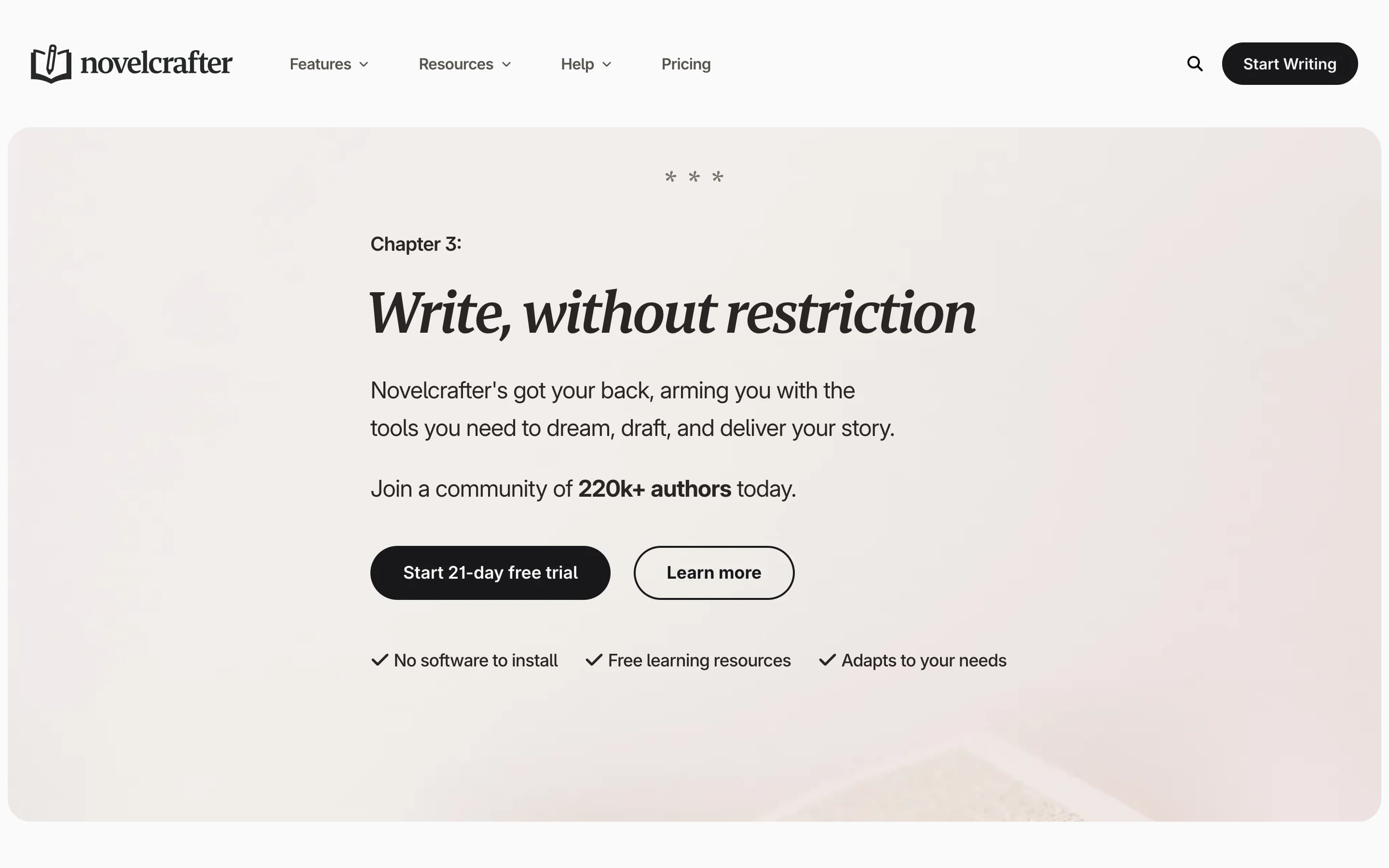
Unlimited books sit on every plan, and a series shares one story bible, which is why writers of long series keep naming it. Scribe at $4 has no AI in it whatsoever, which puts that tier closer to Scrivener, Atticus, Dabble and Ulysses than to the generators here. Bring your own key starts at $8, and from there a scene card grid, a codex of names and a chat against your own model all sit in one browser tab.
Two bills instead of one is the trade. The figure on the pricing page buys software, and the tokens are charged to you by whoever holds the model, so a heavy month costs whatever you generated while the subscription line stays flat. For a writer already paying for a key, that arrangement comes out below a bundled allowance. For a writer without one, that means an account to open, a card to enter and a rate table to read before a single scene appears.
What it does well
- One story bible shared across every book in a series
- 21 day trial, every feature, no card
- Unlimited books on all four tiers
Where it falls short
- The $4 tier has no AI in it at all
- The subscription is not what the month costs, because tokens are billed by the model provider
4. NovelAI

- Best for
- Fan fiction and worldbuilding where the pictures matter as much as the prose
- Price
- Tablet $10, Scroll $15, Opus $25 a month, after 30 free generations.
- Runs on
- Any browser
Roundups on this search list NovelAI for lorebooks and worldbuilding, so what its own front page says today is worth reporting. The title reads AI Anime Image Generator and Storyteller, and the plans are sold on images: unlimited image generation across all three tiers, monthly Anlas for the extras, 1,000 bonus Anlas on Tablet and Scroll against 10,000 on Opus, and 20% off Anlas bought as you go. Thirty free generations up to 1024 by 1024 come before any payment.
What the landing page leaves out is the part a novelist would buy it for. No context size, no text generation limit, and no mention of a lorebook anywhere on it. A plan covering images and text together is one a text-only writer part-pays for. Expect a community writing fan fiction rather than a pipeline aimed at a finished manuscript.
What it does well
- Thirty free generations before any payment
- One subscription covers text and images
- Tiers start at $10 a month
Where it falls short
- The landing page states no context size and no text limits
- Writers who want text alone still pay for image generation
5. Squibler
- Best for
- Finding out what a generated manuscript reads like without paying for the answer
- Price
- Free with 1,000 AI credits a month. Plus $15.83 and Pro $49.17 a month billed annually, at $192 and $588 a year.
- Runs on
- Any browser
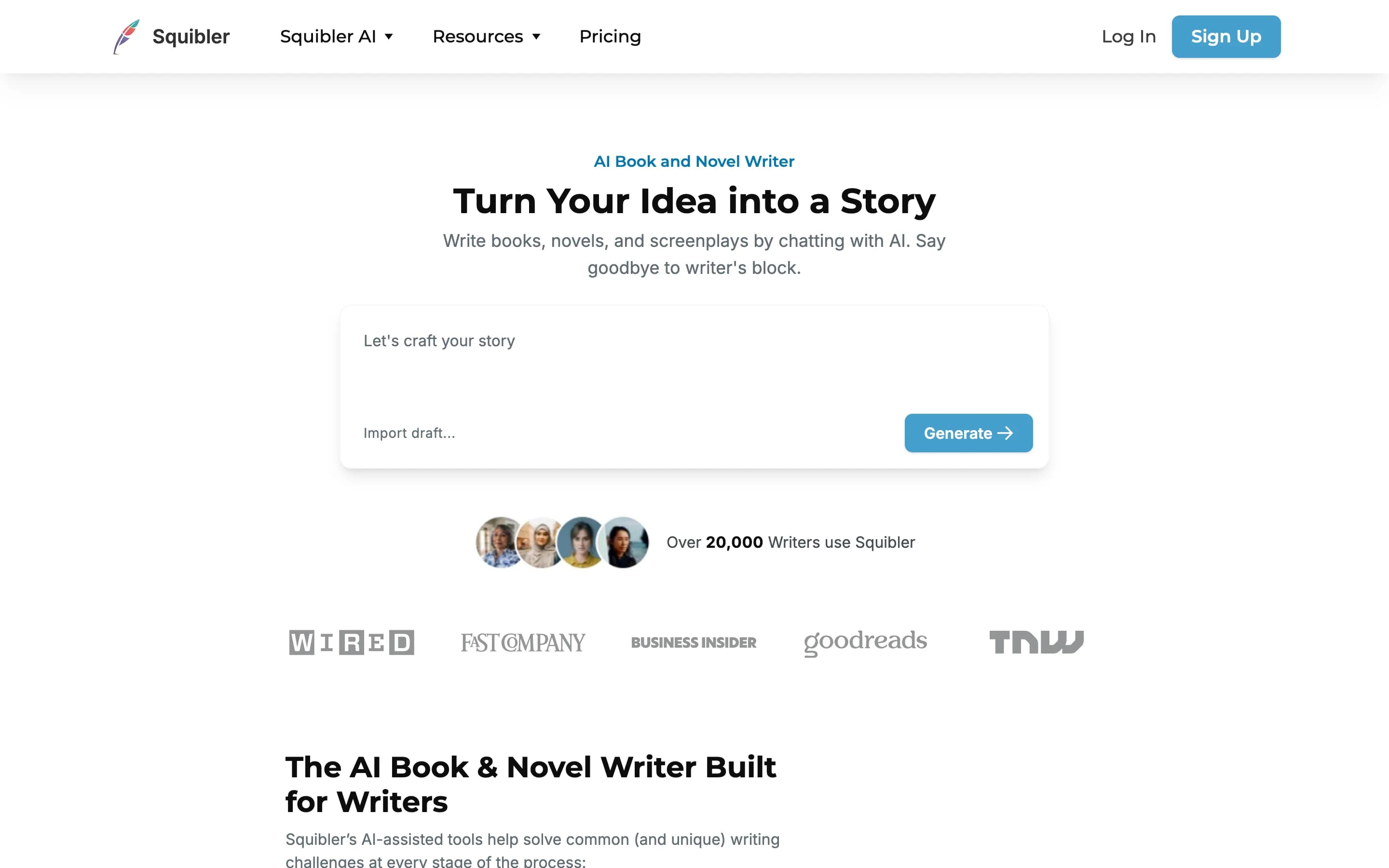
The free tier is the part worth knowing about: 1,000 AI credits a month, no time limit, and the pricing page says work stays reachable after a cancellation. Plus lifts that to 10,000 credits and states what they are for, which is full length manuscripts of 200 to 300 pages, AI editing passes over them, and export to PDF and DOCX. Pro removes the ceiling on credits and on books. The monthly figures on display are annual rates, so paying by the month costs $29.99 and $89.99.
Squibler makes a large claim: complete novels and screenplays in minutes, with character and plot consistency held across the length. Test that on the free credits before spending anything, because a draft generated in one pass is the version a reader spots first, and 1,000 credits cost nothing to spend on finding out. Where it earns its place is speed to a full skeleton, which is a real thing to want when an outline keeps stalling.
What it does well
- A free tier with 1,000 AI credits a month and no time limit
- Generates a full length draft and exports to PDF and DOCX
- No credit ceiling on the top plan
Where it falls short
- The headline monthly prices are annual rates, so paying monthly costs more
- A draft generated in one pass still needs the work every draft needs
6. Claude
- Best for
- Working through one chapter at a time in a chat window
- Price
- Free. Pro $17 a month billed annually or $20 monthly. Max from $100 a month.
- Runs on
- Browser, desktop and mobile apps
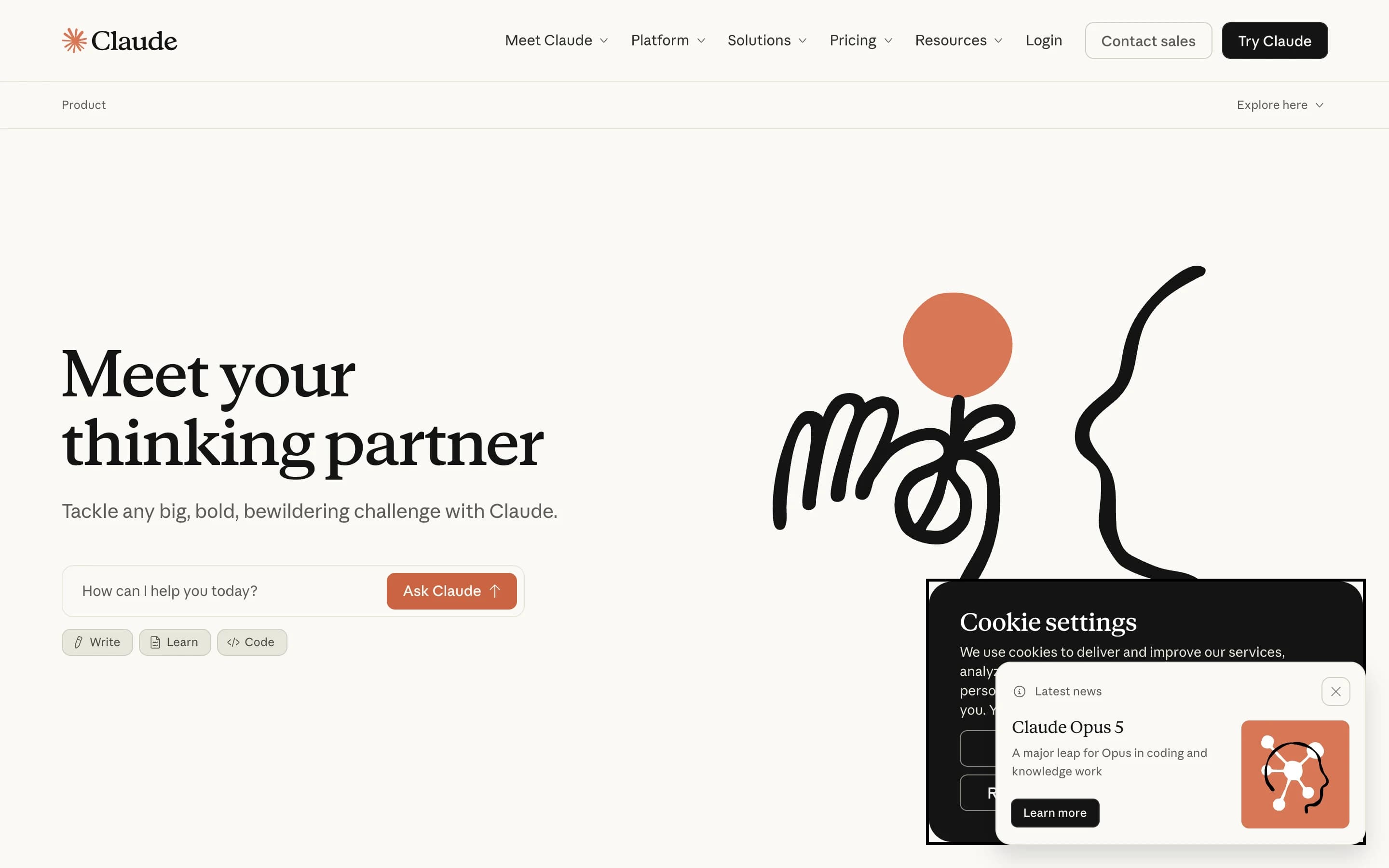
The free tier covers more than a free tier usually does: chat on every platform, web search, memory, file creation and extended thinking. Pro adds higher usage, a choice of models and unlimited projects. Max sells five and twenty times the Pro usage from $100 a month. For prose at the paragraph this is where a lot of novelists have quietly ended up, and the reason is the quality of the line rather than any feature aimed at fiction.
Nothing here holds a book. There is no chapter list, no cast that persists against the text, and no export a retailer would accept. Usage limits appear on the pricing page without numbers, which matters on the day a long chapter goes in whole. Anyone drafting a novel in a chat window is doing the structural work elsewhere, in a document, on a wall of cards, or in another tool.
What it does well
- A free tier that covers real drafting
- Pro at $17 a month when billed annually
- Projects keep related files together
Where it falls short
- No chapter structure, no persistent cast, no book export
- Usage limits are stated without numbers
7. ChatGPT
- Best for
- Brainstorming, and rewriting a passage you paste in
- Price
- Free. Go $8, Plus $19.99, and Pro from $100 a month, as the US App Store lists them. ChatGPT's own pricing page localises and showed us 8, 23 and 103 euro.
- Runs on
- Browser, desktop and mobile apps
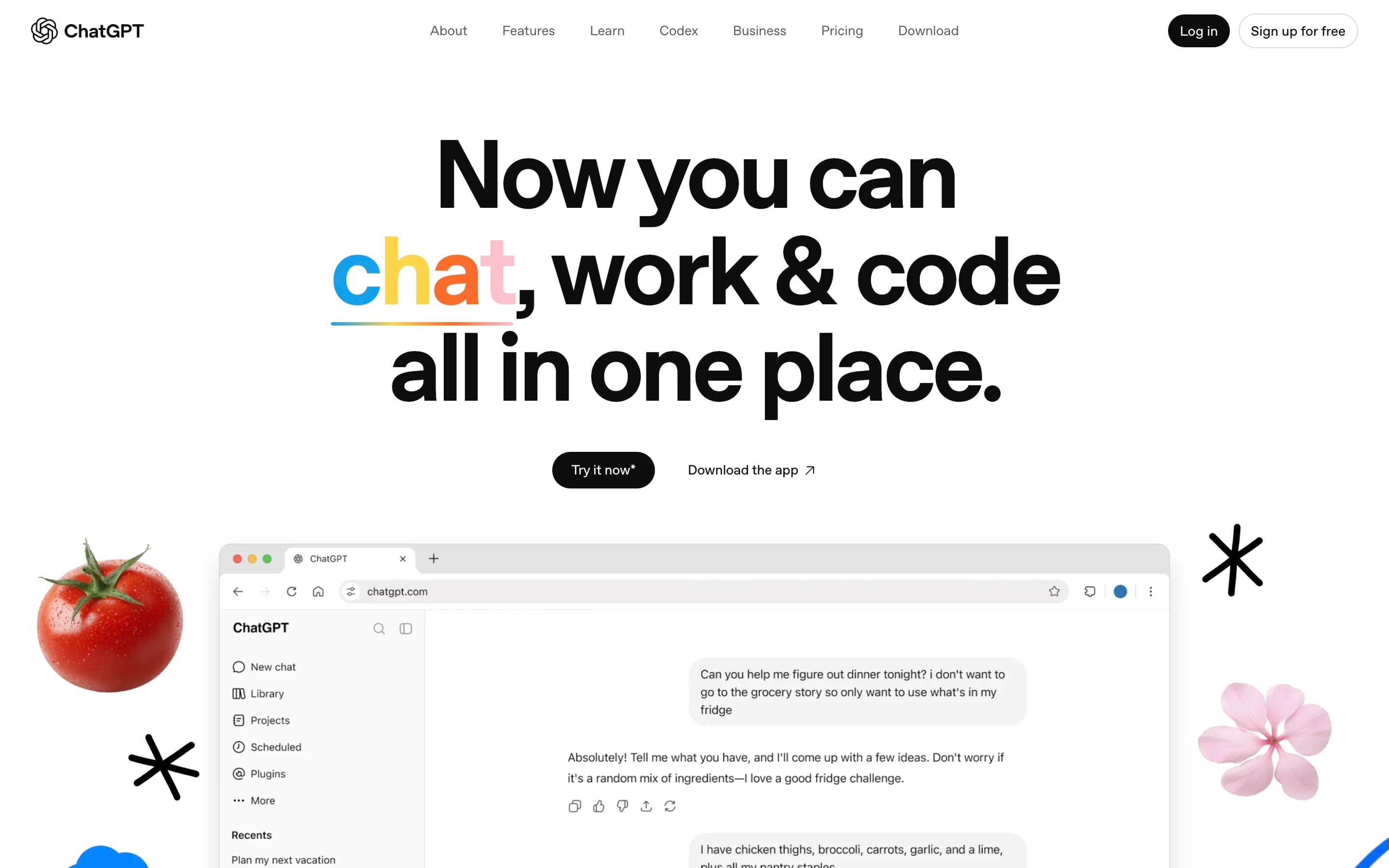
Four consumer tiers, and the differences that matter to a novelist are memory and context rather than model names. Free carries unlimited text chats with limited memory and context. Go buys longer conversations and, by its own page, may include ads. Plus opens advanced reasoning, expanded memory and context, projects, scheduled tasks and custom GPTs. Pro sells five or twenty times the usage from $100. The prices above are Apple's US listing, because OpenAI's page bills in the currency you read it from and quoted us euros.
As a tool for a novel it has the same shape of gap as Claude, with one addition. Memory carries facts between chats, which helps and also drifts: a detail invented in one session comes back altered in another, and there is no page to open that shows what it believes about your book. Paste in a chapter and it will rework the prose. Ask what is wrong with the whole draft and it is answering about the part it was shown.
What it does well
- The free tier covers most drafting done in a chat
- Go at $8 a month for light use
- Plus adds projects and expanded context for long chapters
Where it falls short
- The Go tier may include ads, by OpenAI's own pricing page
- Memory drifts and there is no list of it to inspect
8. Fictionary
- Best for
- Diagnosing structure in a draft that is complete and not working
- Price
- StoryTeller $19 and StoryTeller Premium $39 a month, over 25% off annually, with a 7 day trial and no card. StoryCoach for editors is $49 a month.
- Runs on
- Any browser
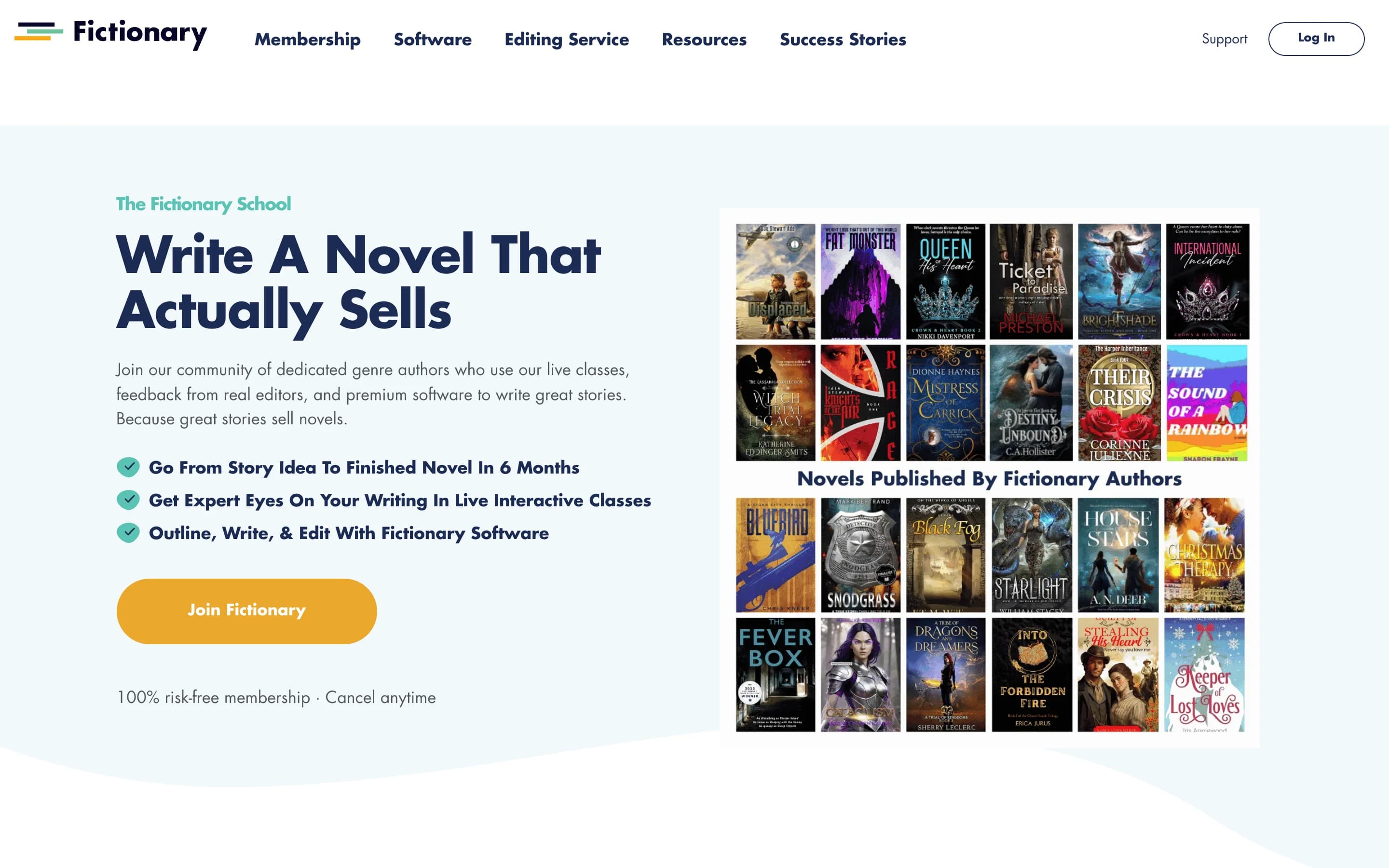
Fictionary reads the manuscript against a method: genre specific templates, a step by step editing journey, and insights on plot, character and setting, with feedback its pricing page calls immediate and AI powered. The story arc chart is the part authors quote in reviews, because it draws the shape of the book and shows where the shape gives way. Premium adds support for ten manuscripts along with track changes and comments, which is what a series wants.
One method is also the limit. What comes back is measured against Fictionary's model of story, so a book departing from that model on purpose is marked for departing from it, and the writer has to know which notes to keep. Editors are a real part of the customer base: StoryCoach at $49 a month is built for someone carrying twenty clients, which tells you how the software thinks about a draft.
What it does well
- A story arc chart drawn over the whole draft
- Genre specific templates rather than one rubric
- 7 day trial, no card, prices quoted in US dollars
Where it falls short
- Every note is measured against one model of story, whatever the genre template
- The lower plan caps how many manuscripts you can hold
9. ProWritingAid
- Best for
- Sentence level work across the length of a book
- Price
- Free with a 500 word limit. Premium 120 euro a year and Premium Pro 144 euro a year, or 30 and 36 euro monthly, with lifetime at 399 and 699 euro.
- Runs on
- Any browser
The free tier is a fair trial of the reports rather than a teaser: 500 words at a time, two runs of each report a day, ten rephrases and three sparks. Premium drops the word limit and opens 25 or more writing analysis reports, a custom style guide, terminology management and one chapter critique a day. Premium Pro raises that to three critiques and fifty sparks and adds live workshops and cowriting sprints, which is a community product wrapped around an editing one.
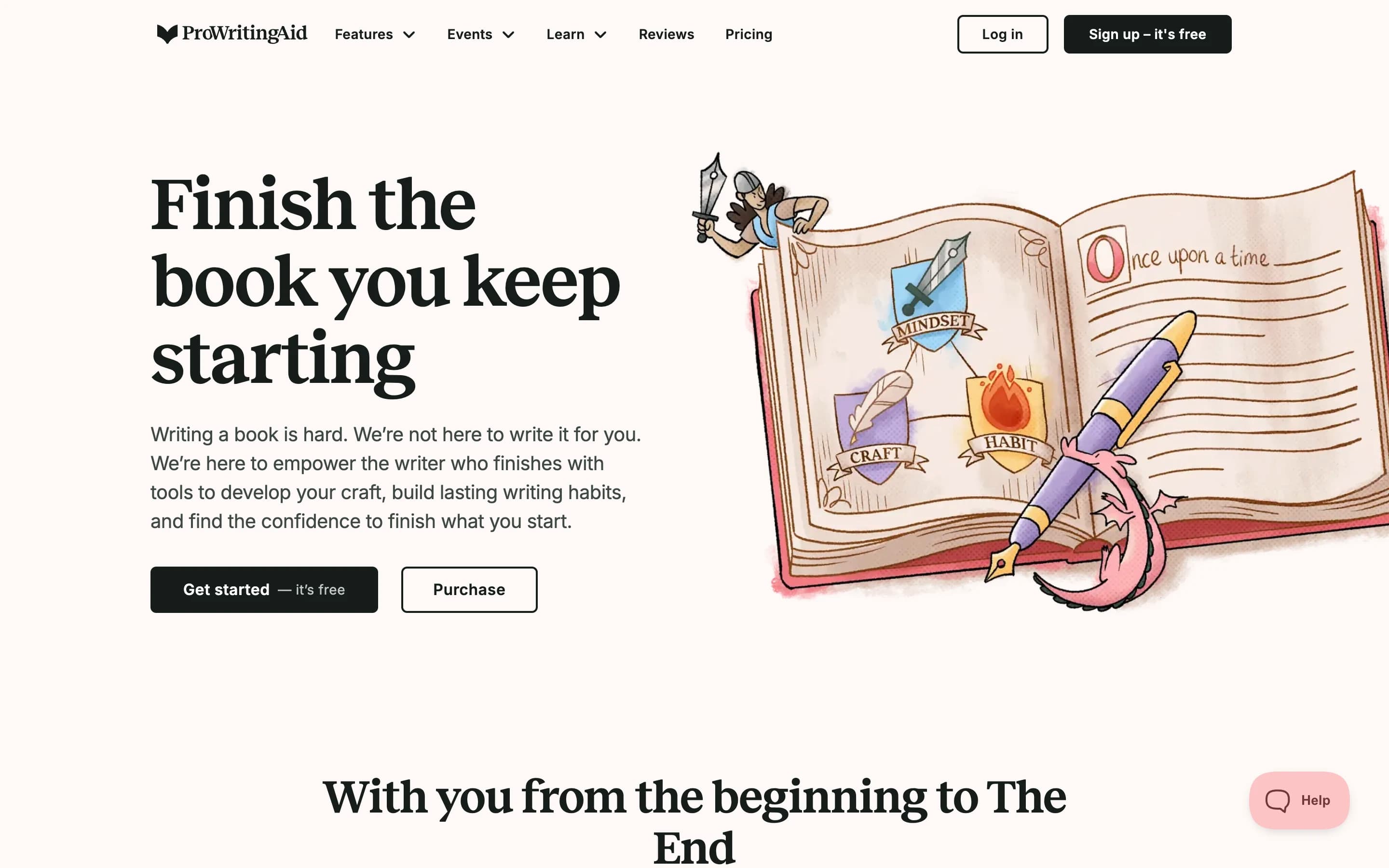
The whole draft question is answered here and it is priced apart from the subscription. Analysis of a complete manuscript runs on story credits bought on top, discounted up to 40% on Premium and up to 65% on Premium Pro. The page prices in the currency you read from, so a US reader sees dollars at the equivalent tiers. Its own homepage is the fairest summary of where it sits: writing a book is hard, and it is not there to write it for you.
What it does well
- A free tier that runs the real reports at 500 words
- 25 or more reports and a chapter critique a day on Premium
- Lifetime pricing exists, at 399 and 699 euro
Where it falls short
- Whole manuscript analysis costs story credits on top of the subscription
- Premium caps chapter critiques at one a day
What you can try without paying
Squibler free tier
A way to see what a generated draft looks like on your own premise. A thousand credits will not carry a novel, and the pricing page says work stays reachable after cancelling.
ChatGPT free tier
Enough to brainstorm, rework a paragraph, or argue with an outline. No chapter structure and no export, so the book has to live somewhere else while you use it.
Claude free tier
Strong prose in a chat window that forgets your book's structure between sessions. Usage limits apply and the page puts no number on them.
Draftly free tier
The editor, the codex, imports and exports cost nothing. The welcome credits buy a sample read rather than a full one, since a 90,000 word manuscript costs around 309 credits, so treat them as a trial of the notes and not of the whole pass.
What none of the six generators does
Six of the nine entries above sell generation as the product, and there is one row where all six answer the same way. Not one of them reads a finished manuscript and reports where it sags. They will continue a scene, rework a paragraph, name twelve plot twists and hold a story bible while they do it. Ask any of them what is wrong with chapter eleven of a 90,000 word draft and the answer comes back shaped like a compliment, because the draft was not in front of it.
That gap is why Draftly exists, which is the reason it opens a page about eight other products. A read here sends the whole manuscript through editors you choose, and the notes come back in the margin against the paragraph that caused them. Fictionary answers the same question through story structure and draws the arc. ProWritingAid sells it as story credits on top of a subscription.
Plenty of novelists want that row empty, and the reasons are good ones. If you would rather no model read your draft whole, the case for the generators is that you decide line by line what goes into them. ProWritingAid says as much on its own homepage. Whichever way you go, read the terms on the tool you pick, because what a company does with your text is a separate question from what it charges you.
Every tool at a glance
| Tool | Price | What it does to your book | Holds between chapters | Whose model bill | Free tier | Best for |
|---|---|---|---|---|---|---|
| Free to start, $10 to $50 a month | Writes at the caret, reads the whole draft | Codex, boards and two timelines | Ours, metered in credits | 200 welcome credits | A finished draft that needs reading | |
| Sudowrite | $10 to $44 a month | Writes and reworks prose | Story bible, no board or timeline | Bundled in the credits | Trial, no card | Words onto an empty page |
| Novelcrafter | $4 to $20 a month | Writes, with a story bible around it | One story bible across a series | Yours, billed by the provider | 21 day trial, no card | Writers who hold an API key |
| NovelAI | $10 to $25 a month | Writes prose and generates images | Nothing stated on its landing page | Bundled in the plan | 30 generations | Fan fiction with art |
| Squibler | Free, then $15.83 to $49.17 a month billed annually | Generates a full draft | Claims consistency across a full draft | Bundled in the credits | 1,000 credits a month | Seeing what a generated book reads like |
| Claude | Free, Pro $17 to $20, Max from $100 | Writes and reworks in a chat | Chat memory, no cast or chapters | Bundled in the plan | Yes | One chapter at a time |
| ChatGPT | Free, Go $8, Plus $19.99, Pro from $100 | Writes and reworks in a chat | Memory that drifts between chats | Bundled in the plan | Yes | Brainstorming and rewriting |
| Fictionary | $19 to $39 a month | Scores a finished draft on structure | Nothing, it reads the finished draft | Bundled in the plan | 7 day trial, no card | Diagnosing structure |
| ProWritingAid | Free, then 120 to 144 euro a year | Line edits, with paid manuscript reports | Style guide and terminology lists | Bundled, story credits extra | 500 word limit | Sentence level polish |
Questions & Answers
- Can AI write a whole novel by itself?
- It will produce a manuscript. Squibler's pricing page offers full length books of 200 to 300 pages and its front page promises complete novels in minutes. What comes out holds together at the paragraph and comes apart across chapters, because nothing in a generator is tracking the promise made in chapter two. Treat generated text as a draft you now have to edit, and price the tool on that basis.
- Can you publish a book written by AI?
- Yes, with a disclosure. Amazon KDP requires you to tell it about AI generated text, images or translations when you publish a book or edit and republish one, and it counts content as AI generated even where you made substantial edits afterwards. Content you wrote yourself and then used AI to refine or error check counts as AI assisted, and disclosing that is voluntary. Other retailers set their own rules, so read them before you upload.
- Is Sudowrite free?
- No. It starts at $10 a month for Hobby and Student, which carries 225,000 credits, and the trial takes no card. The free lane elsewhere on this page: Squibler gives 1,000 AI credits a month at no cost, ChatGPT and Claude both run free tiers, and Draftly starts with 200 welcome credits.
- Is Sudowrite worth it?
- It depends on whether the prose exists yet. At $10 a month for 225,000 credits it is inexpensive for a generator, the story bible runs from idea to chapter beats, and the line tools are the finest grained of the six. If the draft is already written, a generator is the wrong purchase, and what you want is something that reads the draft.
- Is NovelAI free?
- There are 30 free generations up to 1024 by 1024, then plans start at $10 a month for Tablet, $15 for Scroll and $25 for Opus. Its landing page now leads with anime image generation, and each plan covers images and storytelling together, so a writer after text alone is paying for both.
- What is the best AI to write a book?
- Whichever one matches the job in front of you. Sudowrite if the prose does not exist yet and you would rather pay one bill, Novelcrafter if you hold an API key and want a story bible around it, Squibler if you want a whole draft in one pass, and ChatGPT or Claude if a chapter you have already written needs reworking. Outline first whichever you pick, because a generator with nothing to aim at produces 60,000 words that resist fixing.
Sources
- Sudowrite plans, credit allowances, rollover on the top plan, and the models it names
- Novelcrafter tiers, which ones include AI, bring your own key, 21 day trial
- NovelAI tiers, Anlas allowances, 30 free generations, and what the landing page leads with
- Squibler free credits, Plus and Pro annual rates, monthly rates, page counts and exports
- Claude free tier contents, Pro at $17 annually or $20 monthly, Max from $100
- ChatGPT in app purchase prices for the US store, quoted because OpenAI's own page prices in the reader's currency
- ChatGPT tiers, what each adds on memory and context, and the ads note on the Go plan
- Draftly plans, the free tier, and the 200 welcome credits
- Fictionary StoryTeller and Premium prices, StoryCoach, the 7 day trial, and the feature list
- ProWritingAid free limits, Premium and Premium Pro, lifetime prices, story credit discounts
- The homepage line about not being there to write the book for you
- Amazon KDP on AI generated against AI assisted content, and what has to be disclosed
Ein Ort für das ganze Buch.
Öffne ein Kapitel, und alles, was dazugehört, liegt schon daneben: das Ensemble, die Orte, die Regeln, die du erfunden hast, die Notiz, die du dir im November hinterlassen hast. Nichts zu suchen, nichts von Hand abzugleichen — und wenn die Reibung weg ist, summieren sich die Tage, an denen du schreibst.