Character flaws
A flaw is a belief your character runs on. It stays invisible until a scene charges her for it. Sixty below, each with the scene that does the charging.
What is a character flaw?
A character flaw is a false belief your character relies on to get what she wants. Will Storr calls the web of those beliefs a theory of control, the private set of instructions somebody carries for making the world behave. A flaw is the instruction that is wrong. She has not spotted it, because it has been returning results for thirty years and the results look like proof.
That is the line between a flaw and a trait. Biting your nails is a trait. Believing that anybody who raises their voice is about to walk out on you is a flaw, because it issues orders and the orders are bad ones. Storr is worth keeping in front of you for one reason that changes how you draft: a flaw is built into how she sees rather than bolted onto her, so it stays invisible from the inside, and on the rare occasions she does catch sight of it, it tends to look to her like a virtue.
A flaw that costs nothing is decoration. The test is whether you can name the scene where it takes something from her, and whether she picks it up again afterwards.
One flaw, stated and then shown
The test above, applied. The flaw is impatience, and the passage announces it in the first line before doing anything to demonstrate it, which is the commonest way a good flaw gets wasted.
Nadia had been an impatient woman all her life.
She hated waiting more than she hated almost anything else.
The pharmacist said it would be twenty minutes and went back through the plastic curtain.
There were two people ahead of her and one chair.
Nadia read the poster about flu jabs twice, then walked to the counter and read the pharmacist's own notice about abusing staff.
She counted the boxes on the shelf behind the till and got a different number the second time.
She was at the bus stop with nothing when her phone said eleven minutes had gone.
- The line that spends the flaw
- Nothing after this can surprise you, because you have the answer and the rest is confirmation. It also carries all her life, a claim no scene can meet.
- The same move, quieter
- Hating waiting is the flaw restated as detail. The passage has now spent it twice before the pharmacist has said anything.
- The line that earns it
- Reading the abuse notice is the whole flaw in one gesture, and it works because it belongs to a pharmacy and to this woman. She has not shouted. Two lines on she counts the same shelf twice and gets a different number, which is the flaw again with no comment attached.
- The line that charges her
- Eleven minutes, and she leaves without the prescription. The number is there so you can watch her make a bad trade.
60 character flaws, and the scene that exposes each one
Most lists of character flaws stop at the word. Read the line under each one instead. Storr calls the collision between the wrong person and the right event the ignition point, and the tell is that your character overreacts to something a stranger would shrug at.
- Pride
- A junior is right, and the room hears it
- Vanity
- A photograph taken without warning
- Cowardice
- His friend is accused and he saw everything
- Jealousy
- Her partner mentions a name she has not heard
- Greed
- The estate is split and one item went unlisted
- Stubbornness
- The map is wrong and the passengers know
- Self-pity
- Somebody in the room has it worse, and says so
- Impatience
- The verdict is put back a week
- Cruelty
- He is handed authority over a person he dislikes
- Dishonesty
- Last year's small lie is quoted back to him
- Snobbery
- The relative he hides turns up where he is admired
- Naivety
- A contract with one clause she did not read
- Recklessness
- The safe route adds two days
- Arrogance
- A stranger does the job faster while he watches
- Envy
- She is asked to write the speech for his promotion
- Insecurity
- Praise arrives with no reason attached
- Perfectionism
- The deadline moves up at ninety percent done
- Needing to be liked
- Two friends who dislike each other ask him to choose
- Needing to be right
- Ending the argument costs him one small concession
- Controlling
- A guest reorganises her kitchen while helping
- Avoidance
- The letter sits on the table for a week
- Denial
- The diagnosis is read out with the numbers
- Martyrdom
- Somebody thanks her properly, which settles the debt
- Grudge-holding
- The man who wronged him asks for help, sincerely
- Suspicion
- A gift arrives with no occasion attached
- Gullibility
- A story flatters the thing he doubts about himself
- Sentimentality
- The house has to be cleared by Friday
- Coldness
- Somebody cries in front of her and waits
- Vindictiveness
- The apology arrives, and it is sincere
- Hypocrisy
- His own rule is turned on him by an admirer
- Cynicism
- Something works, and he has to say so aloud
- Idealism
- The compromise saves the project and breaks the principle
- Laziness
- The colleague who covered for him finds the shortcut
- Overwork
- A family holiday somewhere with no signal
- Miserliness
- The bill comes and the table splits it evenly
- Extravagance
- The account is frozen on the second
- Boastfulness
- He is asked for the details he claimed
- Self-deception
- He hears himself described accurately by a stranger
- Timidity
- The room goes quiet and turns to her
- Aggression
- A slow queue and a clerk following procedure
- Possessiveness
- Her closest friend makes a closer friend
- Nostalgia
- The old place is renovated, and improved
- Superstition
- The ritual is impossible on the morning it matters
- Prudishness
- The joke lands with the whole table except her
- Flattery
- The boss he has been flattering is demoted mid-meeting
- Pettiness
- He is asked to overlook something small
- Indecision
- Two good offers and a door closing on Friday
- Fatalism
- The plan works and she must take the credit
- Rigidity
- The rule produces an outcome he knows is wrong
- Impulsiveness
- A resignation letter and a bad afternoon
- Neediness
- She gets what she asked for and nothing more
- Contempt
- He needs a favour from a man he wrote off
- Squeamishness
- The wound needs cleaning and his hands are free
- Secrecy
- Somebody answers his phone
- Self-righteousness
- The cause is right and the ally is not
- Passivity
- She is asked what she wants, and the room waits
- Bitterness
- A younger colleague asks him for advice, sincerely
- Restlessness
- What she started is working and needs two more years
- Pedantry
- A good story, told with one date wrong
- Insularity
- The one person who can help speaks no English
Two writers can take the same word from this list and produce different books, because a flaw does nothing on its own until you decide which situation you walk her into.
Minor, major and fatal flaws
The tiers describe how much of the book a flaw is allowed to eat. One character can carry all three.
Minor
Costs her a scene rather than the book. The belief underneath is narrow, something like a conviction that being early proves you care, and it shows in how she behaves in a queue or a waiting room without ever threatening the plot she is standing in. Minor flaws make somebody specific.
Major
Drives the plot, and she could set it down, which is what separates this tier from the one below. She does not, because the belief is load-bearing, and giving it up means rebuilding everything she currently thinks is true about herself. That rebuild is the book. A change arc runs here.
Fatal
The one she cannot set down, so it finishes her. Aristotle called it hamartia, a missing of the mark, and his word is wider and colder than the tragic flaw it later became, because it stretches to cover an honest mistake made in ignorance, as Oedipus makes his. He insisted the fall come from error rather than wickedness. A villain getting his deserts is satisfying. An innocent being crushed is only shocking.
12 fatal flaws, and the ending each one writes
This is the tier above, given its own list. The third column is a character the flaw is usually taught through.
| Fatal flaw | The ending it writes | Who wears it |
|---|---|---|
| Hubris | He is the last to accept the thing has got away from him | Victor Frankenstein, Frankenstein |
| Ambition | Each rung he takes removes the one below it | Macbeth, Macbeth |
| Vengeance | The debt is paid and there is nothing left to be | Captain Ahab, Moby-Dick |
| Jealousy | The proof he wants cannot exist, so he takes a handkerchief instead | Othello, Othello |
| Self-deception | The correction arrives too late to act on | Stevens, The Remains of the Day |
| Rigidity | The rule finally points somewhere he cannot follow | Javert, Les Miserables |
| Exceptionalism | He tests whether the rules apply to him and finds out they do | Raskolnikov, Crime and Punishment |
| Wrath | He withdraws to punish them, and it costs him the one it was for | Achilles, The Iliad |
| Cowardice | He jumps, and spends the rest of his life answering for it | Lord Jim, Lord Jim |
| Vanity | He keeps the face and loses everything behind it | Dorian Gray, The Picture of Dorian Gray |
| Indecision | The moment to act passes while he is weighing it | Hamlet, Hamlet |
| Illusion | She keeps buying the life she read about | Emma Bovary, Madame Bovary |
Any flaw in the earlier list can turn fatal if nothing in the story lets her drop it. These twelve are the usual candidates because each supplies its own last chapter.
Five character flaw examples from novels
Three of the five do not name the flaw they demonstrate. The other two name it and carry on anyway.
1Minor: arrogance that cannot take a compliment
Watson has told Holmes he is as good as Poe's Dupin, and meant it kindly.
Ten words, and the flaw is complete. Conan Doyle hands him a compliment and lets him fumble it, and the word vain appears nowhere. Notice the placement too: this lands early, long before the case matters, so by the time Holmes is being brilliant we have already agreed on the terms.
Try this. Give your character a compliment in the next scene and write the reply. If it is gracious, you have not found the flaw yet.
Now, in my opinion, Dupin was a very inferior fellow.
2Major: shame about where he came from
Pip has come back from a house where he was made to feel common.
The sentence admits the flaw and does not excuse it, which is the move worth stealing. Dickens lets Pip know exactly what he is doing while he carries on doing it, so the reader is spared the job of disapproving and can get on with watching a boy be ashamed of the one man who has been kind to him.
Try this. Let your character say the true thing about himself in one line, then act against it for a chapter.
It is a most miserable thing to feel ashamed of home.
3Major: a grudge kept past its object
Heathcliff is a boy, asked what he is thinking about.
The third sentence does the work, and it is where Bronte separates a grudge from a grievance. A grievance wants the wrong put right. This one wants the man alive long enough to be repaid, which means the flaw has outlasted its own occasion.
Try this. Ask what your character needs the other person around for. If the answer is nothing, that is anger.
I'm trying to settle how I shall pay Hindley back.I don't care how long I wait, if I can only do it at last.I hope he will not die before I do!
4Fatal: hubris, and the certainty underneath it
Victor has heard a lecture on modern chemistry and is alone with it.
It reads like a boast. It is a plan, which is what makes it frightening. Shelley gives him three verbs in a row, all of them things done to the world by one man who has kept it to himself, and the flaw sits in the arithmetic: no second person in the sentence checks him.
Try this. Write his plan in his own words and count the people in it. A fatal flaw shows up as an absence.
I will pioneer a new way, explore unknown powers, and unfold to the world the deepest mysteries of creation.
5Fatal: ambition he cannot stop obeying
Macbeth has been listing the reasons not to kill Duncan, and runs out.
This is a play, and it is here because the vocabulary in the tier above came out of drama before novelists borrowed it. Macbeth diagnoses himself correctly and proceeds anyway. He sees the flaw. He has the right word for it. The seeing changes nothing, and then Shakespeare cuts him off mid-line, because Lady Macbeth walks in.
Try this. Let your character be right about herself once, out loud, then do it anyway.
I have no spurTo prick the sides of my intent, but onlyVaulting ambition, which o'erleaps itselfAnd falls on th' other
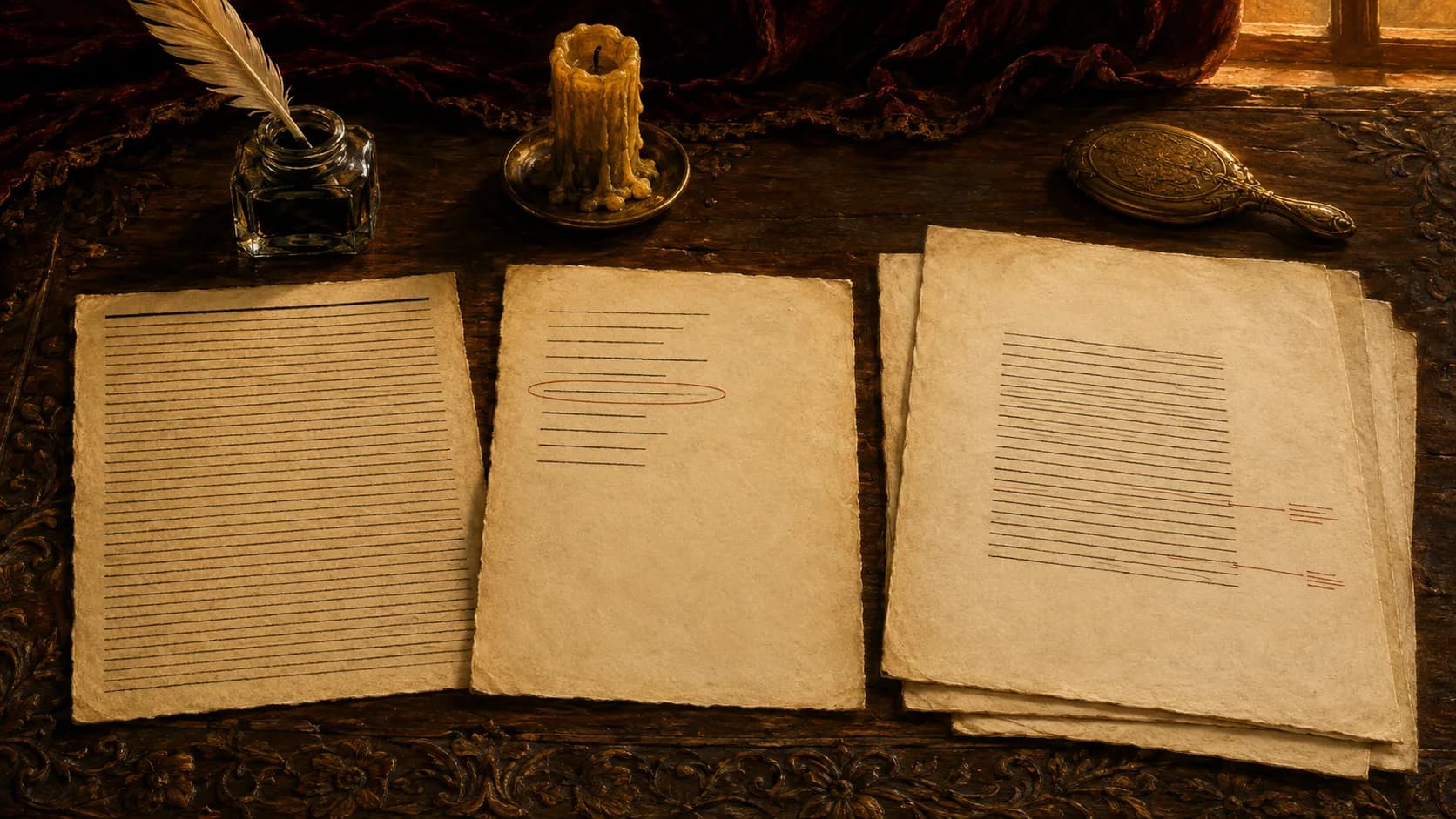
A flaw named in a synopsis, and the same flaw given a scene
A paragraph where the flaw is stated four times and dramatised none. The note is from Callum Rhys Mahoney, a developmental editor inside Draftly.
Drag to compare original and revised text


Questions & Answers
- What are examples of character flaws?
- Pride, cowardice, jealousy, self-deception and impatience turn up most in fiction, and the list above pairs sixty with the situation that exposes each. Pick the one you can see costing your character something in the next three chapters.
- How many flaws should a character have?
- One that the plot runs on, and two or three small ones that make her a person. Give her two load-bearing flaws and the book has to choose between them.
- What is the difference between a tragic flaw and a character flaw?
- A tragic flaw is the one the character cannot survive. The term is a later shorthand for Aristotle's hamartia, a word meaning missing the mark that reaches well past temperament to cover the honest mistake made in ignorance which undoes Oedipus. Most flaws you write are not tragic.
- What are some flaws to give a character?
- Work backwards from the scene. Decide what she has to lose in the middle of the book, then ask what somebody would have to believe to walk into that loss with her eyes open.
- How do you write a flaw without making a character unlikeable?
- Arrange what surrounds her. Sympathy gets built, and good behaviour is not what builds it. Bruno Bettelheim argued that a child taking a fairy-tale hero to heart is asking who he wants to be like, and goodness barely enters it. Nabokov keeps Humbert readable for four hundred pages by telling us on the first page that he is already caught and already dead, then handing him wit and a rival more repellent than he is.
- What are 50 negative personality traits?
- Those lists are written for describing real people, and they stop at the adjective. A trait becomes a story flaw once it starts issuing instructions and the instructions are wrong. Selfish describes her. Believing that asking for help ended her mother's marriage tells her what to do on Tuesday.
Name the belief, then find the scene
Flaw is a field on the character profile template, and the lie she believes about herself is another. Filling both is where a word from this list turns into somebody.
Open the character profile templateUn seul endroit pour tout le livre.
Ouvrez un chapitre et tout ce qu'il lui faut est déjà à côté : les personnages, les lieux, les règles que vous avez inventées, la note que vous vous êtes laissée en novembre. Rien à chercher, rien à synchroniser à la main — et sans ces frottements, les jours où vous écrivez commencent à s'accumuler.