A world building template for fiction writers
The longest worldbuilding questionnaire online runs to a hundred and seventy-five questions and gives you nowhere to write the answers. This one has thirty-four and a line under each.
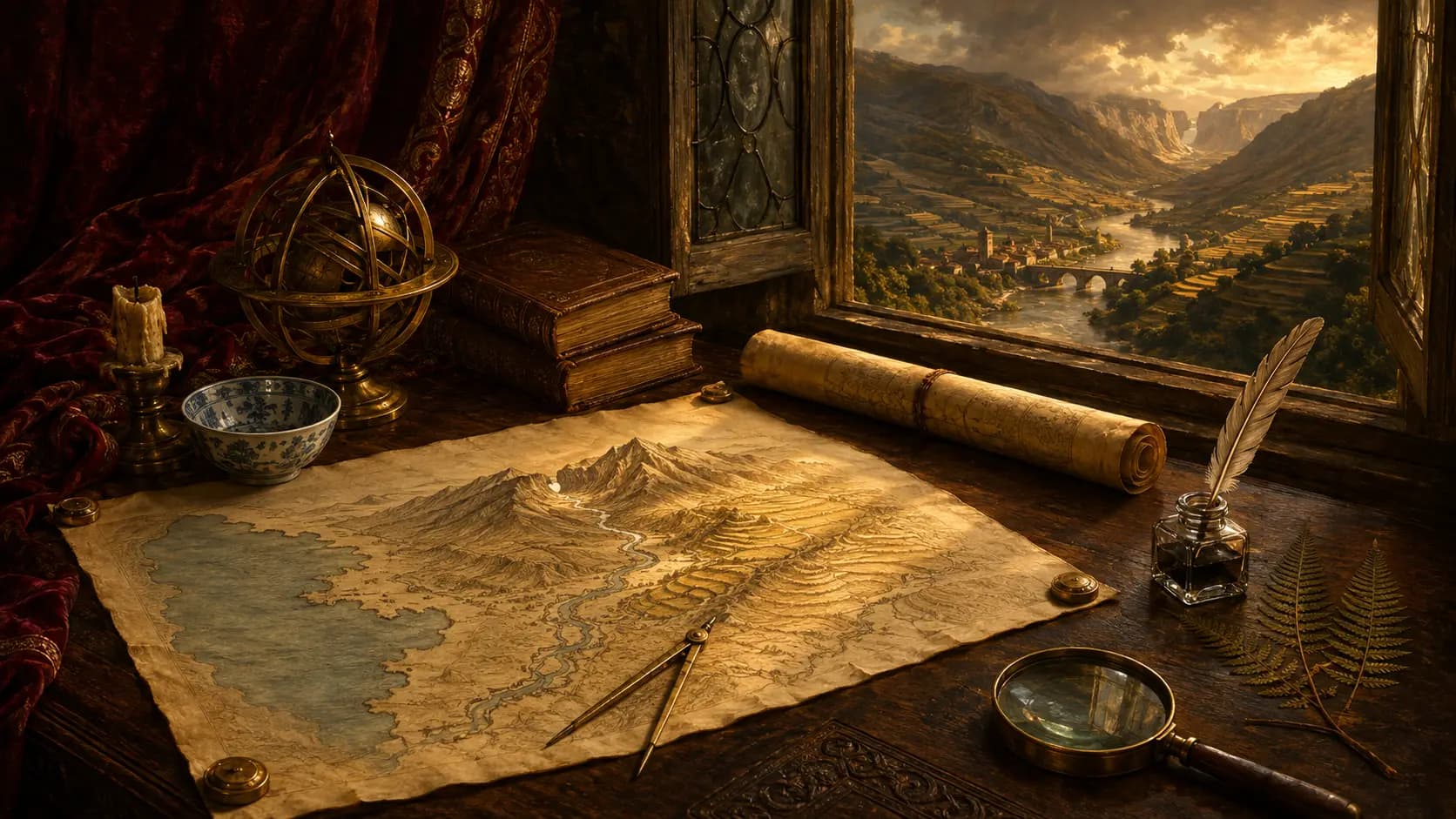
The world building questions your first scene needs
Each of these names its own scale: the whole world, one place, or the people in it. Two answers written a month apart still agree.
Every field is filled in for Middle-earth — The Lord of the Rings, J. R. R. Tolkien, 1954. Every field has an answer from Middle-earth under it, in our own words. It is familiar enough to judge an answer against rather than take ours on trust.
Middle-earth, which is one continent of a much larger world. Deciding which of the two you mean saves an argument later.
Map
Stays in your browser. It prints with the sheet.
Before the first scene
8 fieldsA continent late in its own history. The powers that shaped it have gone, and the people left live among ruins they cannot repair.
The Shire: a farming county with no army, no king, and a postal service.
Unsettled, where we begin. Elsewhere two old powers, one hiding and one rebuilding openly, and kingdoms that forgot they were once one.
Loyalty and old debts rather than money. Armies come from summons and inheritance, and the side with better roads arrives first.
Nothing is written down. The strongest prohibition is not a law: you do not pick up the enemy's instrument, whatever your reason.
That the danger ended when the enemy lost the first time. Almost every character starts the book holding some version of this.
Something small and portable surfaced in the hands of the least important person alive, and the people hunting it found out where.
Little, in the Shire, which is the point of it. Six meals, no tax worth the name, news that arrives late.
Geography and nature
4 fieldsThe land decides how long a journey takes.
Geography and nature
4 fieldsTemperate, colder eastward. The book runs autumn to spring, and the weather is an antagonist for most of it.
Two passes through the mountains, both watched. A marsh that cannot be crossed quickly. Distance is the obstacle for a third of the book.
Barley, orchards and pipe-weed in the west. Almost nothing east, where industry poisoned it.
Spiders big enough to hunt a person, in a forest that used to be safe and was renamed after.
The place your scenes happen
5 fieldsOne location, in detail. Copy this group for each place that gets a scene of its own.
The place your scenes happen
5 fieldsMoria: vast, cold and quiet, and the quiet is the problem. A hall built for thousands with four people crossing it.
Dust nothing has disturbed in years. Water running somewhere below. Your own footsteps coming back to you a second late.
The short way through, the place the group loses its leader, and proof that something worse than orcs is still down there.
Empty of the living, and only recently. The party works out when by reading a journal somebody left behind.
A city and a mine, rich enough to trade with elves, emptied by digging deeper than was sensible.
People and power
5 fieldsOne faction, and what it wants. Copy this group for each one that matters.
People and power
5 fieldsThe council at Rivendell exists to make one decision and then dissolve. Nine people, one errand, no chain of command.
Rangers are treated as vagrants by the villages they have quietly protected for generations, and none of the villagers know.
One of them is the rightful king of a country that has managed without one for a thousand years.
The Shire, entirely. The war is settled by people who have not heard of it, until it is not.
By inheritance, badly. A steward holds the throne for an heir who did not come, and has begun to enjoy it.
Magic and technology
5 fieldsFantasy or science fiction: fill in what it cannot do before what it can.
Magic and technology
5 fieldsUnexplained, deliberately. It behaves like craft rather than a system: a made thing carries the intent of whoever made it.
Left blank in the original, and the book is better for it. Leave yours blank on purpose, and write down that you decided to.
It cannot win a battle by itself. The most powerful figures spend theirs on light, doors, persuasion, and one bridge.
Whoever carries the instrument is worn down by it. The price is paid slowly and in character, not in spell slots.
Few can use it, and the consequences reach people who cannot: the weather, the roads, whether a river can be crossed.
Culture and daily life
4 fieldsSmall ordinary facts. They place a scene faster than a battle does.
Culture and daily life
4 fieldsSix meals a day in the west, discussed constantly. Waybread in the field, which becomes a plot point when it runs low.
Wool and leather, no uniforms outside the cities. A grey cloak given as a gift counts as equipment.
Almost no organised religion appears. One culture stands silent for a moment before eating, and that is close to all of it.
Kings under stone, and a long memory. A burial done wrong is a scandal that outlives the people in it.
History
3 fieldsOnly the parts still causing trouble.
History
3 fieldsA war that left the enemy beaten but not finished, because the man who could have ended it kept the thing instead.
Kingdoms split, a line of kings went into hiding, and the survivors agreed among themselves that the matter was closed.
Most people. Scholars keep it in books that go unread, and the ones in danger have it as a rhyme for children.
Blank, ready to print or type into. No email, no account.
What to build, and when to stop
Build outward from the first scene, not down from a map. The thing you need on day one is what the place your characters are standing in makes possible and impossible, and that takes eight lines. A map drawn before that is a drawing.
Say what each answer is about. A question that does not name its scale gets answered at whatever size you happen to be thinking in, and two answers written a month apart will quietly disagree. Every field above says which one it means.
Write what the magic cannot do before what it can. A power with no stated limit carries no tension, because the reader cannot tell when anyone is in trouble. Middle-earth withholds its rules and works anyway, because the limits show in what the powerful decline to do.
An empty field is allowed, as long as you know you left it. The Rules line is the clearest case: plenty of good fantasy withholds its rules, and the difference between mystery and vagueness is whether the author picked one.
World building ideas worth stealing
A checklist of prompts, for when a world will not come into focus. Take what is obviously true of yours, write it in above, and stop.
Climate
- two seasons only
- a monsoon that sets the calendar
- permanent overcast
- a summer too hot to work
- snow at sea level
- dry riverbeds
- fog most mornings
- a wind with a name
Government
- elected for life
- inherited badly
- a council that cannot agree
- rule by the oldest family
- a regent who will not step down
- occupation with local collaborators
- no government at all
- whoever owns the water
Money
- coins traders refuse
- barter and favours
- one bank
- debt inherited by children
- a currency pegged to grain
- letters of credit
- tax collected in labour
Faith
- one god, badly served
- many gods, casually
- ancestors instead of gods
- a state religion kept for show
- an outlawed faith that is growing
- prophecy taken literally
- no religion at all
- holy days that stop trade
Travel
- rivers instead of roads
- one pass, watched
- boats only in summer
- a road built by an empire that is gone
- an animal found only here
- a bridge that is also a border
- news travels faster than people
- a valley people are born and buried in
Language
- one trade language
- a script with no spoken form
- an accent that marks your class
- names that change with rank
- a script only clerks read
- a dead language kept for law
- swearing borrowed from the enemy
- two words for one thing, depending who you ask
Food
- the same grain three ways
- meat only at festivals
- preserved fish everywhere
- a fruit from one valley
- bread as a unit of pay
- a drink that stands in for water
- famine within living memory
Death
- buried under the house
- burned at sea
- left for birds
- a year in mourning clothes
- graves all facing one way
- debts die with you
- debts do not die with you
- a name struck from the record
Questions & Answers
- What is the golden rule of worldbuilding?
- Build what a scene needs and stop. Every version of the rule reduces to that: a detail earns its place when it changes what somebody does, and costs you an afternoon when it does not.
- What are the four C's of world building?
- There is no settled list. The versions in circulation usually include culture, climate and conflict, then differ on the fourth: commerce, cosmology or communication, depending who is writing. It is a memory aid rather than a method, and the sections above cover all of them without it.
- How do you start world building?
- With the scene you are about to write rather than with a map. Answer the eight questions at the top of this page for the place your first chapter happens in, then stop until a later chapter asks you something you cannot answer.
- How much worldbuilding is too much?
- When you are still building instead of drafting, and when the answers stop changing what anyone does. A tax system matters if somebody is taxed in chapter four. If not, it is a hobby.
- Do I need to build the world before I write?
- No, and a great deal of published fantasy was not written that way. Enough to place the first three chapters is enough to begin. The rest is easier to invent once the story has told you what it wants.
- Is this world building template free?
- Yes, and there is no account. Type into it here, print it with your answers in place, or take the PDF or the Word version. What you write stays in your own browser.
Un seul endroit pour tout le livre.
Ouvrez un chapitre et tout ce qu'il lui faut est déjà à côté : les personnages, les lieux, les règles que vous avez inventées, la note que vous vous êtes laissée en novembre. Rien à chercher, rien à synchroniser à la main — et sans ces frottements, les jours où vous écrivez commencent à s'accumuler.