Forty-four character archetypes
Forty-four types in one table: what each one wants, where it usually stands in a plot, a novel you can find it in, and which of the well-known lists it comes from.
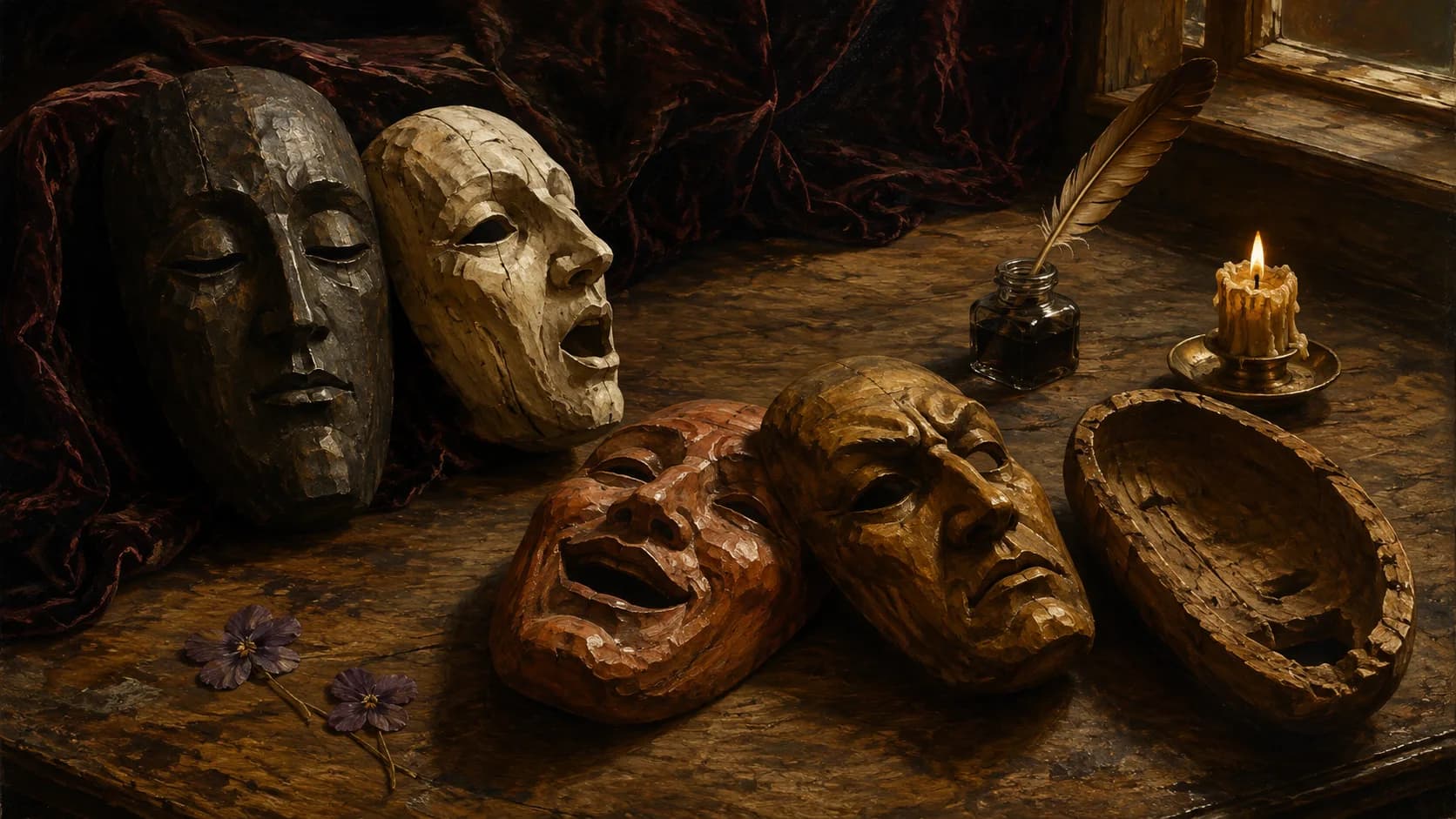
Start with what the character is for
A character who will not come into focus is usually a character with no job. Give her one and the scene has something to do with her: the person who brings the news, the person who will not let the hero pass, the person the hero cannot lie to.
That job is what a character archetype is. It is a recurring role, a pattern of want and function that a reader recognises before being told anything about the person filling it, and it is the fastest thing to change when a cast has gone flat.
Three well-known sets name these roles, each built by somebody for a different job, and working novelists keep longer lists of their own. What follows is a list of forty-four character archetypes with an example for each, drawn from all of them.
Read the third column first. An archetype is a job the plot needs doing, so where a type usually stands tells you more than its name does.
Forty-four archetypes, and what each one wants
| Archetype | What they want | Where they stand in the plot | Example | Whose list |
|---|---|---|---|---|
| Hero | To be equal to what is asked | Carries the main line of action | Odysseus, The Odyssey | All the sets |
| Anti-hero | The same end by means we would refuse | Where a hero would be, doing it wrong | Heathcliff, Wuthering Heights | No named set |
| Mentor | To hand something on before the end | Arrives early, gone before the climax | Athena as Mentor, The Odyssey | Vogler's 8 |
| Sage | Say it once and be right | Consulted at the turn, then set aside | Prospero, The Tempest | Pearson's 12 |
| Shadow | What the hero wants, for himself | Opposite the hero, mirroring him | Hyde, Dr Jekyll and Mr Hyde | Vogler's 8 |
| Nemesis | To take the same prize first | Blocks the hero at each stage | Javert, Les Miserables | Hauge's 4 |
| Trickster | To see what happens | Anywhere the plot has settled | Puck, A Midsummer Night's Dream | Vogler's 8 |
| Jester | To say the unsayable and keep the job | Beside power, licensed to insult it | The Fool, King Lear | Pearson's 12 |
| Herald | To deliver the news and go | One scene, where the trouble starts | The messenger, Oedipus the King | Vogler's 8 |
| Threshold Guardian | To keep the door shut | At the edge of the new world | Charon, Inferno | Vogler's 8 |
| Shapeshifter | To keep both options open | Beside the hero, loyalty unclear | Long John Silver, Treasure Island | Vogler's 8 |
| Ally | To carry what the hero drops | Alongside the hero from early on | Sancho Panza, Don Quixote | Vogler's 8 |
| Sidekick | To stay in the room | Half a step behind the lead | Watson, A Study in Scarlet | No named set |
| Confidant | To hear it first | Wherever the hero thinks aloud | Horatio, Hamlet | No named set |
| Reflection | To hold the hero to the plan | Close enough to argue | Banquo, Macbeth | Hauge's 4 |
| Romance | To matter more than the mission | The other half of the want | Rosalind, As You Like It | Hauge's 4 |
| Lover | To be undivided | Where duty pulls the other way | Anna, Anna Karenina | Pearson's 12 |
| Femme fatale | To use what she was handed | Near the money or the secret | Milady, The Three Musketeers | Reedsy's 12 |
| Innocent | To go on believing it | Early, and again after the fall | Candide, Candide | Pearson's 12 |
| Orphan | To belong somewhere | Outside the family, looking in | Oliver, Oliver Twist | Reedsy's 12 |
| Child | To be carried a while longer | Where the adults are failing | Tiny Tim, A Christmas Carol | Reedsy's 12 |
| Everyman | To be left alone | The reader's seat in the story | Leopold Bloom, Ulysses | Pearson's 12 |
| Caregiver | Someone who still needs her | Holding a household together | Marmee, Little Women | Pearson's 12 |
| Explorer | To see past the edge of the map | Leaving, at each act break | Fogg, Around the World in Eighty Days | Pearson's 12 |
| Rebel | To break the rule with witnesses | Against the order the plot assumes | Bazarov, Fathers and Sons | Pearson's 12 |
| Creator | To finish the thing | Apart from the others, working | Victor, Frankenstein | Pearson's 12 |
| Magician | To know how it is done | Where the rules of the world are set | Faust, Faust | Pearson's 12 |
| Ruler | To keep what he holds | At the top, with the most to lose | Macbeth, Macbeth | Pearson's 12 |
| Warrior | To go first, where it is seen | First into the fight | Achilles, The Iliad | Reedsy's 12 |
| Guardian | To keep one person safe | Between the threat and the innocent | Magwitch, Great Expectations | No named set |
| Martyr | To pay for it himself | At the cost, near the end | Carton, A Tale of Two Cities | No named set |
| Investigator | To know | Arriving after the event | Holmes, A Study in Scarlet | No named set |
| Manipulator | To ask once and have it done | At the elbow of whoever decides | Iago, Othello | No named set |
| Monster | To come back for what it is owed | Off the page until it is late | The creature, Frankenstein | No named set |
| Recluse | To stop the clock | Indoors, while the plot comes to her | Miss Havisham, Great Expectations | No named set |
| Coward | To get out of the room | Where courage is being counted | Falstaff, Henry IV | No named set |
| Curmudgeon | To watch it go wrong, as predicted | Blocking the warm scene | Scrooge, A Christmas Carol | No named set |
| Dreamer | To be someone else | Where the ordinary is on show | Emma, Madame Bovary | No named set |
| Foil | Little, and that is the point | Next to the lead, showing the gap | Laertes, Hamlet | No named set |
| Rival | The same thing, sooner | At the point the prize is decided | Uriah Heep, David Copperfield | No named set |
| Outcast | To be let back in | At the margin of every gathering | Quasimodo, The Hunchback of Notre-Dame | No named set |
| Scapegoat | To survive being blamed | Where the group needs someone | Hester, The Scarlet Letter | No named set |
| Underdog | To finish above where he started | Bottom of the order, climbing | David, David Copperfield | No named set |
| Zealot | To be right at any cost | Driving the plot past reason | Ahab, Moby-Dick | No named set |
The sets rename the same types, which is half of why they look further apart than they are: the Seductress and the femme fatale are one row, and so are the Joker and the Jester. Once a type is chosen, the character profile template is where it stops being a type.
Three sets, and who made them
Three of the tags in that last column are named frameworks, built by three people for three different jobs. Reedsy's 12 marks the four types that sit in one publisher's twelve and nowhere else. No named set marks the eighteen that belong to none of them.
Pearson's 12
Margaret Mark and Carol Pearson published this set in The Hero and the Outlaw in 2001, and it sorts characters by what they are like. This is the twelve that gets filed under Jung. Pearson's own site gives her twelve under a different set of names -- the Innocent is now the Idealist -- and records the book as the marketing application, so the version in circulation is the branding one.
Vogler's 8
Christopher Vogler wrote his eight for screenwriters in 1992. They sort characters by function. The Herald delivers the news and the Threshold Guardian exists to be got past, so each name is a job the plot needs doing. Of the three sets this is the one that answers a question you actually have while drafting.
Hauge's 4
Michael Hauge's four are the smallest set and the most relational: Hero, Nemesis, Reflection, Romance. Hauge is a screenwriting consultant, which is why the set counts relationships rather than qualities. Each of the four is defined by how it stands to a single protagonist. It earns its keep when a cast has grown past the point where half of it can be accounted for.
Why the well-known lists disagree
The two twelves, side by side. One guide lists the Ruler, the Creator, the Sage, the Innocent, the Explorer, the Rebel, the Hero, the Magician, the Jester, the Everyman, the Lover and the Caregiver. Another lists the Warrior, the Child, the Orphan, the Creator, the Caregiver, the Mentor, the Joker, the Magician, the Ruler, the Rebel, the Lover and the Seductress. Seven names appear in both, or eight if the Jester and the Joker are the same character wearing two hats, which is a judgement both pages leave to the reader without mentioning that there is one to make.
The first of those twelves is usually filed under Jung. It is not his. Jung wrote about the shadow, the persona, the anima and animus, the trickster and the wise old man, and he never published a numbered cast list. Jung died in 1961. The twelve in wide circulation are Margaret Mark and Carol Pearson's, from The Hero and the Outlaw in 2001, and they were built to give brands a personality. That is worth knowing before planning a novel around them, because a framework designed to make a soft drink feel like an outlaw is answering a different question from the one a drafting writer has.
Which set to reach for follows from that. When the question is what a character is like, Pearson's twelve helps. When the question is why this scene has this person in it rather than somebody else, Vogler's eight helps, and it helps faster. Most problems in a draft are the second kind, which is the argument for reading the third column of the table before the first.
Eighteen of the forty-four types above sit outside every named set, and four more sit in one publisher's twelve alone. The Curmudgeon has no place in Pearson and no function in Vogler, and he has a place in a plot, which is why he keeps turning up on the lists novelists write for their own use rather than for publication.
Three of them, read in the books
Every guide to this names example characters. Naming is cheap. Here are three archetypes with the sentences that make them, what the prose is doing in each, and one change you could make to your own draft tonight on the strength of it. All three books are old enough to check.
1The Mentor
Hands the hero what he needs to start, then gets out of the way.
The word mentor is this character's name. Homer gives the man himself a handful of lines, and in most of them he is somebody else: Athena wears his face when she wants Telemachus to sail, and again when she wants Odysseus to hold the hall. The third line is the one worth taking. Odysseus accepts the help and knows the whole time that a god is wearing his old friend, which turns a piece of stage machinery into an arrangement between two parties who both understand it and neither names. A mentor who fools the hero is a device. A mentor the hero sees through, and lets stand, is a relationship.
Try this. Take your mentor's best scene and let the hero see through it. Change nothing else.
Then Jove's daughter Minerva came up to them, having assumed the voice and form of Mentor.Ulysses was glad when he saw her and said, "Mentor, lend me your help, and forget not your old comrade, nor the many good turns he has done you. Besides, you are my age-mate."But all the time he felt sure it was Minerva, and the suitors from the other side raised an uproar when they saw her.
2The Shapeshifter
Runs two selves at once and lets the reader pick which to believe.
Stevenson does not have Jekyll say he became a monster. He has him say respectability is clothing. Lendings is Lear's word for it, thrown off on the heath when the king strips down to unaccommodated man, and Stevenson hands it to a gentleman stripping the other way, into appetite. The archetype turns on the pleasure of having somewhere to put the second self, which is why the confession reads as boasting for three sentences before it hears itself.
Try this. Give your shapeshifter one scene where the second self is the likeable one.
Men have before hired bravos to transact their crimes, while their own person and reputation sat under shelter.I was the first that ever did so for his pleasures.I was the first that could plod in the public eye with a load of genial respectability, and in a moment, like a schoolboy, strip off these lendings and spring headlong into the sea of liberty.
3The Recluse
Stops her own clock and makes the plot come indoors to her.
Miss Havisham is three of the rows in the table at once. The clocks say twenty minutes to nine. She is the Recluse who stopped them, the Shadow who wants Pip's expectations to come to nothing, and the Mentor who trains Estella to do the damage. Dickens holds the three together with one image and gives it twice in four lines: a body shrinking inside clothes that stayed the size they were. That is also the answer to whether a character can hold more than one archetype. She has to, or the book has no engine.
Try this. Name the second archetype your antagonist is running, then find the single image that shows both.
I saw that the bride within the bridal dress had withered like the dress, and like the flowers, and had no brightness left but the brightness of her sunken eyes.I saw that the dress had been put upon the rounded figure of a young woman, and that the figure upon which it now hung loose had shrunk to skin and bone.
Archetype, stereotype, stock character, trope
Four words get used for one thing and mean four. An archetype is a position in a story. A stereotype is an assumption about a group of people. A stock character is a shortcut the reader agreed to in advance, the butler or the drill sergeant, and a trope is a recurring pattern of events rather than of people.
The distinction that matters while drafting is smaller than any of that. An archetype tells you what a character is for. Archetypal characters are not thin characters. The label describes the job, not the depth of the person doing it. A stereotype tells you what they are like before you have written a line of them, which is an answer arriving in place of a question.
So the test on any row above. Does it tell you what this person wants and where they stand when the plot moves, or does it tell you how they talk and what they wear? Want and position are the archetype. Manner is where the stereotype gets in. One more field is worth writing down and no framework has a slot for it, which is the refusal: the thing this character will not do, written down before the scene that would ask her to do it. A limit tells a reader more than a skill does. The Investigator who will not question a child is specific in a way no archetype can be. Write it on the same line as the archetype so the two get read together.
Three ways to complicate one
Each of these is one revision pass rather than a rewrite.
Let the want fail
An archetype is a starting position and a reader treats it as a promise. Break the promise once, on the page. The type turns into a person. The Caregiver who declines to care for somebody is still the Caregiver. She now costs something, which is where [[page:guides/character-arc|the arc]] starts.
Run two at once
Give one character two types that pull against each other. Mentor and Nemesis. Guardian and Manipulator. Miss Havisham runs three, and a reader feels the friction without being able to name which two are pulling.
Move them to the wrong slot
Put a type where the plot does not expect it. The Herald who arrives at the climax instead of the first act. The Threshold Guardian at the last door rather than the first one. Vogler puts him at the first. Same character, different pressure.
The same character with an editor on it
A paragraph where the type is doing the work the person should be doing, and the same paragraph after one pass. The note beside it is from Danae, one of the developmental editors inside Draftly, who reads a chapter the way this reads a paragraph.
Drag to compare original and revised text


Questions & Answers
- What are the 12 character archetypes?
- The twelve usually meant are the Ruler, the Creator, the Sage, the Innocent, the Explorer, the Rebel, the Hero, the Magician, the Jester, the Everyman, the Lover and the Caregiver. They are Margaret Mark and Carol Pearson's from The Hero and the Outlaw, not a list Jung published, and other pages give a different twelve, so check which set you are reading before planning a cast around it.
- How many character archetypes are there?
- There is no fixed number. The sets in wide use run to eight, twelve or twenty-four, and the table on this page holds forty-four because it merges the named frameworks with the longer lists working writers keep for themselves. Any count you are given is a choice somebody made about where to stop.
- What is the difference between an archetype and a stereotype?
- An archetype describes what a character is for in the story. A stereotype describes what a character is like on the basis of a group they belong to. The first is a structural decision. The second is an assumption the writer has not examined yet.
- Are archetypes the same as tropes?
- No. An archetype is a kind of character and a trope is a recurring pattern of events or situations, such as the locked room or the false confession. A character can occupy an archetype while the scene around them runs a trope.
- What are archetypes in literature?
- In literature the term covers recurring characters, images and situations that readers recognise across centuries, such as the wise old teacher, the flood, or the journey into the underworld. Character archetypes are the part of that which describes people, and they are what this page lists.
- Can one character be more than one archetype?
- Yes, and the memorable ones usually are. Miss Havisham holds Recluse, Shadow and Mentor at the same time in Great Expectations. Working out which two types a character is running, and finding the place in the book where those two pull in opposite directions, is most of what filling in a character profile is for.
Turn the type into a person
The character profile template has the fields that make an archetype specific: what she wants, what she fears, and the flaw that decides how the plot goes.
Open the character profile templateUm só lugar para o livro todo.
Abre um capítulo e tudo o que ele precisa já está ao lado: o elenco, os lugares, as regras que inventaste, a nota que deixaste a ti mesmo em novembro. Nada para procurar, nada para sincronizar à mão — e sem essa fricção, os dias em que escreves começam a somar.